

How we see things
All the parts of the eye form your baby's eyesight (vision).
Light enters the eye through the cornea, the clear outer skin or window at the front of the eye.
Light passes through the pupil, the hole in the iris or coloured part of the eye.
Light rays are then focused on the retina at the back of the eye.
That then sends information via the optic nerve to the brain. There, the pictures are recognised and interpreted.
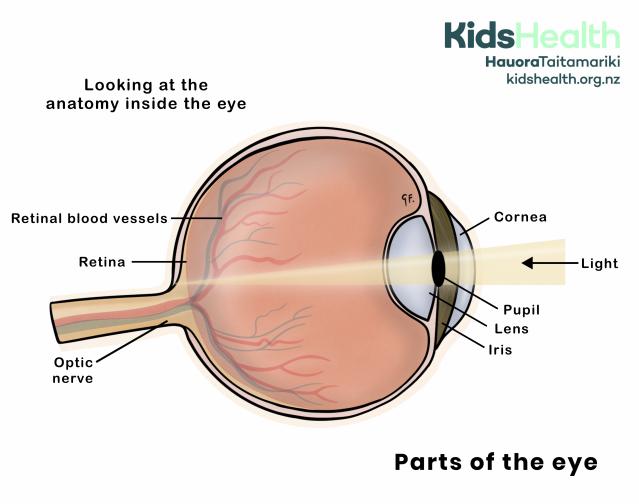
An illustration showing the inside of the eye with its main parts and how light enters the eye.
Source: KidsHealth
transcribeTranscript
The illustration shows a cross-section of the eye with the main parts labelled.
An arrow shows light entering the eye through the cornea and pupil before passing through the lens to the retina.
The following anatomy labels appear on the illustration and are connected to the relevant part with a line:
- Cornea
- Light
- Pupil
- Lens
- Iris
- Retina
- Retinal blood vessels
- Optic nerve
The words 'Looking at the anatomy inside the eye' appear at the top left of the illustration.
The title 'Parts of the eye' appears at the bottom right of the illustration.
At the top right is the KidsHealth logo with the website: kidshealth.org.nz.
Baby's first year - checklist
If you have any concerns about your baby's vision, see a health professional.
At birth
- pēpi (babies) are attracted to faces
- they may avoid bright lights by closing eyes
- their eyes may sometimes appear to wander or be turned
At 1 month
- pēpi start to fix on their parent's face while feeding
- their eyes may sometimes appear to wander or be turned
- they follow large moving objects for a few seconds and begin to show interest in toys
At 2 months
- pēpi are becoming more interested in toys and objects
- they recognise a parent's face and can tell it from other faces
- they're starting to make eye contact
- they begin to smile to a smile
At 4 months
- pēpi can focus on toys held close to them
- their eyes should be straight and move together in all directions
- pēpi are interested in smaller more detailed toys
- they reach for toys, grasp firmly and regard closely
- they make good eye contact and are interested in facial expressions
At 6 months
- pēpi become more skilled in using their eyes to locate and reach for objects of interest
- they follow objects with their head and eyes in all directions
- they are visually alert and curious about their surroundings
- they follow an adult's movement across the room
At 12 months
- pēpi recognise familiar people from at least 6 metres away
- they will have binocular vision (the ability to use the eyes together) from 9 months
Acknowledgements
Starship Foundation and the Paediatric Society of New Zealand acknowledge the cooperation of The Children's Hospital at Westmead, Sydney Children's Hospital at Randwick, and Kaleidoscope - Hunter Children's Health Network in making this content available to patients and families. The content has been slightly adapted for New Zealand families.