

Key points about rheumatic fever
- rheumatic fever is a serious illness
- it often starts with a sore throat caused by strep bacteria
- without treatment, strep throat can cause rheumatic fever
- rheumatic fever can damage the heart leading to rheumatic heart disease
- regular penicillin injections help protect your child from another episode of rheumatic fever
- Māori and Pasifika children are at greatest risk of developing rheumatic fever
What is rheumatic fever?
Rheumatic fever is an illness that can develop after a strep throat infection that isn't treated with antibiotics. When the strep infection is not treated, the body can react by causing inflammation. This inflammation can affect the heart, joints, skin and brain. Heart inflammation can cause permanent damage to the heart valves. Health professionals call this damage rheumatic heart disease.
Rheumatic Heart Disease in Children & Young People
Causes of rheumatic fever
Rheumatic fever can happen after a strep throat infection. If the infection isn't treated with antibiotics, it can cause inflammation in the body.
Strep Throat In Children & Young People
Symptoms of rheumatic fever
Tamariki (children) and rangatahi (young people) with rheumatic fever may have:
- pain or swelling in the knees, ankles, elbows or wrists
- discomfort when walking
- fever
- tiredness
- a skin rash
- chest discomfort
- shortness of breath
- jerky or unusual movements
Symptoms often start 1 to 5 weeks after a strep throat infection.
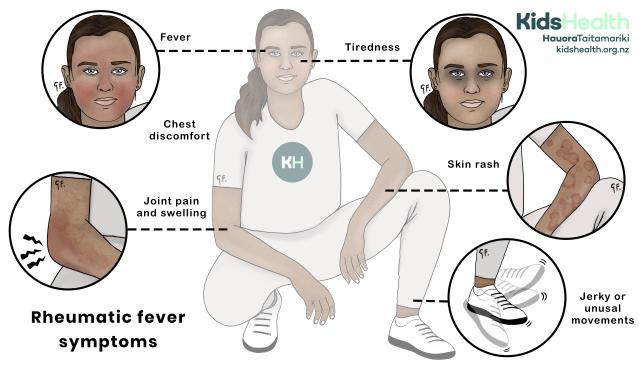
An illustration showing some of the symptoms of rheumatic fever.
Source: KidsHealth
transcribeTranscript
The illustration shows a young person with symptoms of rheumatic fever highlighted by magnified circles.
The following symptom labels appear on the illustration and are connected to the relevant body part with a dotted line:
- Fever – showing a flushed face
- Tiredness – showing dark circles under the eyes
- Joint pain and swelling – showing a swollen, painful elbow
- Skin rash – showing a pink ring-shaped rash on the arm
- Jerky or unusual movements – showing a foot shown moving involuntarily
- Chest discomfort
At the bottom left is the title 'Rheumatic fever symptoms'.
At the top right is the KidsHealth logo with the website: kidshealth.org.nz.
Diagnosing rheumatic fever
If you think your child could have rheumatic fever, take them to a health professional. They will examine your child and talk to you about their symptoms.
They may arrange tests to look for inflammation and to check your child’s heart. These might include:
- a throat swab
- blood tests
- an ECG - a tracing of heart activity
- a chest x-ray
- an echocardiogram - an ultrasound scan that shows how the heart and valves work
Complications of rheumatic fever
Inflammation from rheumatic fever can damage the heart valves. Damaged valves may not open or close properly, and this makes the heart work harder.
Some tamariki recover without heart damage. Others develop long-term valve problems that need ongoing care.
How rheumatic fever affects the heart
The heart has 4 valves that help blood flow. Rheumatic fever can inflame and scar these valves. Scarred valves can leak or become narrow, which puts extra strain on the heart.
Tamariki with valve damage may:
- feel short of breath
- have less energy
- feel breathless when lying flat
- need more pillows to sleep comfortably
See the page on rheumatic heart disease to learn more.
Rheumatic Heart Disease in Children & Young People
Managing rheumatic fever
Hospital stay
Tests
Most tamariki need a hospital stay when they are first diagnosed. They may need tests, including an echocardiogram, to check their heart.
Rest and pain relief
Your child may need rest and pain relief for swollen or painful joints. Some tamariki may stay in the hospital for several weeks. This depends on their symptoms and test results.
First penicillin injection
Before leaving hospital, your child will have their first penicillin injection. Penicillin helps protect your child from strep infections and another episode of rheumatic fever.
If your child cannot have penicillin, the health professional will discuss another antibiotic treatment.
Penicillin Injections After Rheumatic Fever
Some children may need heart surgery
A small number of tamariki with severe valve damage may need heart surgery.
At home after the hospital stay
Continue to rest
Your health professionals will let you know how long your child should continue to rest.
Gentle return to activity
Many tamariki slowly return to gentle activity as they recover. Your health professional will tell you when it’s safe for your child to start being fully active again.
Regular penicillin injections
Regular penicillin injections are the most important part of long-term care. A nurse will usually give these every 28 days. Penicillin helps protect your child from another strep infection. This is important because it can prevent rheumatic fever from coming back. Another episode of rheumatic fever can cause more damage to the heart.
Many tamariki need these injections for at least 10 years or until they turn 21, whichever is longer. Tamariki with heart valve damage may need treatment for longer.
See the page on penicillin injections to learn more.
Penicillin Injections After Rheumatic Fever
Talia'uli talks about his experience of having rheumatic fever.
Source: Ministry of Health
transcribeTranscript
[Music]
(Talia'uli Vete)
My name is Talia'uli Vete. I'm 11 years old.
I play for Mount Roskill District. When I grow up I want to be a rugby player, for the All Blacks. I'm learning how to kick like Daniel Carter.
[Music]
One day I went to school where, we were running. I was coming fourth, and suddenly my chest like just started uh feeling like slowing down and I felt so tired and weak. I dropped back and I started coming second to last.
I told my mum I was going to die. I nearly died on the race.
(Mum)
He said to me Mum, I nearly die at school. I feel like I don't have any air, any more air to breathe.
(Talia'uli Vete)
The next morning my mum took me to hospital.
When the doctor told me my heart was damaged, I was laughing for a while because I thought it was not true. I thought he was joking, and then um they told me it's true. I caught rheumatic fever.
(Mum)
I was just sitting there crying and looking at my son and I just said to myself, please don't tell me that my son is going to die, because I don't want to lose him.
(Dad, speaking in a Pacific language. English translation: What I felt was the love for my son).
(Mum)
It's quite hard to explain how we feel, when they are like telling us, knowing that there's something wrong with his heart.
(Talia'uli Vete)
I take injections every month. I have to have my injections until I'm 21. That's 10 more years. The doctor told me not to play rugby for a little while.
If I couldn't play rugby anymore I would just feel like bored.
I thought my sore throat wouldn't be that dangerous. I thought it would just go away just simply.
When you have a sore throat it's best to go to a doctor straight away.
(Voiceover)
Sore throats can lead to rheumatic fever and heart damage.
Every time your child has a sore throat, please, get them checked by a doctor or nurse as soon as possible.
If they're given antibiotics, make sure they take them for the full 10 days, even if they feel better.
If you're not sure what to do, call Healthline for advice.
[Music]
When to get medical help for your child
When to see a health professional
See a health professional if your child:
- gets a sore throat
- develops joint pain or swelling
- is limping
- becomes unusually tired
- gets breathless
- misses a penicillin injection
When to see a health professional urgently
See a health professional urgently if your child:
- has chest discomfort
- develops swelling in the legs or feet
- becomes more breathless than before
- feels faint or dizzy
When to call 111
Call 111 for urgent medical help if your child:
- has severe trouble breathing
- becomes very unwell or hard to wake
- has sudden severe chest pain
Keeping well after rheumatic fever
Avoid getting rheumatic fever again
The best way to protect your child is to make sure they get penicillin injections on time. Penicillin kills the strep bacteria that trigger rheumatic fever and helps protect the heart valves.
Your child will have penicillin injections:
- usually every 28 days
- in a muscle near their hip or bottom
- from your community nurse, district nurse or public health nurse
- at home, at a school clinic or at a community clinic
Tamariki can find penicillin injections uncomfortable. Nurses can use numbing medicine and distraction to help reduce the discomfort.
Penicillin Injections After Rheumatic Fever
Medical appointments
Have a plan to get to your child’s medical appointments. You can set reminders on your phone, mark dates on a calendar, or ask for text reminders.
Tell your child’s healthcare team if you plan to move house, travel or go on holiday so they can plan injections ahead of time.
Let health professionals know
Always tell doctors, nurses and dentists that your child has had rheumatic fever. Your child might need extra antibiotics before certain dental or medical procedures. This helps protect their heart valves.
Good dental care
Good dental care also helps protect the heart. Sometimes germs from the mouth can enter the bloodstream during dental work. This can cause endocarditis, which is an infection in the heart valves.
Good dental care helps protect your child’s heart. Support your child to:
- use their own toothbrush
- brush twice a day with fluoride toothpaste
- reduce sweet food and drinks
- have regular dental checks
Rheumatic fever and pregnancy
If you have had rheumatic fever, you will need a heart check-up before getting pregnant. Talk to your health professional to learn more about this.
More information
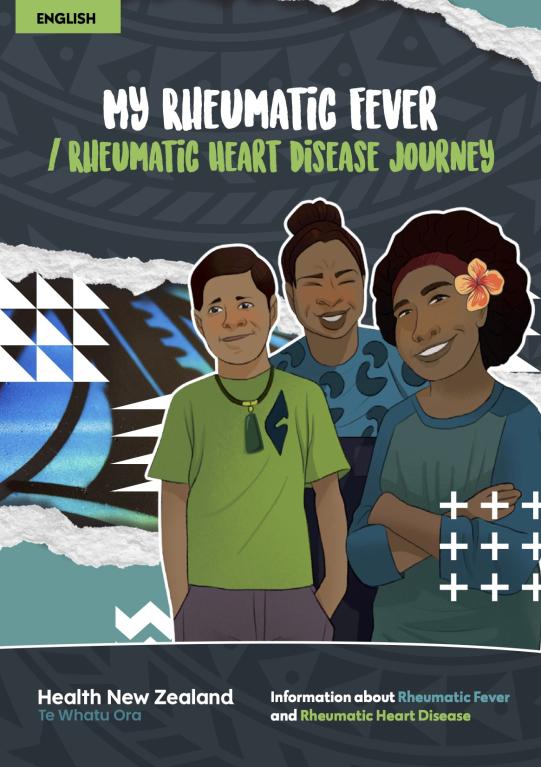
If your child has been diagnosed with rheumatic fever or rheumatic heart disease, there is some information to help you, your child and your whānau navigate the journey ahead.
Pū Manawa provides information and guidance on rheumatic fever and rheumatic heart disease from some of Aotearoa New Zealand's leading health experts. See their website for information, resources and whānau stories.

Heart Kids New Zealand supports Kiwi kids, teens and whānau impacted by congenital heart defects or acquired childhood heart conditions. Visit their website to see how they can support you and your whānau.
The Heart Foundation is a non profit, non government organisation that funds research that promotes heart health. Their website has resources as well as shared experiences from people with rheumatic fever and rheumatic heart disease.
Acknowledgements
The Paediatric Society of New Zealand is grateful to the Heart Foundation for providing the content for this page. The booklet Rheumatic fever and rheumatic heart disease (PDF, 1.7MB) was revised in November 2019.
The video is copyright Kylie Sullivan 2017. Licensed under a Creative Commons Attribution-ShareAlike 3.0 Unported License. Acknowledgements: Starship Child Health, Starship Foundation, Auckland District Health Board (Alison Leversha, Faith Mahony).
Illustrations by Dr Greta File. Property of KidsHealth.