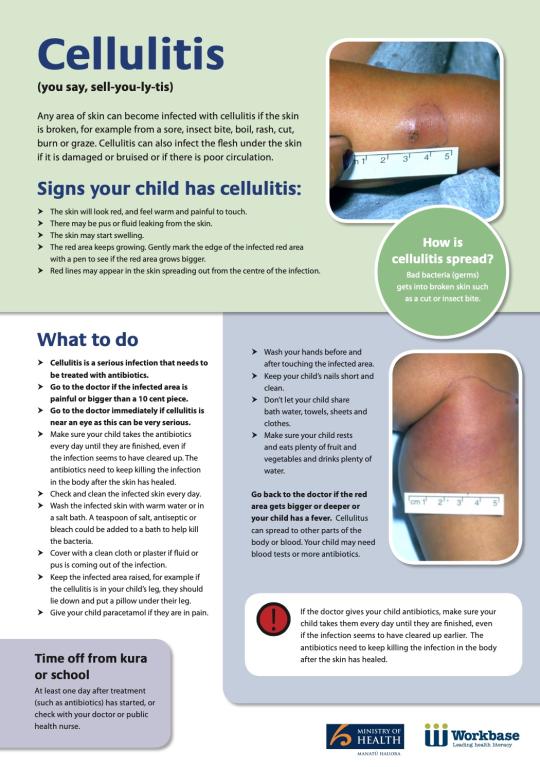

Key points about cellulitis
- any area of skin can become infected with cellulitis
- cellulitis can develop from any break in the skin - even from something small like an insect bite
- cellulitis can spread quite quickly and can be serious without treatment
- tamariki (children) with cellulitis need treatment with antibiotics
- take your child to a health professional the same day if you think they have cellulitis
- see a health professional immediately if cellulitis is near your child's eye - this can be very serious
What is cellulitis?
Cellulitis is a skin infection that affects the deeper layers of the skin. It usually affects one part of the body.
Causes of cellulitis
Bacteria are present on our skin all the time without causing infection. But, if they get through breaks in the skin, they can cause cellulitis. Cellulitis can get through breaks in the skin from:
- eczema
- sores
- insect bites
- boils
- cuts
- burns
- grazes
Sometimes the break in the skin is so small it’s hard to see.
Once the bacteria are in the skin, they cause redness and swelling that can spread rapidly.
You can't catch cellulitis from another person.
Signs and symptoms of cellulitis in children
Symptoms of cellulitis can include:
- red, warm, swollen skin – often in one area, like a leg, arm, or face
- pain or tenderness in the affected area
- skin that feels tight or looks shiny
- pus or fluid leaking from the skin
- fever
- feeling unwell
- red streaks spreading out from the infected area (a sign the infection may be spreading)
If you notice a red area on your child’s skin, take photos. This will help to show if it is spreading or getting worse.
When to get medical help for your child with cellulitis
When to see a health professional
Cellulitis can be a serious infection. Take your child to a health professional the same day if your child has symptoms of cellulitis.
Tamariki with cellulitis need treatment with antibiotics.
When to seek immediate medical help
See a health professional immediately if cellulitis is near your child's eye. This can be very serious.
Go to the hospital or call 111 (in New Zealand) immediately if your child with cellulitis has:
- a very high temperature or they feel hot and shivery
- a fast heartbeat or fast breathing
- confusion
- drowsiness
- cold, clammy, pale skin
Managing cellulitis
Antibiotics
For mild cellulitis your health professional will prescribe antibiotics (by mouth). Make sure your child takes all their antibiotics as prescribed. It is important to do this even if the infection seems to have cleared up. There may be infection under the skin that you can't see.
For more severe cellulitis, your child may need intravenous antibiotics (through a vein) in hospital.
Watch the area
Your health professional may mark the edge of the red area with a marker pen or take a photo. This is to see if your child's skin infection is improving.
The redness may continue to spread a little during the first days of taking antibiotics. Go back to a health professional if:
- the red area gets much bigger
- the red area gets more intense
- your child has a fever
- your child seems more unwell
- you’re worried for any reason
Wound care
If your child has a wound which led to the cellulitis, keep it clean and cover it with a dressing.
A health professional will tell you how to look after the wound at home.
Cellulitis does not cause pus. If your child has pus coming from their wound, tell a health professional. There may be an abscess that needs draining so the infection can get better.
Eye specialist
For cellulitis near the eye that’s not getting better, your child may need to see an eye specialist (ophthalmologist).
Caring for your child with cellulitis at home
As well as taking antibiotics, there are some simple things you can do to help your child.
Rest
Your child needs to rest. This helps their body fight the infection.
Keep the affected area raised
Raise the affected part of your child's body on a pillow or chair when they're sitting or lying down. This helps reduce swelling.
If your child’s cellulitis is on their arm or hand, you could use a sling. This helps to support the arm when they are walking around.
Eat and drink normally
Encourage your child to eat and drink normally.
Pain relief
Cellulitis can be quite painful because it puts pressure on the skin from underneath. If your child has discomfort, you can give paracetamol to make them more comfortable. You must follow the dosage instructions on the bottle or packet. It is dangerous to give more than the recommended dose.
Your health professional will talk to you about pain relief. They may also give your child a prescription for something stronger if needed.
Never give your child aspirin, this may increase the risk of Reye syndrome, a rare and serious illness.
Time off from kura or school
Your child may need some time off school while they recover. Be guided by how your child is feeling. Check with your health professional if you are unsure.
Cellulitis resource for printing