

Dehydration animation
An animation about dehydration, including symptoms and when you might need to see a health professional.
Source: KidsHealth
transcribeTranscript
Dehydration happens when the body doesn’t have enough water.
It can happen when your child loses fluid faster than they replace it.
Pēpi and tamariki can get dehydrated quickly because their bodies are smaller.
Common causes of dehydration in pēpi and tamariki include:
- loose runny poo
- vomiting
- fever
- not drinking enough
- hot weather
Early signs of dehydration in tamariki can be easy to miss.
Tamariki and pēpi with dehydration may:
- wee less than usual or
- have dark yellow wee or
- have a dry mouth or dry lips or
- be tired and less active than usual or
- have no tears when crying or
- lose weight
More serious signs of dehydration include:
- very little or no wee or
- cool hands and feet or
- fast breathing or
- sunken eyes or
- feeling very sleepy or being hard to wake
The main treatment for dehydration is giving fluids.
For mild dehydration, you can usually look after your child at home.
Give small amounts of fluid often.
You could try giving apple juice mixed with an equal amount of water.
If you breastfeed your baby, offer feeds more often.
Call Healthline on 0800 611 116 or see a health professional if your child:
- is vomiting and cannot keep fluids down or
- has runny poo lasting more than a few days or
- has an ongoing fever or
- is not improving
See a health professional urgently if your child:
- is under 6 months old and unwell or
- has very little or no wee or
- has cool hands and feet or
- has fast breathing or
- has blood in their vomit or poo or
- seems very drowsy or hard to wake
Call 111 and ask for urgent medical help if your child:
- is floppy or
- is blue around the mouth or
- is struggling to breathe or
- is unresponsive
You know your child best.
If you're worried at any stage, always get help.
An animation about dehydration including signs of dehydration and when you might need to see a health professional (in te reo Māori).
Source: KidsHealth
transcribeTranscript
Ka tūpono te tauraki i ngā wā kāore e rawaka ana te wai o te tinana.
Ka tūpono mai pea i ngā wā ka tere ake te ngaro o te wē i tāu tamaiti i tērā te whakakapi anō.
Ka tere pea te tauraki haere o te pēpi, o te tamaiti nohinohi hoki, nā te mea he iti iho ō rātou tinana.
Anei ētahi pūtake auau o te tauraki o te pēpi me te tamaiti:
- te tiko tino waiwai
- te ruaki
- te kirikā
- te iti rawa o te inu
- te wera o te huarere
He māmā pea te pahemo i ngā tohu tōmua o te tauraki o te tamaiti.
Ka pēnei pea te pēpi, tamaiti rānei e tauraki ana:
- ka iti iho pea te mimi i tērā o ia rā, tērā rānei
- ka kōwhai me te pōuriuri pea te mimi, tērā rānei
- ka maroke te waha, ngā ngutu rānei, tērā rānei
- ka ngenge pea, ka iti iho pea te ngoi i tērā o ia rā, tērā rānei
- ka kore ōna roimata i te wā ka tangi ia, tērā rānei
- ka heke haere tōna taumaha
Anei ētahi tohu taimaha ake o te tauraki:
- te tino iti o te mimi, te kore rānei, tērā rānei
- te makariri o ngā ringaringa me ngā waewae, tērā rānei
- te tere rawa o te whakahā, tērā rānei
- te pakoko o ngā kanohi, tērā rānei
- te tino ngenge, he wero rānei te whakaoho
Ko te tino rongoā ki te tauraki ko te hoatu i te wai.
Ina he tauraki māmā ka taea e koe te tiaki i tāu tamaiti ki te kāinga, i te nuinga o te wā.
Kia auau tō hoatu i te wai iti.
Ka hoatu pea te waireka āporo kua hanumitia ki tōna rahinga ōrite o te wai.
Mēnā he whāngai ū tō pēpi, kia auau ake te hoatu i te ū.
Waea atu ki a Healthline ki 0800 611 116, haere rānei ki tētahi mātanga hauora, mēnā:
- kei te ruaki tō tamaiti, tē taea rānei e ia te pupuri i ngā wē, tērā rānei
- kei te waiwai ōna tiko mō te roa ake i te ruarua ngā rā, tērā rānei
- kei te pāngia mauroatia ia ki te kirikā, tērā rānei
- kāore tōna ora i te piki
Haere nonoi atu kōrua ko tāu tamaiti ki tētahi mātanga hauora mēnā:
- kei raro tōna pakeke i te 6 marama, ā, kei te māuiui ia, tērā rānei
- kua tino iti ōna mimi, kua kore rānei, tērā rānei
- kei te makariri ōna ringaringa me ōna waewae, tērā rānei
- kei te tere rawa tōna whakahā, tērā rānei
- he toto i roto i ōna ruaki, tiko rānei, tērā rānei
- kei te tino hiamoe ia, he wero rānei te whakaoho i a ia
Waea atu ki 111, tono atu ai ki te āwhina hauora nonoi mēnā:
- kei te pītawitawi tō tamaiti, tērā rānei
- kei te kahurangi te takiwā o tōna waha, tērā rānei
- kei te hēmanawa ia, tērā rānei
- kāore ia i te urupare
Ko koe te tino pūkenga mō tō tamaiti.
Mēnā kei te paku āwangawanga koe, tonoa atu ki te āwhina i ngā wā katoa.
An animation about dehydration including signs of dehydration and when you might need to see a health professional (in Samoan).
Source: KidsHealth
transcribeTranscript
E matutu le tino pe a lē lava le vai i le tino.
O le tulaga lena e tupu i lau alo pe a tuai na toe faainu le tele o le vai ua alu.
E vave tele na matutu tino o pepe ma fanau iti ona e tino laiti.
E tele ina matutu tino o pepe ma fanau iti pe a:
- sisī le manava
- faasuati
- fiva
- lē lava le vai o inu
- vevela le tau
E faigofie na misi foliga e iloa ai le matutu o tino o fanau iti.
Atonu e iloa le matutu o tino o tamaiti ma pepe pe a:
- tau lē fai se feauvai po o le
- sasama paauli o feauvai po o le
- mago gutu po o laugutu po o le
- lelavā ma tau lē gaioi pei ona masani ai po o le
- lē loimatā pe a tagi po o le
- foliga paee
O foliga e iloa ai ua matutu leaga e aofia ai:
- tamai feauvai pe leai foi po o le
- maluluina lima ma vae po o le
- vave o le mānava po o le
- totō mata po o le
- faagalegalemoe po o le fiu e fafagu
O le togafitiga sili pe a matutu le tino le faainu.
E gafatia na vaai lelei i le fale, pe a tau feololo le matutu o le tino.
Toaga e faainu sina vai.
E mafai foi na faainu se apple juice ua sui i le vai.
Toaga e faasusu, pe afai o lena e faasusu si au tama.
Valaau le Healthline i le 0800 611 116 pe ave loa e vaai se fomai pe afai o:
- puai ma toe luai mai fafo le vai pe a faainu po o le
- faitau aso o sisī le manava po o le
- lē te‘a le fiva po o le
- leai se suiga lelei
Vaai loa se fomai pe afai:
- e le i atoa le 6 masina o pepe ma ua ma‘i tele po o le
- tamai feauvai pe leai foi po o le
- faalogoina le maluluina o lima ma vae po o le
- vave o lana mānava po o le
- filogia puaiga po o feaumamao po o le
- faagalegalemoe po o le fiu e fafagu
Valaau le 111 ma talosaga i ai le moomia vave o se fesoasoani pe afai:
- ua galemulemu po o
- ua lanu moana le gutu po o le
- tau lē mafai na mānava po o le
- fiu e gole
Na o oe e iloa lelei si au tama.
Saili se fesoasoani, mo soo se tulaga o faapopoleina ai.
An animation about dehydration including signs of dehydration and when you might need to see a health professional (in Tongan).
Source: KidsHealth
transcribeTranscript
‘Oku hoko ‘a e mahahu‘á (dehydration) ‘i he taimi ‘oku ‘ikai ke ma‘u ai ‘e he sinó ha vai fe‘unga.
‘E lava ke hoko ia ‘i he taimi ‘oku vave ange ai ‘a e maha ‘a e vaí ‘i ho‘o ki‘i leká ‘i hono fetongi atú.
‘E lava ke vave ‘a e mahahu‘a ‘a e fanga ki‘i pēpeé mo e fānau iikí koe‘uhi ko e iiki ange honau fanga ki‘i sinó.
‘Oku kau ki he ngaahi me‘a ‘oku angamaheni ‘enau fakatupunga ‘a e mahahu‘á ‘i he fanga ki‘i pēpeé mo e fānaú ‘a e:
- fakalelé
- luá
- mofí
- si‘isi‘i ‘a e inu vaí
- vai velá
‘E ala faingofua pē ke ta‘efakatokanga‘i ‘a e ngaahi faka‘ilonga tōmu‘a ‘o e mahahu‘á ‘i he fānaú.
Ko e fānau mo e fanga ki‘i pēpē ‘oku mahahu‘á ‘e ala:
- si‘isi‘i ange ‘i he angamahení ‘enau tu‘uofí pe
- lanu engeenga mālohi ‘enau tu‘uofí pe
- mōmoa honau ngutú pe loungutú pe
- hela‘ia mo si‘isi‘i ange ‘i he angamahení ‘enau longomo‘uí pe
- ‘ikai ke tō ha lo‘imata he taimi ‘e tangi aí pe
- holo honau mamafá
Ko e ngaahi faka‘ilonga lahi ange ‘o e mahahu‘á ‘oku kau ki ai ‘a e:
- si‘isi‘i ‘aupito pe ‘ikai pē ha tu‘uofi pe
- momoko ‘a e ongo nimá mo e va‘é pe
- vave ‘a e mānavá pe
- ‘ono ki loto ‘a e ongo fo‘i matá pe
- ongo‘i tulemohe pe faingata‘a ke ‘ā‘ā
Ko e faito‘o tefito ki he mahahu‘á ko hono ‘oatu ‘o ha me‘a huhu‘a.
Te ke fa‘a ala tauhi pē ‘a ho‘o ki‘i leká ‘i ‘api, ‘i he mahahu‘a ‘oku ‘ikai ke fu‘u lahí.
Toutou ‘oange ha fanga ki‘i me‘a huhu‘a.
Te ke lava ‘o ‘ahi‘ahi ‘oange ha huhu‘a‘i ‘āpele kuo fio ‘aki ha vai ‘oku na lahi tatau pē.
Kapau ‘okú ke fakahuhu ho‘o pēpeé, toe ki‘i hokohoko ange hono fafangá.
Telefoni ki he Healthline ‘i he fika 0800 611 116 pe ‘alu ki ha tokotaha ngāue palofesinale ki he mo‘ui leleí ‘i he vave tahá, kapau ‘oku hoko eni ki ho‘o ki‘i leká:
- lua mo ‘ikai fa‘a mapukepuke ‘a e ngaahi me‘a huhu‘á ‘i loto pe
- fakalele ‘i ha ngaahi ‘aho pe
- hokohoko ‘ene mofí pe
- ‘oku ‘ikai ke fakalakalaka ki mu‘a
Sio ki ha tokotaha ngāue palofesinale ki he mo‘ui leleí ‘i he vave tahá kapau ko ho‘o ki‘i leká ‘oku:
- si‘i hifo ‘i he māhina ‘e 6 hono ta‘u motu‘á mo puke pe
- si‘isi‘i ‘aupito pe ‘ikai pē ke tu‘uofi ia pe
- momoko hono ongo nimá mo e va‘é pe
- vave ‘ene mānavá pe
- ‘asi ha toto ‘i he‘ene luá pe tu‘umama‘ó pe
- tāvaivaia ‘aupito pe faingata‘a ke ‘ā‘ā
Telefoni ki he 111 ‘o kole ha tokoni fakafaito‘o fakavavevave kapau ‘oku hoko eni ki ho‘o ki‘i leká:
- ngāvaivai hono sinó pe
- takataka‘uli takatakai ‘a e ngutú pe
- faingata‘a ke fakatau ‘ene mānavá pe
- ‘ikai ke toe ngaue hake
‘Okú ke ‘ilo‘i lelei ange pē ‘e koe ‘a ho‘o ki‘i leká.
Kapau ‘okú ke hoha‘a ‘i ha fa‘ahinga taimi pē, kumi ma‘u pē ki ha tokoni.
Watch an animation on dehydration in your preferred language.
Key points about dehydration in babies and children
- dehydration happens when tamariki (children) lose more fluid than they take in
- vomiting and loose, runny poo (diarrhoea) are the most common causes
- pēpi (babies) and young tamariki can become dehydrated quickly
- early signs include weeing less, dry lips and feeling tired
- you can often treat mild dehydration at home with small, frequent drinks
- if you're worried about your child at any stage, always get help
What is dehydration?
Dehydration happens when the body does not have enough water. It can happen when your child loses fluid faster than they replace it.
Your child loses fluid all the time through wee, poo, sweat and breathing. They replace this by drinking fluids and, in pēpi, through breastmilk or formula.
If your child loses too much fluid and does not drink enough to replace it, dehydration can happen. Pēpi and young tamariki are at higher risk because their bodies are smaller and they can lose fluid quickly.
Causes of dehydration in babies and children
Common causes of dehydration in pēpi and tamariki include:
- loose runny poo (diarrhoea)
- vomiting
- fever
- not drinking enough
- hot weather
- lots of activity without enough fluids
Pēpi can also easily become dehydrated if they have feeding difficulties.
Gastroenteritis is the most common reason tamariki become dehydrated.
Symptoms of dehydration in babies and children
Dehydration can be mild, moderate or severe. Early signs can be easy to miss.
Symptoms in children
Tamariki with dehydration may:
- wee less than usual
- have dark yellow wee
- feel thirsty
- have a dry mouth or dry lips
- feel tired
- be less active than usual
- have a headache
More serious signs of dehydration include:
- very little or no wee
- cool hands and feet
- fast breathing
- sunken eyes
- feeling very sleepy or being hard to wake
Symptoms in babies
Pēpi with dehydration may:
- have fewer wet nappies
- have dry lips and tongue
- have no tears when crying
- be more sleepy
- not feed as well
- lose weight
It can be hard to know whether younger tamariki are weeing less often. The best way to tell is by checking their nappies. They might have lighter or fewer wet nappies than usual.
When to get medical help
When to see a health professional
Call Healthline on 0800 611 116 or see a health professional if you’re worried or your child:
- shows signs of dehydration
- is vomiting and cannot keep fluids down
- has runny poo (diarrhoea) lasting more than a few days
- has an ongoing fever
- is not improving with fluids at home
When to see a health professional urgently
See a health professional urgently if your child:
- is under 6 months old and unwell
- has very little or no wee
- seems very drowsy or hard to wake
- has cool hands and feet
- has fast breathing
- has severe tummy pain
- has blood in their vomit or poo
When to call 111
Call 111 and ask for urgent medical help if your child:
- is floppy
- is blue around the mouth
- is struggling to breathe
- is unresponsive
Diagnosing dehydration in babies and children
The health professional will ask about your child’s symptoms. They will ask you about how much fluid your child is drinking and how much they are weeing.
They will check your child for signs of dehydration.
Most tamariki do not need blood tests.
Treating dehydration in babies and children
Fluids
The main treatment for dehydration is giving fluids. For mild dehydration, you can usually look after your child at home. Give small amounts of fluid often. Small, frequent sips work better than large drinks.
If you are giving juice or fizzy drink, mix with an equal amount of water.
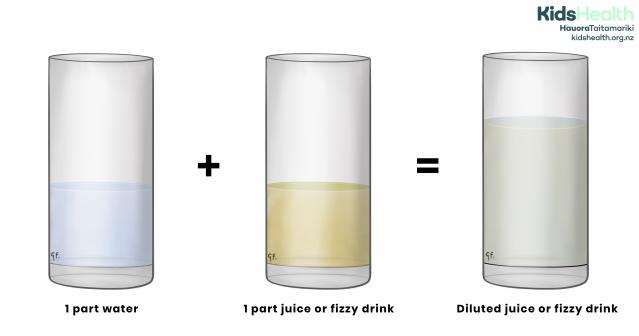
Illustration showing how to make a diluted drink.
Source: KidsHealth
transcribeTranscript
This illustration shows 3 glasses.
A glass with some water in it.
Label: 1 part water.
An addition sign (+).
A second glass with some juice or fizzy drink in it.
Label: 1 part juice or fizzy drink.
An equals sign (=).
A third glass containing a mix of the contents of the other 2 glasses.
Label: Diluted juice or fizzy drink.
This shows that mixing equal parts of water and juice or fizzy drink makes a diluted drink.
Oral rehydration solution
Your health professional may recommend a rehydration solution if your child is dehydrated. Hydralyte is one example of a rehydration solution. You can get these from the supermarket and pharmacy - follow the instructions on the bottle or packet. These solutions contain the right balance of water, salts and sugar to help your child absorb fluids well.
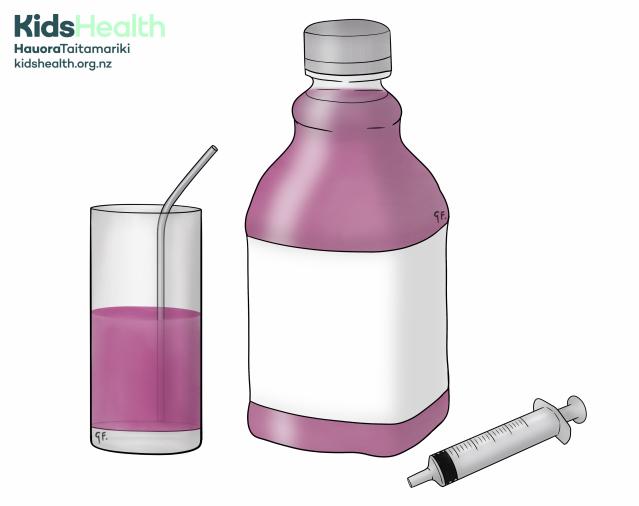
An illustration showing a bottle of rehydration fluid, a glass with a straw, and an oral syringe.
Source: KidsHealth
Breastmilk and formula
If you breastfeed your baby, continue breastfeeding. Offer feeds more often. Breastmilk helps replace lost fluids and provides nutrition.
If your baby has formula, continue formula feeds unless a health professional tells you otherwise.
Hospital stay
If your child has moderate or severe dehydration, they may need treatment in hospital. This may include fluids through a tube through the nose into the stomach or fluids through a drip into a vein.
Preventing dehydration in babies and children
You can reduce the risk of dehydration by:
- encouraging frequent drinking, especially in hot weather
- offering extra fluids during illness
- continuing breastfeeds or formula feeds during mild illness
- giving oral rehydration solution early if vomiting or diarrhoea starts
- making sure your child rests when unwell
