

Key points about clubfoot in babies and children
- clubfoot is when a baby’s foot is twisted out of its normal position
- it is present at birth and often diagnosed on ultrasounds during pregnancy
- it can affect one or both feet
- clubfoot is not painful for pēpi (babies)
- treatment usually starts in the first few weeks of life and continues throughout childhood
- most tamariki have excellent outcomes with early treatment
- treatment often involves gentle stretching, casting and sometimes a small procedure
What is clubfoot?
Clubfoot is a condition where a baby’s foot turns inwards and downwards and cannot be gently pulled into normal position. The foot may look smaller than usual, and the calf muscles on that side may also be smaller.
The medical name for clubfoot is congenital talipes equinovarus (CTEV).
In clubfoot, the soft tissues are tighter than usual. This pulls the foot into an abnormal position.
Clubfoot can affect one foot or both feet.
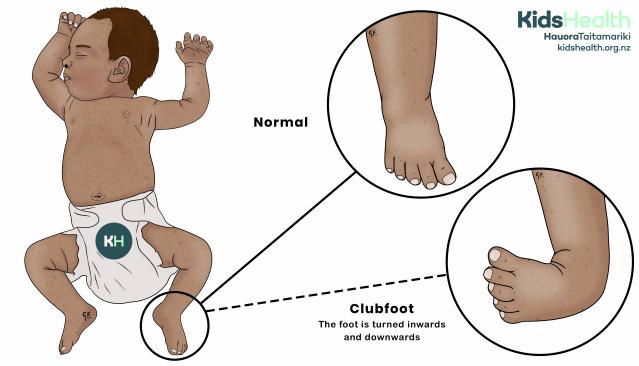
An illustration showing clubfoot compared with a normal foot.
Source: KidsHealth
transcribeTranscript
This illustration shows a baby with clubfoot and compares it with a normal foot.
- On the left is a baby lying on their back wearing a nappy. The foot is highlighted.
- A close-up circle shows a normal foot, with the foot resting in a straight position.
- Another close-up circle shows clubfoot, where the foot is turned inwards and downwards.
At the top right is the KidsHealth logo with the website: kidshealth.org.nz.
A bit about the foot
The foot has many bones, joints, muscles and tendons. These all work together to help your child stand, walk and balance.
The main parts of the foot include:
- heel bone (calcaneus)
- ankle bone (talus)
- midfoot bones
- toes (phalanges)
- Achilles tendon (connects the calf muscle to the heel bone)
Muscles, ligaments and tendons help hold the bones in place and allow the foot to move.
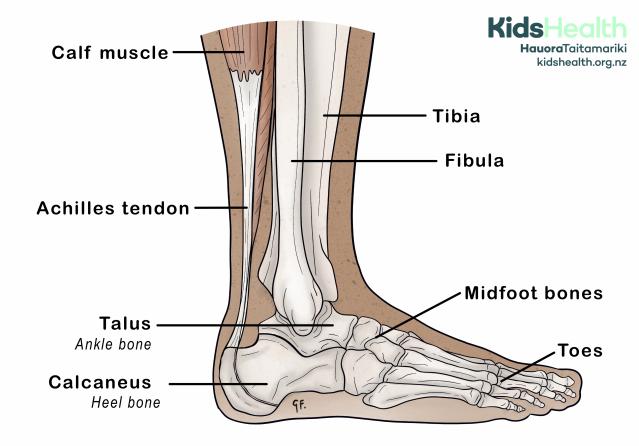
An illustration showing the bones and structures of the foot and ankle.
Source: KidsHealth
transcribeTranscript
This illustration shows the anatomy of the lower leg, ankle, and foot in a side view.
- The calf muscle is shown at the back of the lower leg.
- The Achilles tendon connects the calf muscle to the heel.
- The lower leg bones are labelled as the tibia and fibula.
- At the ankle is the talus (ankle bone).
- Below this is the calcaneus (heel bone).
- In the foot, the midfoot bones are shown, leading to the toes.
At the top right is the KidsHealth logo with the website: kidshealth.org.nz.
Causes of clubfoot
Clubfoot is a congenital condition. This means it is present at birth.
It is not fully known what causes clubfoot. It is likely due to a mix of genetic and environmental factors. This means it can sometimes run in a whānau (family), but it can also happen when there is no family history.
Clubfoot is not caused by anything parents did or did not do during pregnancy.
Sometimes clubfoot occurs on its own. For some tamariki, it can be linked with other conditions, such as spina bifida.
Symptoms of clubfoot
The main sign of clubfoot is the shape and position of the foot.
Your baby’s foot may:
- point downwards
- turn inwards
- have a curved shape
- be stiff and difficult to move into a normal position
If one foot is affected, it may be smaller than the other. The calf on that side may also be smaller.
Clubfoot is not usually painful for pēpi. However, without treatment, it can affect how your child stands and walks later on.
Diagnosing clubfoot
Health professionals can diagnose clubfoot by examining your baby’s feet.
Sometimes, a scan during pregnancy can show signs of clubfoot before your baby is born.
After birth, your health professional may refer your baby to a specialist team. This specialist team will assess your baby and discuss treatment options with you.
Tests are not usually needed. A health professional may suggest them if there are signs of another condition.
Managing clubfoot
Treatment for clubfoot usually starts soon after birth. Early treatment gives the best results.
The most common treatment is the Ponseti method. This method gently moves the foot into a better position over time. The Ponseti method includes:
- stretching and plaster casts
- a small procedure called a tenotomy
- bracing with boots and a bar
Stretching and plaster casts
A health professional gently stretches your baby’s foot and places it in a plaster cast. The cast holds the foot in the new position. Your child will have their cast changed weekly. Each time the foot moves closer to a normal position. This usually continues for several weeks.
Small procedure (tenotomy)
Many pēpi need a small procedure to release a tight tendon at the back of the ankle. This procedure is a tenotomy. It is quick and usually done with local anaesthetic.
Bracing (boots and bar)
After casting, your baby will need to wear special boots attached to a bar. This helps keep the feet in the correct position. At first, your baby wears the brace most of the time. Later, they only need to wear it during sleep.
It is important to follow the bracing plan carefully. This helps stop the clubfoot from coming back.
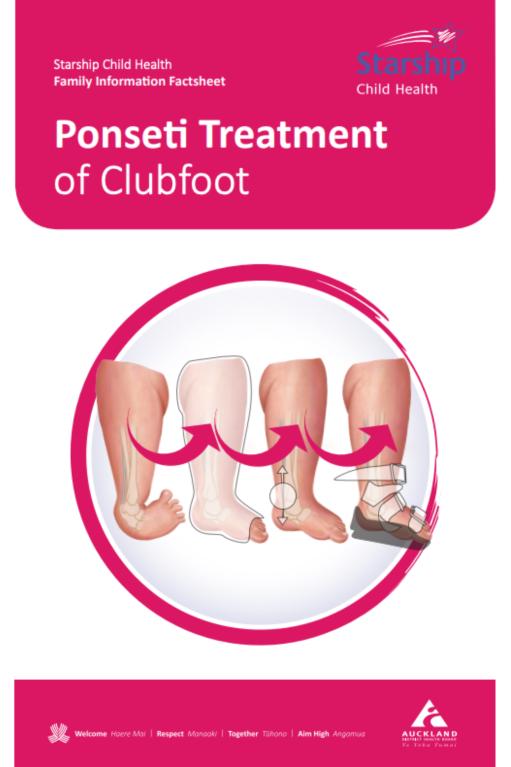
Visit the Starship website to see their information booklet on what is involved in ponseti treatment. You can read or download the booklet (PDF, 2 MB) on the Starship website.
Long-term outlook
Most tamariki with clubfoot who have early treatment grow up to walk, run and play normally.
The foot may remain slightly smaller, and the calf muscles may be thinner, but this usually does not affect their day to day activities.
Some tamariki may need further treatment as they grow. Further treatment is usually needed if the clubfoot starts to return.
With the right treatment and follow-up, the long-term outlook for tamariki with clubfoot is very good.
More information

See the Starship website for more information on treatment for club foot. It has resources and helpful information for whānau.
Acknowledgements
Illustrations by Dr Greta File. Property of KidsHealth.
