

Key points about coeliac disease
- coeliac disease is an autoimmune disease
- coeliac disease happens when your child's immune system reacts to gluten
- gluten is a protein in wheat, barley, rye and sometimes oats
- talk to your health professional if you think your child has coeliac disease
- your child may need some blood tests and a biopsy to see if they have coeliac disease
- a strict gluten-free diet is the only treatment for coeliac disease
What is coeliac disease?
An autoimmune disease
Coeliac (sometimes spelled celiac) disease is an autoimmune disease. It happens when your child's immune system reacts to gluten. Gluten is a protein in wheat, barley, rye and sometimes oats. Your child's immune system mistakes gluten as a threat to the body. In an attempt to protect the body, the immune system creates antibodies to fight it. In coeliac disease, these gluten-fighting antibodies damage the lining of the small bowel.
Damage to the small bowel
Your child's small bowel is lined with tiny finger-like projections, called villi. Villi help absorb nutrients in food. In coeliac disease, gluten damages the villi and they become flat. This interferes with the absorption of nutrients from food. This means your child may not absorb enough:
- vitamins - such as folic acid
- minerals - such as iron and calcium
- fat - which is essential for growth
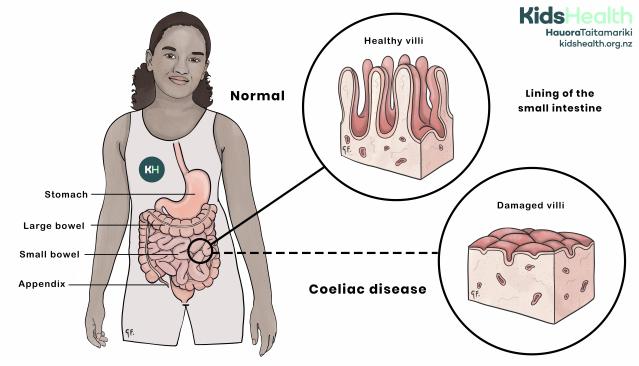
This illustration shows coeliac disease, where the villi in the small bowel become damaged compared with normal healthy villi.
Source: KidsHealth
transcribeTranscript
The illustration shows a teenage girl with an overlay of the digestive system on her body. The stomach, large bowel, small bowel, and appendix are labelled. A small inset circle highlights the small bowel, with two enlarged diagrams comparing normal and coeliac disease.
- The top circle is labelled Normal. It shows the lining of the small bowel with tall, healthy villi. The label reads: Healthy villi.
- The bottom circle is labelled Coeliac disease. It shows the lining of the small bowel with flattened, shortened villi. The label reads: Damaged villi.
- At the bottom right, text reads: Coeliac disease.
At the top right is the KidsHealth logo with the website: kidshealth.org.nz
How common is coeliac disease?
About 1 in 70 New Zealanders may have coeliac disease - many of them are unaware they have the condition. It’s more common in people of European or Indian descent but can affect anybody. It can affect tamariki (children) of any age after they start eating food with gluten in it.
People with a family history of coeliac disease are more likely to develop it themselves. Coeliac disease can also develop in tamariki with other autoimmune conditions. This includes conditions such as type 1 diabetes and thyroid disease. It’s also more common in tamariki with chromosomal conditions such as Down syndrome.

You could try the Coeliac NZ online self-assessment survey to find out if your child may be at risk of coeliac disease. Remember not to act on the assessment results alone - talk to your health professional.
Symptoms of coeliac disease
Some tamariki have no symptoms. Some tamariki with coeliac disease may have some of the following symptoms:
- large, bulky, smelly poo
- loose runny poo (diarrhoea)
- constipation
- farting
- poor weight gain
- poor growth
- weight loss in older tamariki and rangatahi (young people)
- low iron or anaemia
- problems with tooth enamel
- uncomfortable and swollen abdomen
- nausea and vomiting
- tiredness
- irritability
Diagnosis of coeliac disease
If you think your child has coeliac disease, talk to your health professional. Tell your health professional if a relative has coeliac disease.
Your child may need a test for coeliac disease. Diagnosing coeliac disease accurately is important because coeliac disease is a life-long condition.
Blood tests
Your health professional will arrange blood tests.
A blood test called coeliac serology
Coeliac serology measures gluten-fighting antibodies in the blood. These antibodies are often higher in people with untreated coeliac disease. Your child must be eating gluten for 4 to 6 weeks before the test.
Your health professional may also check for other things. This may include some vitamin and mineral levels, particularly iron.
If coeliac serology is positive, your child will need to have further tests. These can include:
- another blood test
- a biopsy at the hospital
Some tamariki may be able to get a coeliac diagnosis without a biopsy. Your health professional or paediatrician will talk with you about this.
A blood test called HLA gene testing
Not all tamariki need HLA testing. It can be useful if there is uncertainty about your child's diagnosis. The gene test alone cannot diagnose coeliac disease.
Endoscopy and biopsy
Your child may need a biopsy.
To have a biopsy, your child needs an endoscopy. This is sometimes called a gastroscopy. This is a simple day procedure. Your child will have an anaesthetic so they’re asleep during the procedure.
The doctor will use a flexible tube with a camera attached to its end (endoscope). The doctor will feed the tube through your child's mouth into their stomach and then the small bowel. The doctor will take several tiny samples (biopsies) of your child's small bowel.
A specialist doctor will look at the biopsies under a microscope. This is to see if your child has coeliac disease. It can take a week or two to get the results.
Treatment for coeliac disease
The only treatment for coeliac disease is for your child to follow a strict gluten-free diet. This allows the villi in the bowel to regrow. After removing all gluten from their diet, your child will return to normal health over a few months.
Your child may need to take a supplement until their bowel heals. This will depend on whether they have low levels of iron or other vitamins or minerals.
What does eating gluten-free involve?
A gluten-free diet means removing foods that contain gluten. This includes removing wheat, barley, oats and rye from your child's diet.
People with coeliac disease need to be on a gluten-free diet for life. Your child's diet needs to exclude all sources of gluten. Eating small amounts of gluten can cause further damage to your child's bowel. This can affect their growth even though it may not lead to symptoms.
It’s important to meet with a dietitian to learn and get the right advice about a gluten-free diet.
You will need to replace many common foods with gluten-free alternatives.
These include:
- breads
- biscuits
- cereals
- pasta
You’ll also need to learn to identify hidden sources of gluten. You’ll need to check packaged foods in particular.
Some people with coeliac disease may be able to eat oats again once their blood tests are back to normal. This is because not all oats contain gluten. Your health professional can give you advice about this.
A gluten-free diet when there is no coeliac disease
If your child doesn't have coeliac disease, they don't need a gluten-free diet. A gluten-free diet can increase the risk of gluten allergies in those without coeliac disease. Tamariki shouldn't be on a restrictive diet if they don't need to be.
Helping your child live with coeliac disease
Tamariki can adapt very quickly to a new diet. They may have been feeling sick for some time so they often feel better on their new diet.
Explaining coeliac disease to your child
You could read an illustrated eBook with your child. It's about Jack, a boy who has coeliac disease. The eBook comes from the USA, so some words are spelled differently.

Getting the whole family involved
It's important to explain coeliac disease to the whole whānau - including siblings. You might like to go through your cupboards and label everything. Add a smiley face sticker to all gluten-free products. For non-gluten-free products, add a warning sticker. This helps everyone see the difference.
Cooking for the whole family
When cooking for the whānau, you can make many dishes gluten-free. Sometimes you can simply change certain ingredients such as stock cubes and sauces. It’s important to try to prevent contamination with gluten-containing foods in the kitchen. This especially applies to toasters. Tamariki with coeliac disease should have their own toaster.
If you are ever unsure about what food is gluten-free, Coeliac New Zealand has a range of resources - these can help you identify gluten-free products.
Going for regular check-ups
It’s important for your child to have regular check-ups with health professionals. This is to make sure that your child recovers as expected. The health professionals will keep an eye on your child's growth. They may also do a blood test to make sure the coeliac antibody levels have returned to normal. This can help show if your child is sticking to a gluten-free diet. It may take time (sometimes over a year) for the antibody levels to return to normal. Your child will feel better before the antibody levels return to normal.
People with a confirmed coeliac disease diagnosis can have a free flu vaccination. Ask your health professional for more information.
Talking to your child's school
Make sure your child's school or daycare knows your child has coeliac disease. Tamariki often share lunch boxes. Also, some play material (such as Play-Doh) contains gluten.
Support for coeliac disease
Having a child diagnosed with coeliac disease can be a stressful life-changing event. Take it one step at a time. Use the support available, and you'll start to get the hang of things in a few months.
Check out the Coeliac New Zealand website for more advice, support and more information, including tips on how to eat gluten free.
Videos about coeliac disease
Coeliac disease in children
A video about coeliac disease in children.
Source: Coeliac New Zealand - Adapted by KidsHealth (with permission).
transcribeTranscript
[Music]
[Text]
Coeliac New Zealand, GF for life
Dr Helen Evans, Paediatric Gastroenterologist, Starship Children's Hospital
You can live a perfectly normal life without gluten, you don't need gluten in the diet. People are very used to the foods that they like and so to change all of that takes a long period of adjustment, but the benefits very much outweigh the disadvantages in that people feel better.
It is important to diagnose coeliac disease early. It's a very simple blood test, and the results are available very quickly. If those blood tests are positive, the patient would then come to the hospital to have a biopsy where a camera is placed through the mouth down into the bowel, and we take some little biopsies to look at under the microscope. It's a day case procedure. It's very straightforward; it literally takes just a few minutes. There is some international evidence that in children with very high levels of coeliac markers in the blood tests that they no longer need to have a biopsy to prove they have coeliac disease.
Coeliac disease impacts on whole families, but once the diet has been established, it transforms the way that the family lives. When children feel well they're more likely to undertake full family and school lives, and you know it's almost though they've come alive again, and it makes the diet less of a problem than it otherwise would have been.
People should not be fearful if they're diagnosed with coeliac disease because what we know is it is completely treatable with the gluten-free diet. They should just take the diet and start to feel better.
Jude Walter
Once you start on the gluten-free journey, you're always looking for new and different ways to make that food really really tasty.
Sam Walter
Within 6 months, I had forgotten that I was eating anything different. It's just like breathing to me really, eating gluten-free.
Jude Walter
The ability to purchase gluten-free at your local supermarket is phenomenally different and so much easier than it was 8 years ago when Sam was first diagnosed.
We joined the my food bag phenomenon. It's actually opened our eyes to just the variety of cooking that you can do even on a gluten-free diet. For me, it comes back to trust and knowing quality brands that have got coeliac's best interests at heart.
Sam Walter
You start to actually desire those foods. You forget what other things taste like.
Jude Walter
So just embrace the gluten-free options that are out there because there are heaps.
Sophie Walter
I'm just open to it, and I'm like "yeah, I have coeliac disease, it is what I have, and it's what makes me unique."
Dana Alexander, General Manager, Coeliac New Zealand
An estimated 65,000 New Zealanders have coeliac disease, and yet 80 percent are completely unaware they have the condition.
Coeliac New Zealand offers support and advice to those of all ages with coeliac disease. We also help to improve the safety standards of packaged gluten-free products available in supermarkets, cafes and restaurants through our internationally recognised cross-grain logo accreditation and dining out programs.
Being diagnosed early with coeliac disease gives people the chance to drive their own health and wellness through good food and lifestyle choices.
Join Coeliac New Zealand, and you'll receive a member's pack full of useful tips and information.
We'll be there to support and guide you to better manage this lifelong condition every step of the way.
[Music]
Find out how to live well by being gluten-free for life every day at coeliac.org.nz.
[Music]
[Text]
Coeliac disease is a permanent autoimmune disorder that causes a reaction to dietary gluten found in wheat, barley, rye and oats.
If left untreated, it can cause diarrhoea, abdominal pain, unexplained fatigue, weight loss and more serious health issues.
Concerned? Try the free online self-assessment at coeliac.org.nz or talk to a health professional.
[Music]
Developments in coeliac research
Video about the latest in research into coeliac disease.
Source: Coeliac New Zealand
transcribeTranscript
Coeliac New Zealand, GF for life.
[Music]
Voice
An estimated 65,000 New Zealanders have coeliac disease. This is increasing every year. But what is coeliac disease?
Dr Helen Evans, Paediatric Gastroenterologist, Starship Children's Hospital
Coeliac disease is an intolerance to gluten and gluten is a protein that's in many food items but predominantly in grains.
What happens when people with coeliac disease eat those food items is that it damages the inside of their bowel, and then it becomes much less efficient at absorbing food. And what happens then as you develop all sort of secondary symptoms because you can no longer absorb food properly.
Voice
Coeliac sufferers often experience many unnecessary years of painful symptoms before they are diagnosed. The treatment changes lives for the better.
Dr Helen Evans
Coeliac disease is completely treatable, and the treatment is a strict gluten-free diet.
Dr Jason Tye-Din, Walter & Eliza Hall Institute, Melbourne
Adherence to a gluten-free diet needs to be very strict in order for the gluten-free diet to actually achieve its goal of leading to a resolution of symptoms and healing of the small bowel.
Voice
Coeliac New Zealand is the cornerstone for going gluten-free for life. But is there a cure?
Dr Jason Tye-Din
We don't really have a way to prevent it at the moment because you're born with the genes, and you can't change those.
Dr Helen Evans
We are progressing all of the time, but we're not yet at a point where we can give people information as to how to avoid getting coeliac disease. Those are the sort of things that people are actively researching.
Voice
Research is crucial to finding better treatments and even a possible cure.
Dr Jason Tye-Din
There's a lot of research being undertaken at the moment around the world to try to improve upon the gluten-free diet, and these approaches are really trying to shift how the immune system sees and responds to gluten. The hope is that these will be able to assist people either with a gluten-free diet or potentially even coming off a gluten-free diet and having a normal diet.
Voice
Coeliac New Zealand is committed to supporting this vital research that will benefit families and individuals for generations to come.
Dr Kristin Kenrick, Dunedin School of Medicine
Coeliac New Zealand has been very helpful to me personally. At a very practical level, they gave me some funding to assist with my research project, and that was really valuable. I couldn't have completed all of the research that I wanted to do without that extra bit of financial support from Coeliac New Zealand.
Voice
Exciting new research will enable positive changes to the availability of safe gluten-free food for consumers.
Dr Jason Tye-Din
An important issue is what the appropriate definition of gluten-free diet should be. We hope to resolve this question by doing a study called the micro gluten challenge study. This study will really help us establish a safe threshold for where we should define gluten-free at, but at the same time ensure that gluten-free options are freely available and affordable to patients because if not then the irony is that you're going to compromise the diet.
[Text]
Coeliac New Zealand coeliac.org.nz.
Acknowledgements
Videos from Coeliac New Zealand.
Illustration by Dr Greta File. Property of KidsHealth.
