
Welcome to the new KidsHealth website! See what is new.

Header

Low or no data? Visit zero.govt.nz, search for KidsHealth, and click on our logo to return and browse for free. Need help?

For free medical advice call Healthline 0800 611 116. Healthline provides a 24 hour, 7 days a week, over-the-phone health service. For emergencies call 111.  

Learning CPR

Learn CPR before you need it - watch the video for step by step instructions.

Caption and credit

Dr. Tony Smith, St John medical director demonstrates how to perform CPR on infants. 
Source: Hato Hone | St John New Zealand

transcribeTranscript

[Dr. Tony Smith, St John Medical Director] 

In this demonstration, I'm going to show you how to do CPR on an infant. 

Before you do anything, make sure an ambulance has been called and nobody is in danger.

You push on the chest 30 times and blow in the mouth twice. 

Remember this 30 to 2, no matter who.

Now let's have a go. To push on the chest, put 2 fingers in the middle of the chest and push fast, 30 times.

 … 28, 29, 30. 

Now blow twice in the mouth and nose. Tilt the head and place your mouth over the infant's mouth and nose and blow

twice. 

Now back on the chest 30 times.

  … 28, 29, 30. 

Remember 30 to 2, no matter who.

Keep doing this until the ambulance arrives.

If you don't know how fast to push, you need to push at 100 a minute and the beat of the Bee Gees song "Stayin Alive" is exactly 100 a minute so get that song in your mind.

Parents and whānau should know how to do CPR (rescue breathing and chest compressions). You can find courses near you.

Book first aid courses at Hato Hone St John

See all first aid courses run by NZ Red Cross 

How to do CPR

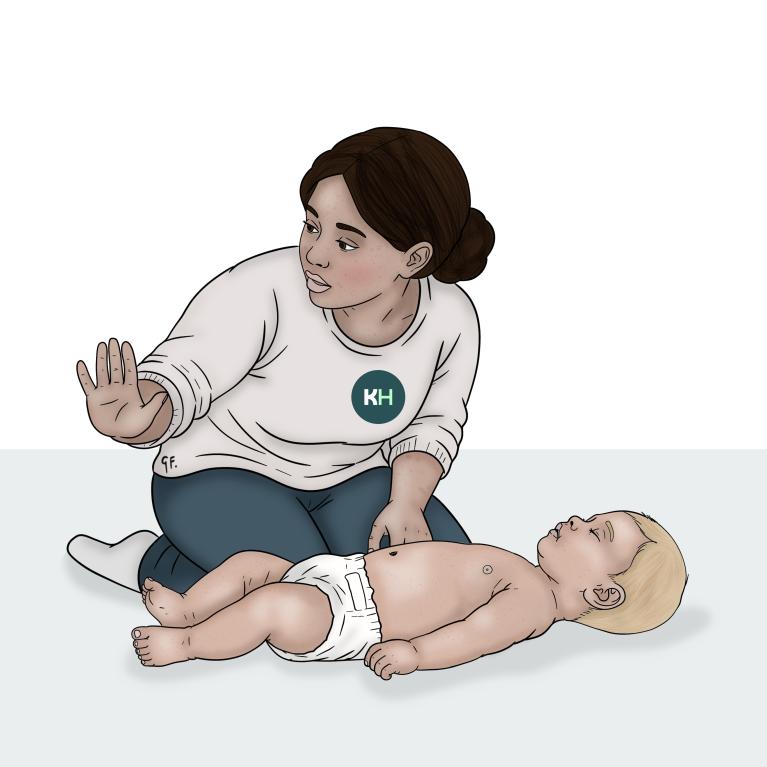
Tamariki and pēpi who are not breathing normally and are not responding need CPR. If you're not sure, it's better to start CPR.

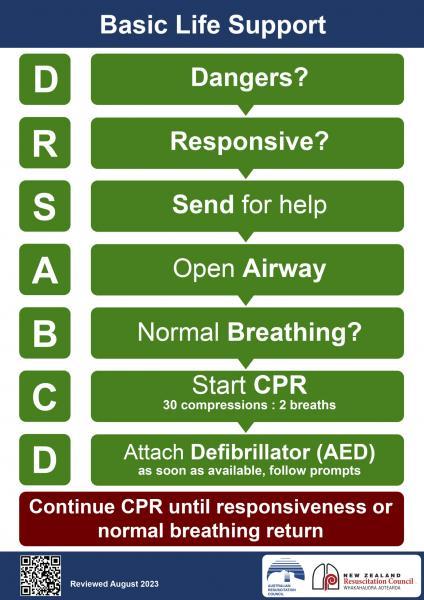
Follow the D.R.S.A.B.C.D of resuscitation

D - Dangers

Check for any danger to you, the child, or people nearby – things like traffic or live electrical wires. Do what you can to reduce the danger. 

R - Response

Are they responding? Ask “what’s your name?” or say “open your eyes” or “squeeze my hand”. Then grasp and squeeze the child’s shoulders firmly. If they move or make a noise, that’s a response.  

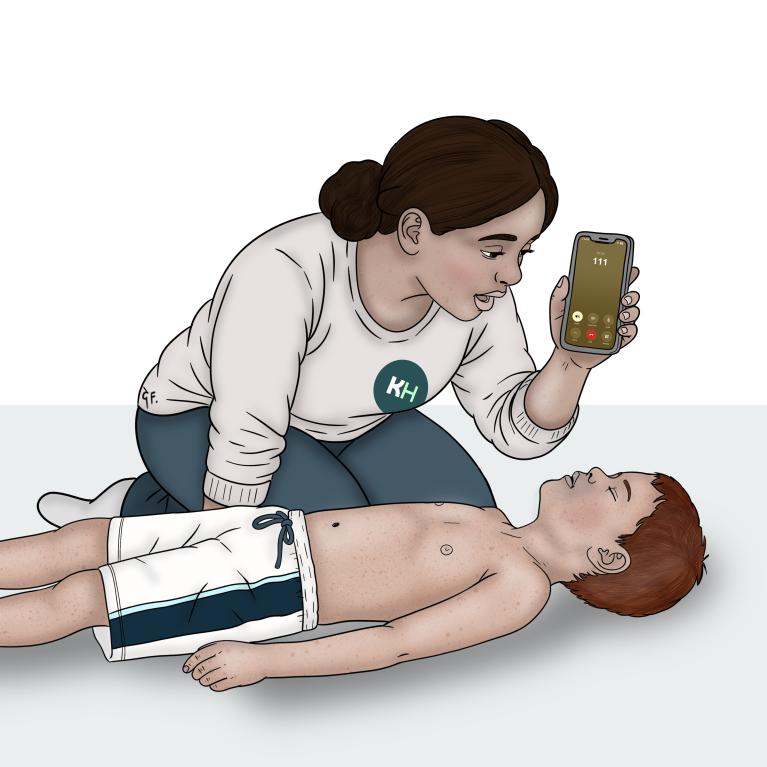
S - Send for help

Call 111 (in New Zealand) and ask for an ambulance.

A - Airway

Tilt their head back and lift their chin, this will open their airway. Make sure the child’s tongue isn’t blocking the airway. If there’s anything in the child’s mouth, use 2 fingers to sweep it out.   

Screenshot from St Johns video showing tilting of the head

Image showing how to open the airway by tilting the head and lifting the chin.
Source: Video screenshots from CPR on infants video, Hato Hone | St John NZ

B - Breathing

Check for normal breathing. Is their chest moving? Can you hear air coming from their nose and mouth? Occasional gasps for air is not breathing normally.  

If they are breathing, place the child in the recovery position.

An illustration of a child in the recovery position, lying on their side. Labels point to the head tilted to keep the airway open, the mouth facing the ground, the hand supporting the head, and the knee preventing the body from rolling.

An illustration showing a child in the recovery position.
Source: KidsHealth

transcribeTranscript

The illustration shows a child with short brown hair, wearing a white T-shirt and shorts, lying on their side in the recovery position.

  • The head is tilted to keep the airway open.
  • The mouth is turned toward the ground.
  • One hand is positioned under the head for support.
  • The top knee is bent forward to stop the body from rolling.

At the top left is the KidsHealth logo with the website: kidshealth.org.nz

C - CPR

Don’t worry about pushing too hard – you need to push hard and fast.

If the child is not breathing normally, start CPR.

Put the child on their back, on a firm surface. Place 2 fingers of one hand (for a baby) or the heel of one hand (for a child) in the centre of the chest just below the nipples.

Screen shot from st johns video showing chest compressions

An image showing chest compressions on a baby placing 2 fingers of one hand in the centre of the chest just below the nipples.
Source: Video screenshots from CPR on infants video, Hato Hone | St John NZ

It's important to push down hard and fast - you need to push at 100 a minute. The beat of the Bee Gees song ‘Staying Alive’ is exactly 100 beats a minute, so get that song in your mind.

Once you have completed 30 compressions (pushes) on the chest, breathe into the child's mouth 2 times.

For a baby - seal your lips around the baby's mouth and nose.

For a child over 1 - pinch their nose closed and breathe into their mouth.

Continue with the cycle of 30 chest compressions and 2 breaths until the ambulance arrives.

Screenshot from st johns video showing breathing during CPR

An image showing breathing into the baby's mouth by sealing the lips around the baby's mouth and nose.
Source: Video screenshots from CPR on infants video, Hato Hone | St John NZ

D - Defibrillator (AED)

If there is an AED nearby, attach it to the child as soon as possible, turn on and follow the instructions on the AED. The defibrillator will talk to you.

The picture on the AED will show you where to put the pads.

Screenshot from st johns video showing AED

An image showing an example of an AED.
Source: Video screenshots from CPR on infants video, Hato Hone | St John NZ

If there are no child pads, use adult pads. The pads should not touch each other. If the pads are too large, put one on the front in the centre of the chest and the other on the back between the shoulder blades.

Return to chest compressions and keep going until the child responds or starts breathing normally, or professional help arrives and takes over.

More information

Caption and credit

Dr. Tony Smith, St John medical director demonstrates how to perform CPR and use an AED on tamariki.
Source: Hato Hone | St John

Acknowledgements

Illustration of a child in the recovery position by Dr Greta File. Property of KidsHealth. 

Video screenshots from CPR on infants video, with permission by Hato Hone | St John NZ.

Last reviewed
Shielded site