

Key points about eosinophilic oesophagitis
- eosinophilic oesophagitis (EO) is a condition that causes inflammation in the oesophagus (food pipe)
- it can make swallowing difficult and sometimes causes food to get stuck
- EO is more common in tamariki (children) and rangatahi (young people) with allergies, asthma or eczema
- doctors diagnose EO with a gastroscopy and biopsies
- treatment may include dietary changes or medicines
- most tamariki and rangatahi with EO need ongoing follow-up with their healthcare team
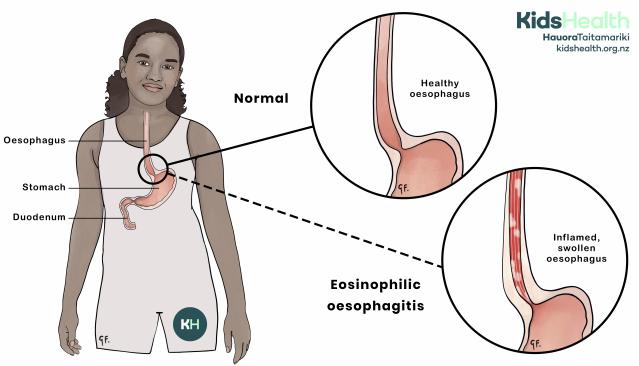
This illustration shows eosinophilic oesophagitis, where the oesophagus becomes inflamed and swollen compared with a normal oesophagus.
Source: KidsHealth
transcribeTranscript
The illustration shows an older child with an overlay of the digestive system on their chest and abdomen. A circle highlights the oesophagus, with two enlarged diagrams comparing normal and eosinophilic oesophagitis.
- The top circle is labelled Normal. It shows a healthy oesophagus with a clear passage. The label reads: Healthy oesophagus.
- The bottom circle is labelled Eosinophilic oesophagitis. It shows the oesophagus with red, inflamed, and swollen walls. The label reads: Inflamed, swollen oesophagus.
- At the bottom right, text reads: Eosinophilic oesophagitis.
At the top right is the KidsHealth logo with the website: kidshealth.org.nz
What is eosinophilic oesophagitis?
The oesophagus (food pipe) carries food and drink from the mouth to the stomach.
When the oesophagus becomes inflamed, it is called oesophagitis.
EO happens when a type of white blood cell called an eosinophil builds up in the lining of the oesophagus. This causes inflammation, which can cause reflux or make it harder for food to pass into the stomach.
Causes of eosinophilic oesophagitis
Experts do not know exactly what causes EO.
Many tamariki and rangatahi with EO also have other allergic conditions, such as:
- asthma
- eczema
- hay fever
- food allergy
Sometimes foods can trigger or make EO worse.
Signs and symptoms of eosinophilic oesophagitis
Symptoms can vary depending on your child's age.
Babies and younger children
Pēpi (babies) and younger tamariki with EO may:
- have reflux (when food or drink comes back up from the stomach)
- refuse food or have feeding difficulties
- eat slowly
- gag or choke when eating
- have trouble swallowing
- complain of tummy pain
- have poor weight gain
- clear their throat often
Older children and young people
Older tamariki and rangatahi with EO may:
- find it difficult or painful to swallow
- refuse to eat at times
- feel like food gets stuck in the oesophagus
- chew food for longer than usual
- need to drink lots of water while eating
- have chest pain when eating
- have reflux
Diagnosing eosinophilic oesophagitis
A healthcare professional will ask about your child's symptoms and examine them.
The only way to confirm EO is with a gastroscopy (also called an endoscopy). During a gastroscopy, a doctor will take biopsies from the lining of the oesophagus.
Gastroscopy
A gastroscopy is a procedure that allows a doctor to look inside the oesophagus, stomach and the first part of the small bowel.
Your child will have the procedure under a general anaesthetic. They will be completely asleep.
During a gastroscopy, a doctor uses a thin, flexible telescope (endoscope) to look inside your child's oesophagus. The endoscope passes through the mouth and into the oesophagus. The endoscope has a camera and light on the end, allowing the doctor to look for signs of inflammation. The doctor will also take photographs of the lining of the oesophagus.
See the page on gastroscopy to learn more about the procedure.
Biopsies
During the gastroscopy, the doctor will take several tiny samples from the lining of the oesophagus. These are called biopsies.
A specialist doctor looks at the biopsies under a microscope in a laboratory. They help confirm whether your child has EO and show how much inflammation is present.
Your child may need more biopsies after starting treatment. This helps the healthcare team see whether the treatment is working.
Health professionals caring for children with eosinophilic oesophagitis
Depending on your child's needs, several health professionals will be part of your child’s healthcare team.
Gastroenterologist
A gastroenterologist is a doctor who specialises in conditions affecting the digestive system. They usually do the gastroscopy and help manage your child's EO.
Paediatrician
A paediatrician is a doctor who specialises in children's health. In some parts of New Zealand, your child's paediatrician will coordinate their care.
Allergy specialist
Because EO is often linked with allergies, your child may also see an allergy specialist. They can assess whether allergies may be adding to your child's symptoms.
Dietitian
If your child needs to avoid certain foods, a dietitian can help you plan a balanced diet. They will make sure your child continues to get all the nutrients they need to grow and develop well.
General practice team
Your child's general practice team can help with prescriptions and referrals if needed.
Management of eosinophilic oesophagitis
The aim of treatment is to reduce inflammation in the oesophagus, improve symptoms and prevent long-term damage.
Treatment may include dietary changes or medicines. Your child's healthcare team will recommend the best treatment for them.
Dietary treatment
For some tamariki and rangatahi, avoiding certain foods can reduce inflammation in the oesophagus.
Removing trigger foods
Some foods are more likely to trigger EO than others. Common trigger foods include:
- cow's milk
- wheat
- soy
- eggs
- peanuts and tree nuts
- fish and shellfish
There is no test that can identify which foods trigger EO for an individual child.
Your child's healthcare team will advise which foods to remove from their diet. Some tamariki only need to avoid 1 or 2 foods, while others may need to avoid more.
A dietitian can help you make these changes safely. They can make sure your child continues to get the nutrition they need for healthy growth and development.
Reintroducing foods
If your child has removed foods from their diet, they may be able to add them back one at a time.
Your healthcare team will guide you on when and how to do this. Your child may need another gastroscopy with biopsies after foods are reintroduced. This is to check whether inflammation has returned.
Elemental diet
Some pēpi and younger tamariki may benefit from an elemental diet.
An elemental diet uses a special formula made from amino acids, which are the building blocks of protein. Because amino acids are very small, they are unlikely to trigger an allergic response.
An elemental diet is usually easier for pēpi and younger tamariki than for older tamariki and rangatahi. This is because it often requires stopping all other foods for a while.
Medicines
Medicines can reduce inflammation and improve symptoms.
Swallowed steroids
Swallowed corticosteroids are one of the main treatments for EO.
Fluticasone is a corticosteroid commonly used to treat asthma. For EO, your child swallows the medicine instead of breathing it into their lungs. Other corticosteroids are available. They come as liquids or specially prepared mixtures that coat the lining of the oesophagus.
These medicines act directly on the inflamed lining of the oesophagus to reduce inflammation.
This video shows the right way to use a fluticasone inhaler to treat eosinophilic oesophagitis.
Source: Starship
Proton pump inhibitors
Proton pump inhibitors reduce the amount of acid made by the stomach.
These medicines can also reduce inflammation in the oesophagus. This may improve symptoms in some tamariki and rangatahi.
They are available as tablets, capsules or liquids.
Dilatation of the oesophagus
Long-term inflammation can sometimes cause the oesophagus to become narrowed or scarred. This is uncommon in tamariki.
If narrowing develops, your child may need a procedure called a dilatation during a gastroscopy.
The doctor gently stretches the narrowed part of the oesophagus, making it easier for food to pass into the stomach.
Follow-up for eosinophilic oesophagitis
EO is a long-term condition, so your child will need ongoing follow-up with their healthcare team.
Several months after starting treatment, your child may need another gastroscopy with biopsies. This helps check whether the inflammation has improved and whether treatment needs to change.
Your child's healthcare team will continue to monitor their symptoms, growth and nutrition over time.
Although there is no cure for EO, treatment can usually control symptoms and help prevent damage to the oesophagus.
Conditions linked with eosinophilic oesophagitis
Many tamariki and rangatahi with EO also have other allergic conditions, including:
- asthma
- eczema
- hay fever
- food allergy
It is important that your child continues treatment for any of these conditions.
Food allergy testing does not diagnose EO. It is sometimes used if there are concerns that a child may have allergic reactions to certain foods.
More information and support
Finding out that your child has EO can feel overwhelming. There is often a lot to learn, especially if your child needs to make changes to their diet or have ongoing hospital appointments.
Your child's healthcare team can answer your questions and help you understand the treatment options.
Support groups and patient organisations like ausEE Inc can also provide practical advice and connect you with other whānau.

ausEE Inc is a resource for whānau affected by eosinophilic disorders. It is a national charity in Australia, and they are happy to help Kiwi families.
Acknowledgements
This content has been developed and approved by the Paediatric Society NZ's Child and Youth Clinical Network for Gastroenterology.
Illustration by Dr Greta File. Property of KidsHealth.
