

Key points about fingertip injuries in children
- fingertip injuries are common in tamariki
- common causes include fingers getting trapped or squashed
- treatment may include cleaning, bandaging or, stitches - this may happen in the emergency department or in the operating theatre
- most tamariki recover well, though the nail may take several months to grow back
What is a fingertip injury?
The fingertip is the end of the finger, including the nail and the pulp underneath. A fingertip injury is when the top part of the finger is injured. It might bleed, swell, or split. The nail might lift or fall off. Sometimes, the bone under the nail can also break.
A bit about the fingertip
The nail bed sits between the nail and the bone. It helps the nail grow normally and keeps the nail fixed to the fingertip.
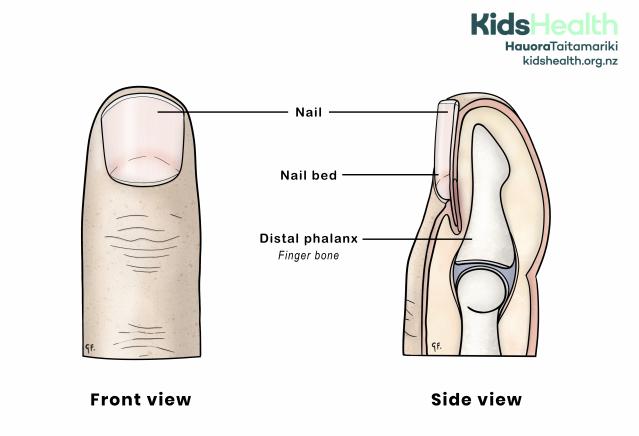
An illustration showing the parts of the fingertip.
Source: KidsHealth
transcribeTranscript
This illustration shows the structure of a fingertip in both front and side views.
- The front view show the outside of the finger. The nail covers the tip of the finger.
- In the side view, the inner layers of the fingertip are shown. The nail sits on top of the nail bed. Underneath is the distal phalanx (finger bone).
At the top right is the KidsHealth logo with the website: kidshealth.org.nz.
Causes of fingertip injuries
Fingertip injuries are common in tamariki.
Some common causes of fingertip injury include:
- a finger getting slammed in a door or drawer
- falling onto a hand
- sports injuries
- heavy objects dropping on a finger
- getting a finger caught in something like a bike chain
Symptoms of a fingertip injury
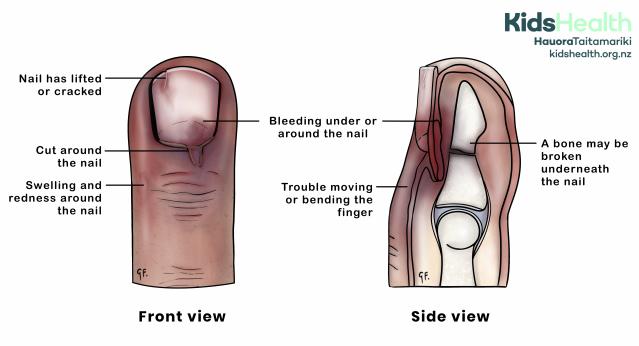
An illustration showing common signs of a fingertip and nail injury.
Source: KidsHealth
transcribeTranscript
This illustration shows a fingertip injury in both front and side views.
The front view shows:
- the nail is shown as lifted or cracked
- there is a cut around the nail
- there is swelling and redness around the nail
The side view shows:
- there is bleeding under or around the nail
- there is trouble moving or bending the finger
- a bone is broken underneath the nail
At the top right is the KidsHealth logo with the website: kidshealth.org.nz.
Tamariki who have had a fingertip injury may have:
- pain around the nail
- swelling or redness around the nail
- bleeding under or around the nail
- a nail that has cracked, lifted, or fallen off
- a cut around the nail
- a finger that looks bent or out of place
- trouble moving the finger
Even if there is no obvious damage to the nail, there could be damage to the nail bed underneath.
What to do if your child has a fingertip injury
If your child has had an injury to their fingertip, take them to a health professional. Even if there is no obvious damage to the nail, there could be damage to the nail bed.
If you are not sure what to do, call Healthline for free health advice on 0800 611 116. Healthline is available 24 hours a day, 7 days a week.
Diagnosing fingertip injuries
The health professional will talk to you about your child’s injury and examine their hand. The health professional may arrange an x-ray of your child's finger. This will check for any broken bones (fractures).
Treating fingertip injuries
Treatment for a fingertip injury depends on how severe the injury is. Minor injuries may only need cleaning and a bandage. The health professional may leave the nail alone or trim it if it's loose. A splint can help to keep the fingertip still.
If there is a deep cut, the health professional may need to stitch the nail bed. If there is blood under the nail causing pain, the health professional may make a small hole in the nail to drain it.
If the bone is broken or the fingertip is badly crushed, your child may need surgery.
Surgery for fingertip injuries
For more serious injuries, your child may need a short operation to repair the fingertip. Your child will be asleep during surgery from a general anaesthetic.
During the surgery, the health professional may remove your child’s nail. They may clean and reattach it. If the health professional reattaches the nail, they will fix it down with dissolvable stitches. Reattaching the nail can help protect the nail bed underneath.
If your child has a broken bone in their finger, it may need fixing with small wires during surgery.
The surgeon will put a dressing on your child’s finger after the surgery.
Follow-up after a fingertip injury
If your child needs surgery for their fingertip injury, they will need follow up. At the follow up, the health professional can check the wound and change the dressing. Your health professional will let you know when this follow-up appointment will happen.
Looking after your child after a fingertip injury
Pain relief
Paracetamol
If your child has pain, you can give paracetamol to make them more comfortable. You must follow the dosage instructions on the bottle. It is dangerous to give more than the recommended dose.
Other medicine
Your health professional may give you child ibuprofen (such as Nurofen or Fenpaed). You can also buy it at the pharmacy. Follow the dosage instructions carefully. Never give your child aspirin. Aspirin may increase the risk of Reye syndrome, which is a rare and serious illness.
Rest
Encourage your child to rest for the first few days after their surgery. Try to prevent them from knocking or banging the wound and causing bleeding and more pain.
Keep the dressing dry
It's important to try and keep your child’s dressing dry. A wet dressing can increase the chance of infection. Talk to your health professional about what to do if your child’s dressing gets wet.
Watch for signs of infection
Once your child has seen a health professional, you will get advice on how to care for their wound.
Keep a close eye on your child’s wound and see a health professional again if:
- there is increasing redness, swelling and pain or it becomes warm to touch
- red streaks develop around the wound
- there is a coloured or smelly discharge
- your child has any new loss of feeling, numbness or inability to move the finger
- the wound has not healed after 2 weeks
Healing after a fingertip injury
Most tamariki recover well after a fingertip injury. If your child has lost their nail completely, it can take up to 4 months for a new nail to grow back fully.
