

Key points about mitochondrial disease
- we all have mitochondria - they are in every cell in our body
- mitochondria are the tiny parts of our cells that are responsible for making energy
- they are often called the 'powerhouse' or battery of the cell
- mitochondrial disease or 'mito' happens when the mitochondria don't work properly
- mitochondria that don't work properly cannot produce enough energy
Receiving a diagnosis of mitochondrial disease
A diagnosis of mitochondrial disease can be very upsetting. It is normal to feel overwhelmed and to have many questions.
What are mitochondria?
Mitochondria are tiny parts inside our cells. They make the energy that our body needs to work.
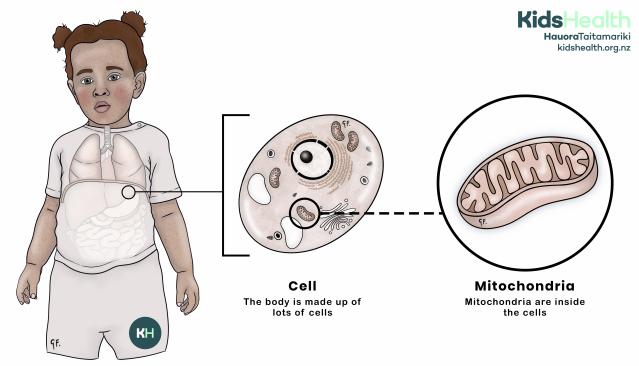
This illustration shows that mitochondria are tiny structures found inside cells throughout the body.
Source: KidsHealth
transcribeTranscript
The illustration shows a child with a semi-transparent view of some internal organs.
A circle on the child's body is magnified to highlight a body cell, which is shown enlarged in the centre of the image.
The enlarged cell contains several structures. One mitochondrion inside the cell is highlighted and shown at a larger scale.
The enlarged mitochondrion is shown on the right side of the image.
The following labels appear on the illustration:
- Cell – The body is made up of lots of cells.
- Mitochondria – Mitochondria are inside the cells.
At the top right is the KidsHealth logo with the website: kidshealth.org.nz
Mitochondria turn oxygen and glucose (sugar) into energy called ATP. This happens through a series of complex chemical reactions. They can also make energy from fat.
If the mitochondria don't work properly, the cell does not get enough energy. This can affect how organs work.
What is mitochondrial disease?
Mitochondrial disease (mito) happens when mitochondria do not work properly. This can damage cells and affect how organs work.
If stress occurs in the body, such as during an illness, it may trigger damage.
Mito often affects parts of the body that need a lot of energy, such as the:
- brain
- heart
- kidneys
- muscles
But any organ can be affected at any age.
There is currently no cure for mitochondrial disease.
Signs and symptoms of mitochondrial disease
Symptoms can vary a lot from person to person, even within the same family. Everyone’s experience is different.
Many people have problems affecting more than one part of the body.
In pēpi (babies), the brain is often affected.
Symptoms may include:
- normal development followed by loss of skills
- poor growth or feeding difficulties
- seizures
- stroke-like episodes
- poor coordination or delayed movement skills
- muscle weakness
- learning difficulties in tamariki (children) or early dementia in adults
- vision problems or drooping eyelids
- hearing loss
- heart problems (such as a thickened heart or an abnormal rhythm)
- liver or kidney disease
Adults may also develop early diabetes or have multiple miscarriages.
Why mitochondrial disease happens
All the proteins in our body are made from DNA (genetic material). DNA gives instructions for how our body works.
We have 2 types of DNA:
- Nuclear DNA (nDNA) – inherited from both parents
- Mitochondrial DNA (mtDNA) – inherited from our mother
Mitochondrial disease can happen due to changes (mutations) in either type of DNA.
These changes may be:
- inherited from one or both parents
- passed down through the mother
- new changes that happen for the first time in a person
Diagnosing mitochondrial disease
There is no easy test to diagnose mitochondrial disease. Reaching a diagnosis often means putting pieces of a jigsaw puzzle together.
Many symptoms of mito are similar to other illnesses. Symptoms can be unpredictable and may be mild at first. This can make diagnosis more difficult.
Clinical features and tests can strongly suggest mitochondrial disease. Tests may include:
- scans
- blood and urine tests
- other biochemical tests
DNA testing is usually needed to confirm mito. Sometimes, a muscle biopsy is also needed.
Sometimes, health professionals can't find a specific genetic cause. In this case, a diagnosis of ‘suspected mitochondrial disease’ may be made based on all the results.
Our understanding of the genetic causes of mito is growing all the time. A specific genetic diagnosis can help whānau understand the condition better and know what to expect in the future. It can also help them make decisions about future pregnancies.
Managing mitochondrial disease
Living with mitochondrial disease can be very challenging. It can affect the physical, emotional, and mental wellbeing of you, your child, and your whānau.
There are no proven treatments that cure mitochondrial disease. However, there are clinical trials and some promising research underway. Some people may benefit from certain vitamins or therapies, depending on their genetic diagnosis.
For most people, treatment focuses on supportive care and an accurate, timely diagnosis. Care focuses on:
- managing symptoms
- maintaining good nutrition
- avoiding illness where possible
- avoiding medicines that may harm mitochondria
Some health professionals suggest a ‘mitochondrial vitamin cocktail’. However, there is no strong evidence that this is helpful for most mitochondrial diseases.
Who helps manage mitochondrial disease in New Zealand
People with mitochondrial disease often need care from a team of health professionals.
This team may include:
- family and whānau
- multi-disciplinary national metabolic team
- community nurses
- GP
- neurologist - a doctor who specialises in the brain
- ophthalmologist - a doctor who specialises in eyes
- dietitian
- physiotherapist
- speech-language therapist
- psychologist
- social worker
- palliative care specialists
The Adult and Paediatric National Metabolic Service is based at Starship National Children’s Hospital Metabolic Service. They support both tamariki and adults across New Zealand.
The metabolic specialists are:
- Dr Callum Wilson
- Dr Bryony Ryder
- Dr Emma Glamuzina
- Dr Isaac Bernhardt
The nurse specialists are:
- Rebecca (Bec) Nicol
- Jessie Vince-Gilmour
They work with local teams and international specialists.
Don't give up hope - don't let the power go out!
More information and support
Mitochondrial Disease Closed NZ Facebook Support Group
The Mito Foundation has information and support for people affected by mitochondrial disease. Find resources about living with mito, research, advocacy and connecting with others in the mitochondrial disease community.
Rare Disorders New Zealand has information and support for people and whānau affected by rare disorders, including mitochondrial disease. Learn about available services, advocacy, support networks and resources in Aotearoa New Zealand.
UMDF supports research and education for the diagnosis, treatment and cure of mitochondrial disorders and to provide support to affected individuals and families. Their website has information for health professionals as well as individuals and their families.

The Lily Foundation is the UK's leading charity dedicated to fighting mitochondrial disease. Their mission is to support people whose lives are affected by the condition, raise awareness and fund research into its prevention, diagnosis and treatment.

Parent To Parent is a nationwide not-for-profit organisation formed in 1983 by parents and professionals to support the families of people with any type of disability or health impairment. Check their website to learn more about their services and how they can help.
Acknowledgements
This page is based on a pamphlet written by parents of children with mitochondrial disease, supported by the NZ National Metabolic Service. The content has been reviewed by metabolic specialists.
