

Key points about testicular torsion in children
- testicular torsion can happen at any age, but it is most common in teenagers
- it happens when a testicle rotates, twisting the spermatic cord that brings blood to the testicle
- it usually causes sudden pain in one testicle or one side of the scrotum
- some tamariki (children) also have lower tummy pain, nausea or vomiting
- if you think your child could have testicular torsion, go to the nearest emergency department straight away
- tamariki with testicular torsion usually need urgent surgery
What is testicular torsion?
The testicles sit inside a pouch of skin called the scrotum, beneath the penis. Each testicle has a spermatic cord that carries blood to it.
Testicular torsion happens when a testicle twists and the spermatic cord twists with it. This cuts off blood flow to the testicle. Without a blood supply, the testicle can become badly damaged within hours.
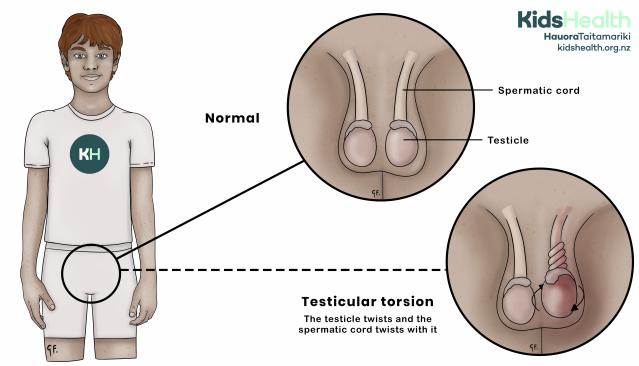
This illustration shows testicular torsion, where a testicle twists and the spermatic cord twists with it, compared with normal testicles.
Source: KidsHealth
transcribeTranscript
The illustration shows a teenage boy. A circle highlights the scrotum, with 2 enlarged diagrams comparing normal testicles and testicular torsion.
- The top diagram is labelled Normal. It shows 2 testicles, each connected to an untwisted spermatic cord. The spermatic cord and testicle are labelled.
- The bottom diagram is labelled Testicular torsion. It shows one testicle twisted around inside the scrotum. The spermatic cord above it is also twisted. The affected testicle is red, and curved arrows show how it has rotated.
- Text beside the bottom diagram reads: Testicular torsion. The testicle twists and the spermatic cord twists with it.
At the top right is the KidsHealth logo with the website: kidshealth.org.nz.
Causes of testicular torsion
Some tamariki have a testicle that moves more freely inside the scrotum. This makes it easier for the testicle to twist. Usually, there is no clear reason why it twists at a particular time.
Testicular torsion can happen during sleep, after exercise or after an injury. It can also happen while a child rests.
Symptoms of testicular torsion
Symptoms often start suddenly. Your child may have:
- pain in one testicle or one side of the scrotum
- swelling or redness of the scrotum
- a testicle that sits higher than usual or lies sideways
- lower tummy pain
- nausea or vomiting
- trouble walking or sitting comfortably
Young pēpi (babies) may not have obvious pain. A swollen or dark-coloured scrotum in a baby needs urgent medical assessment.
Sometimes the testicle twists and then untwists by itself. The pain may ease or disappear, but it can twist again. Take your child to an emergency department even if the pain has gone away, so a health professional can check whether the testicle is still twisted.
Diagnosing testicular torsion
The health professional will ask about your child’s symptoms. They will examine your child's tummy, groin and scrotum. The examination may feel embarrassing for an older child, but it helps the health professional work out what is wrong.
If the health professional suspects testicular torsion, they will arrange an urgent review by a surgeon. Your child may need an operation straight away. Sometimes, the healthcare team may arrange an ultrasound scan to help work out what is causing the symptoms.
Managing testicular torsion
Testicular torsion usually needs urgent surgery. The surgeon will untwist the testicle to restore its blood flow. Your child will have a general anaesthetic, so they will be asleep and not feel anything during the operation.
The surgeon will stitch the testicle in place to lower the chance of it twisting again. They will usually stitch the other testicle in place too, to prevent it from twisting.
Sometimes, the surgeon cannot save the affected testicle. This can happen if the testicle has lost its blood supply for too long. If this happens, and the testicle cannot recover , the surgeon will remove it. The healthcare team will explain what they found and what it means for your child.
Recovery from testicular torsion
Your child may have some pain, bruising and swelling after surgery. These can take a week or two to settle. After surgery, the healthcare team will explain how to:
- care for the wound
- manage any pain your child has
- help your child return to school and sport
Follow the advice your child’s healthcare team gives you. They will also arrange any follow-up appointments your child needs.
Long-term outlook after testicular torsion
If your child has treatment quickly, the surgeon may be able to save the testicle. The chance of saving it drops the longer it has been twisted. So get help straight away if you suspect torsion.
If one testicle needs to be removed, the other can usually make all the hormones your child needs. Most people with one testicle can still have tamariki. Talk to your child’s healthcare team if you or your child have any concerns.
Acknowledgements
Illustrations by Dr Greta File. Property of KidsHealth.
