

What is an MCU?
A micturating cysto-urethrogram (MCU) is an x-ray test of the bladder as it fills and empties. It checks to see if the urine is flowing backwards from the bladder up towards the kidneys.
The test will take place in the radiology department of your hospital, or at another radiology centre.
Why a child may need an MCU
Your baby or child may have an MCU to find out if they have urinary reflux. Urinary reflux is the abnormal flow of urine back up the ureters towards the kidneys.

This illustration shows normal urine flow compared with grade 1 urinary reflux, where urine refluxes partway back up the ureter.
Source: KidsHealth
transcribeTranscript
The illustration shows a young child with a simplified diagram of the kidneys, ureters, bladder, and urethra drawn on the body.
A circle highlights the urinary tract, with dashed lines pointing to 2 enlarged diagrams:
The top diagram is labelled Normal and shows urine flowing in the correct direction — from the kidneys down the ureters into the bladder. Labels read:
- Normal flow of urine
- Urine inside the bladder
The bottom diagram is labelled Grade 1 urinary reflux. An arrow shows urine moving partway back up one of the ureters from the bladder. A label reads: Urine refluxes part way up the ureter.
At the top right is the KidsHealth logo with the website: kidshealth.org.nz.
If your child is a boy, they may also have an MCU to check for an obstruction of the urethra.
How the urinary tract works
The urinary tract includes the kidneys, ureters, bladder, and urethra.
The kidneys filter and remove waste and water from the blood to produce urine. The urine travels from the kidneys down 2 narrow tubes called the ureters. The urine is then stored in the bladder.
When your child does a wee, urine flows out of the body through the urethra, a tube at the bottom of the bladder. The opening of the urethra is at the end of the penis in boys and in front of the vagina in girls.

An illustration showing the front and side view of the female urinary tract.
Source: KidsHealth
transcribeTranscript
The illustration shows the front view and side view of the female urinary tract.
The illustration's main label is: Female urinary tract
The left side of the illustration has the label: Front view
- Inside her body, there are 2 kidneys.
- Thin tubes called ureters run from each kidney down to the bladder.
- A short tube called the urethra leads from the bladder to the outside.
The right side of the picture has the label: Side view
- In this side view, inside her body, you can see 1 kidney.
- The ureter goes down from the kidney to the bladder.
- The urethra goes from the bladder to outside the body.
Labels point to these parts on both views:
- Kidney
- Ureter
- Bladder
- Urethra
At the bottom left is the KidsHealth logo with the website: kidshealth.org.nz.
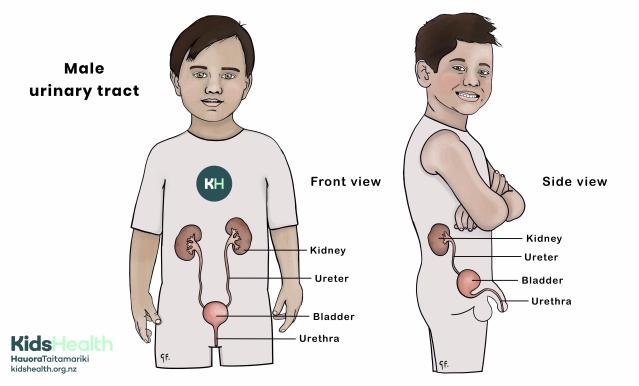
An illustration showing the front and side view of the male urinary tract.
Source: KidsHealth
transcribeTranscript
The illustration shows the front view and side view of the male urinary tract.
The illustration's main label is: Male urinary tract
The left side of the illustration has the label: Front view
- Inside the young boy's body, there are 2 kidneys.
- Thin tubes called ureters run from each kidney down to the bladder.
- A short tube called the urethra leads from the bladder to the outside.
The right side of the picture has the label: Side view
- In this side view, inside his body, you can see 1 kidney.
- The ureter goes down from the kidney to the bladder.
- The urethra goes from the bladder, through the penis, to outside the body.
Labels point to these parts on both views:
- Kidney
- Ureter
- Bladder
- Urethra
At the bottom left is the KidsHealth logo with the website: kidshealth.org.nz.
Preparing for an MCU
Some radiology departments may recommend antibiotics around the time of the test to prevent urinary infection. You will get instructions about this from your radiology department, or from the health professional who referred your child for the test.
Your radiology centre might give medicine to make your child sleepy before the MCU. If healthcare staff do offer this medicine to your child, they will give you instructions about when your child needs to stop eating and drinking before the test.
What happens during an MCU
Your child empties their bladder (if toilet-trained) and lies on an x-ray table. Your child may lie in a cradle so they can be gently restrained for their safety and to make the test quicker.
A health professional will clean the area around the opening of the urethra (the tube where urine passes out of the bladder) with a mild antiseptic. Then they insert a catheter (a soft thin plastic tube) up through the urethra and into the bladder.
A bag of contrast (dye) is connected to the catheter and the bladder is slowly filled while x-rays are taken. Pēpi (babies) and tamariki (children) who are not toilet-trained will wee around the catheter when their bladder is full. Older tamariki may find it harder and require gentle encouragement to wee on the table.
The doctor, or x-ray technologist, will take x-ray pictures while your child is weeing, and after the catheter is removed. The solution is washed off at the end of the procedure.
Is an MCU uncomfortable?
Putting a catheter in can be uncomfortable, more so for boys because of their longer urethra. The health professional will use a lubricating anaesthetic gel to make it more comfortable. The x-rays are not painful. Tamariki may find having a full bladder can be uncomfortable, but this goes away when they empty their bladder.
Preparing your child for an MCU
Many medical procedures or tests can be frightening for tamariki. To help your child feel more comfortable or reassured, you can try the following.
Bring comforters or any toys that will reassure your child
A dummy (pacifier) for pēpi (if they normally suck on one) can be very soothing.
It is also helpful to bring something that will catch your child's interest and help them to focus on something else during the procedure. This could be a book that has an element of surprise or requires your child's concentration such as:
- a 'pop up' book
- a 'Where's Wally?' book
- an 'I spy' book
See some other suggestions for helping your child manage their treatment or procedure.
Helping Your Child Manage Their Treatment
Play specialists can help
Many hospitals have play specialists. Their job is to help explain these tests to your child. Play specialists use play to show your child what is going to happen and ways to help them cope.
Watching a video can help
If your child is old enough, ask if your hospital's x-ray or children's department has a video explaining MCUs. It may help your child to watch this. Your local branch of Kidney Kids may also be able to help with this.
You can stay with your child
You will be able to stay with your child for the test. Your presence can help reassure your child.
Pregnant mothers cannot stay during the test, and in this case, a whānau (family) member who is familiar to your child can be there.
After effects from an MCU
There are usually minimal side effects from this test. Some tamariki may feel a mild burning while weeing for a short time afterwards (1 to 2 days). There may occasionally be a small amount of blood in the nappy. Encourage your child to drink plenty of fluids and this will pass quickly.
In rare cases, tamariki can have difficulty emptying their bladder. If your child has this problem, get them to wee while sitting in a warm bath.
Very rarely, your child may develop a urinary tract infection (UTI) after an MCU. Signs of a UTI in tamariki include:
- fever
- loss of appetite
- smelly urine
- being unwell without an obvious cause
To learn more about signs and symptoms of a UTI and what to do, see the page on urinary tract infections.
Urinary Tract Infection In Children
Results of an MCU
The x-ray doctor (radiologist) will examine and interpret the x-ray films and send a written report to your health professional. This usually takes several days. Sometimes the radiologist will be able to discuss the results with you at the time of the examination.
Acknowledgements
Urinary tract anatomy illustrations and urinary reflux illustration by Dr Greta File. Property of KidsHealth.
