

Key points about antibiotics for children
- antibiotics treat some infections caused by bacteria
- antibiotics do not work for viruses, such as most colds and flu
- give your child the antibiotic exactly as it says on the label
- give the full course of antibiotics, even if your child starts to feel better
- do not give your child antibiotics prescribed for someone else
- see a health professional if your child has side effects or you are worried
What are antibiotics?
Antibiotics are medicines that kill bacteria or stop bacteria from growing. Most of the time, your child’s immune system can protect them from harmful bacteria. Sometimes, antibiotics are needed to treat an infection that is unlikely to get better by itself.
Antibiotics do not work against viruses. This means they do not help with most colds, flu, coughs or runny noses.
Why it’s important to use antibiotics carefully
It is important to give antibiotics exactly as prescribed. This helps make sure the antibiotic works for your child’s infection.
Using antibiotics when they are not needed, or not taking them properly, can make antibiotics less effective. This is called antibiotic resistance. It means antibiotics may not work as well in the future when your child, or someone else, really needs them.
What to tell your health professional before your child takes antibiotics
Tell your health professional if your child has had any reactions to medicines before. This helps them choose the safest antibiotic for your child.
How to give antibiotics to your child
Follow all the instructions on the medicine label. The label will tell you:
- how much antibiotic to give
- whether to give it with or without food
- how often to give it
- how long to give it for
Give your child the full course of antibiotics, even if they start to feel better. This means giving the antibiotics for the number of days your health professional has prescribed.
Antibiotics are only for the child they are prescribed for. Do not give your child’s antibiotics to another child or adult.
Measuring the dose
Use a plastic measuring syringe to give liquid antibiotics to your child. This helps you give the exact amount written on the label.
Make sure the syringe has markings that show how much medicine to give. Wash the syringe straight after using it.
Medicine measuring spoons and cups do not measure the small amounts of liquid antibiotics tamariki (children) are often prescribed.
Do not use a kitchen spoon or regular cup. These do not measure medicine accurately.
Positioning your child
Give the antibiotic while your child is sitting up or supported upright. Do not give medicine while your child is lying down.
Giving liquid antibiotics with a medicine measuring syringe
Place the syringe tip just past your child’s teeth or gums.
Slowly push down the syringe plunger. Aim the medicine towards the inside of your child’s cheek.
Do not squirt medicine at the back of your child’s throat. This can make them cough or choke.
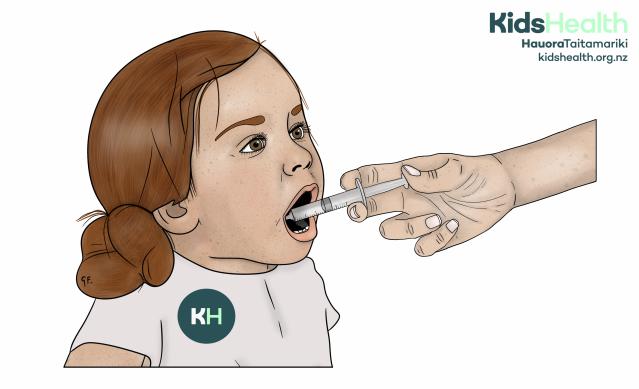
An illustration showing how to give liquid antibiotics by aiming the oral syringe towards the inside of your child's cheek.
Source: KidsHealth
What can help if your child doesn’t like the taste of the antibiotic liquid
If your child doesn't like the taste of the antibiotic liquid, you could try:
- giving your child a drink or food straight after the antibiotic - check with your pharmacist if the antibiotic has to be taken with food or on an empty stomach
- letting your child suck on a small ice block or ice cube first to help numb their taste buds
- using role play, such as pretending to give medicine to a favourite teddy first
- explaining to older tamariki why they need the antibiotic
Keep calm, positive and firm. Do not force the medicine into your child’s mouth. If needed, take a break and try again in half an hour.
If your child is still refusing to take the prescribed antibiotics, speak to your health professional or pharmacist about other options. There may be an antibiotic with a different taste or a capsule or tablet form for older tamariki.
Giving antibiotics to babies
Give the dose before feeding your baby, if possible. Some pēpi (babies) may refuse medicine if they are not hungry.
Do not mix the antibiotic into your baby’s bottle. If your baby does not finish the bottle, they may not get the full dose.
Sometimes it may be OK to mix antibiotics with a small amount of milk or fluid. Ask your pharmacist first.
What to do if your child misses a dose
If your child misses a dose, give it as soon as you remember. But if it is nearly time for the next dose, skip the missed dose. Give the next dose at the usual time.
Do not give 2 doses at the same time.
What to do if you accidentally give an extra dose
If you accidentally give an extra dose, try not to worry. Your child may be more likely to have common side effects, such as feeling sick, diarrhoea or a sore tummy.
See a health professional or call Healthline free on 0800 611 116 if you are worried.
What to do if your child spills or vomits the antibiotic
If a small amount is spilled, do not give extra antibiotic.
If your child vomits straight after the dose, you can try giving the full dose again later.
Ask your pharmacist or doctor if you are not sure what to do.
How to store antibiotics safely
Follow the storage instructions on the label. Some liquid antibiotics need to be kept in the fridge. Make sure they do not freeze.
If the antibiotic does not need to be kept in the fridge, keep it away from sunlight and heat.
Always keep antibiotics where tamariki cannot see or reach them. Make sure the lid is on properly. Some liquid antibiotics have flavouring added, which may make them appealing to tamariki.
Call the National Poisons Centre on 0800 764 766 if you are worried your child may have swallowed too much antibiotic.
Possible side effects from antibiotics
Most of the time, antibiotics do not cause noticeable side effects. If they do, side effects are usually mild.
Common side effects include:
- feeling sick (nausea)
- runny, watery poo (diarrhoea)
- mild tummy pain
When to get medical help
When to see a health professional
See a health professional if your child has:
- a rash, especially if it is spreading
- thrush, such as a white or yellow coating on the tongue
When to see a health professional urgently
See a health professional urgently if your child has:
- runny, watery poo (diarrhoea) that won’t settle
- blood in the poo
- severe tummy pain
When to call 111
Call 111 and ask for urgent medical help if your child:
- has swelling of the lips, tongue, face or throat
- is wheezing or struggling to breathe
- is floppy
- is blue around the mouth
- is unresponsive
- has a rash that is hot, itchy or blistering
- has signs of a severe allergic reaction
More information

The New Zealand Formulary for Children has a leaflet with general advice about giving antibiotics to children.
Download the PDF (PDF, 315KB) from the New Zealand Formulary for Children website
