

Key points about appendicitis
- the appendix is a small finger-like tube attached to the first part of the large intestine
- appendicitis is inflammation of the appendix
- appendicitis is a potentially serious condition
- tamariki (children) with appendicitis, especially those under 5 years old, can become unwell quickly
- see a health professional promptly if you think your child has appendicitis
What is appendicitis?
Appendicitis is when the appendix becomes inflamed and swollen. The appendix is a small finger-like tube. It is attached to the first part of the large intestine (called the caecum). It is normally in the lower right side of the abdomen.
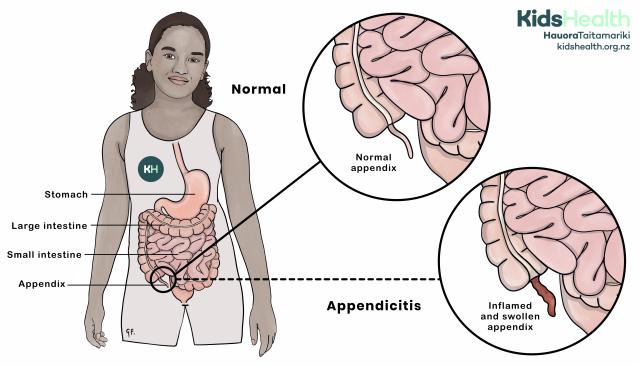
This illustration shows appendicitis, where the appendix becomes inflamed and swollen compared with a normal appendix.
Source: KidsHealth
transcribeTranscript
The illustration shows a teenage girl with an overlay of the digestive system on her body. The stomach, large intestine, small intestine, and appendix are labelled. A small inset circle highlights the appendix, with two enlarged diagrams comparing normal and appendicitis.
- The top circle is labelled Normal. It shows a healthy appendix extending from the large intestine. The label reads: Normal appendix.
- The bottom circle is labelled Appendicitis. It shows the appendix as red, inflamed, and swollen. The label reads: Inflamed and swollen appendix.
- At the bottom right, text reads: Appendicitis.
At the top right is the KidsHealth logo with the website: kidshealth.org.nz
Causes of appendicitis
The appendix may become inflamed because of a blockage within it. The blockage causes the appendix to swell, and it can easily become infected by bacteria. Often, the cause is not clear.
Anyone can get appendicitis, but it occurs most often between the ages of 10 and 30.
Signs and symptoms of appendicitis
Symptoms vary between tamariki.
Tummy pain often starts around the belly button (navel). It may move to the lower right side of the tummy (abdomen) and become sharper and more severe. The pain often gets worse when your child moves, coughs or walks.
Your child may also have:
- fever
- loss of appetite
- nausea (feeling sick)
- vomiting
- constipation
- runny poo (diarrhoea)
Diagnosing appendicitis
A health professional can often diagnose appendicitis by asking about your child’s symptoms and examining them.
Appendicitis can be difficult to diagnose, especially in younger tamariki. A health professional may need to examine your child more than once as their symptoms develop.
Some tamariki may need tests. These may include:
- an ultrasound scan
- blood tests
- a urine sample (to rule out a urinary tract infection)
See the section on x-rays and scans to learn more about different scans.
When to get medical help for your child
Appendicitis can be a serious condition.
If you think your child may have appendicitis and are taking them to hospital, do not give them any food. Ask the healthcare team whether they can have clear fluids.
You may give your child paracetamol to help reduce the pain. Follow the dosage instructions on the bottle. It is dangerous to give more than the recommended dose.
Possible complications of appendicitis
Sometimes, an inflamed appendix develops a hole and leaks infected contents into the abdomen. This is called a perforated or burst appendix. It can cause a serious infection of the lining of the abdomen called peritonitis. Your child will need emergency hospital treatment. This may include antibiotics through an intravenous (IV) line and surgery.
Signs of a perforated appendix may include:
- severe and constant tummy pain that gets worse or spreads across the tummy
- not wanting to move because movement makes the pain worse
Treatment for appendicitis
Usually, a surgeon removes the appendix in an operation called an appendicectomy.
Sometimes, surgery may be delayed while your child is treated with antibiotics.
Surgeons can perform an appendicectomy in 2 ways - as an open appendicectomy or a laparoscopic appendicectomy.
Open appendicectomy
A surgeon makes a single cut (incision) over where the appendix is. The inflamed appendix is removed through this cut.
Laparoscopic appendicectomy ('keyhole' surgery)
A surgeon will make 3 small 'keyhole' cuts over the lower abdomen. Then, they insert special instruments through these cuts to remove the appendix.
When a laparoscopic appendicectomy becomes an open appendicectomy
Sometimes, a laparoscopic appendicectomy may need to become an open appendicectomy. This happens if the surgeon cannot safely remove the appendix any other way.
Your child will have the surgery under a general anaesthetic (GA). This means they will be completely asleep.
See the page on anaesthetic to learn more about what a GA involves.
Discussing the operation with the surgical team
Your child's surgical team will discuss the operation with you. They will tell you which technique they will use. You can ask them any questions you have then.
When the surgeon finds something else during the appendicectomy
Occasionally, a surgeon will find another cause for the pain during the appendicectomy. If this happens, the surgeon may be able to deal with it during the same operation.
When your child needs IV antibiotics
All tamariki having an appendicectomy receive at least 1 dose of antibiotics around the time of surgery.
In some situations, the healthcare team may give your child antibiotics through an intravenous (IV) line and delay surgery. This is more likely if your child has:
- had symptoms for several days
- advanced or complex appendicitis
Before the operation
Before the operation:
- the healthcare team will tell you when your child needs to stop eating and drinking
- your child will have an intravenous (IV) line put into their hand or arm
- your child will receive antibiotics around the time of surgery
- the surgeon will explain the operation and any other treatment your child may need
- the anaesthetist will talk with you about your child’s general anaesthetic
- you will need to sign a consent form
You can ask the surgeon and anaesthetist any questions you have.
In some cases, your child may need a nasogastric tube. This is a tube that passes through the nose into the stomach. Your child is more likely to need one if they have had symptoms for several days or have vomited a lot.
After the operation
After the operation:
- the healthcare team will monitor your child closely as they recover
- nurses will give your child pain relief
- older tamariki may use a pump to control their own pain relief, called patient-controlled analgesia (PCA)
- your child may need IV antibiotics for several days if their appendix burst or they have peritonitis
How long your child stays in hospital will depend on:
- how unwell they are
- whether their appendix was perforated.
Tamariki with a perforated appendix or peritonitis usually need to stay in hospital longer.
See the section on pain to learn more about different types of pain relief.
Possible complications from the operation
All surgery has some potential risks. Infection is one of the most common complications following appendicectomy. Some tamariki with a perforated appendix develop an abscess, which is a collection of pus inside the tummy.
Your child may need antibiotics or a procedure to drain the abscess. Doctors may use an ultrasound or another type of scan to guide a narrow tube into the abscess.
Acknowledgements
Illustration by Dr Greta File. Property of KidsHealth.
