

Key points about peripherally inserted central catheters (PICCs)
- a peripherally inserted central catheter (PICC) is a soft, flexible tube that goes into a large vein near the heart
- health professionals use it to give medicines and fluids and to take blood samples during treatment
What is a PICC?
A PICC is a type of central venous access device (CVAD). It's a soft, flexible tube. The tube can also be called a 'line'. It usually goes into a vein in your child’s arm. It's gently guided through the vein until it sits in a large vein close to the right side of the heart. Part of the tube stays outside the body on your child's arm.
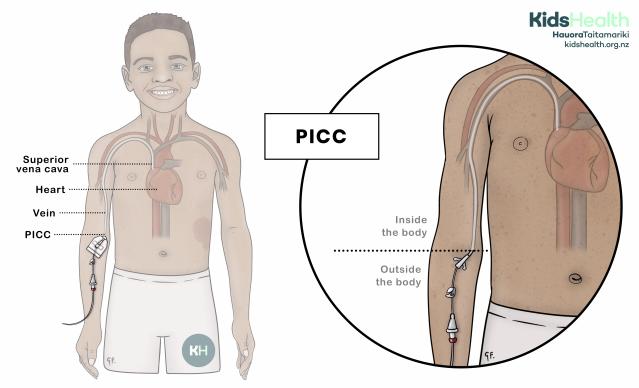
An illustration showing a peripherally inserted central catheter (PICC) and where it sits inside and outside the body.
Source: KidsHealth
transcribeTranscript
The illustration shows a child with a peripherally inserted central catheter (PICC) in their upper arm.
The PICC is shown passing through a vein in the arm. The tip of the PICC sits in the superior vena cava near the heart.
A magnified view on the right shows the PICC travelling from the arm vein to the superior vena cava. It also shows the part of the catheter inside the body and the part outside the body.
The following anatomy labels appear on the illustration and are connected to the relevant part with a dotted line:
- Superior vena cava
- Heart
- Vein
- PICC
The title 'PICC' appears in the centre of the illustration.
At the top right is the KidsHealth logo with the website: kidshealth.org.nz.
Some tubes have 1 end. Others have 2 or more ends. The ends are called 'lumens'.
A PICC allows easy access to the bloodstream to give medicines and fluids and to take blood samples during treatment.
You can also read the overview page about central venous access devices (CVADs).
Why your child might need a PICC
A PICC is useful if your child needs weeks of IV (intravenous) treatment. It can stay in for months if working well.
Putting in the PICC
Putting in a PICC is a minor procedure. Your child will need to stay very still. Pēpi (babies) and young tamariki (children) usually need a general anaesthetic. Older tamariki can have the procedure while they're awake.
A health professional will gently guide the tube into place. They'll use an x-ray to check it's position.
The end of the PICC will be outside your child's body. Your healthcare team will cover this with a see-through dressing.
Caring for your child with their PICC
Changing dressings
A transparent, waterproof dressing always covers the skin where the tube comes out, and the first few inches of the outside tube. Your healthcare team will change this dressing each week or sooner if it becomes unstuck or dirty. They check the area and give it a good clean with antiseptic solution to prevent infection. They might also use barrier solutions to prevent skin irritation.
Your healthcare team may cover the dressing with a tubular bandage to protect the dressing and the exit site.
Your healthcare team may also show you how to change your child's dressing and care for your child's PICC.
Flushing the line
At least once a week, your healthcare team will also check the PICC line to make sure it's working well. They'll flush the lumen with sterile saline and a solution to prevent the tube from getting blocked.
Preventing pulling or tugging
Avoid pulling or tugging the PICC. Take care when dressing your child.
Sports and swimming
Avoid swimming. Talk to your child's healthcare team about the sports your child can safely do with the PICC in place.
Showers and baths
Keep the PICC dry and out of the water when bathing or showering.
Don’t soak the dressing in water as it may become unstuck. If it gets too damp and stays damp, it can cause infection and skin irritation.
Managing water under the dressing
If you know how to do it, change the dressing straight away. Otherwise, tell your child's healthcare team or phone the ward at your local hospital if you are at home.
Checking the device and dressing each day
- redness
- oozing
- the dressing coming off
- the tube coming out
- water under the dressing
Taking your child's temperature
What to do if there is a problem with the PICC tube
If the tube is pulled out
- immediately apply pressure to the exit site
- contact your healthcare team immediately
If the tube breaks
- clamp the tube between the break and your child’s body using the clamp from your safety pack
- if you cannot clamp it, fold the tube over and and tape the fold together to work as the clamp
- contact your healthcare team straight away
If the dressing starts to lift or come off
- cover it with a dressing from the safety pack
- contact your healthcare team for a dressing change
- the safety pack should include sterile gauze, a clamp, a dressing and any extra supplies your child needs
Removing a PICC
Your healthcare team will take out the PICC at the end of treatment or when your child no longer needs it. Taking out a PICC is usually a simple procedure. A member of your child's healthcare team can do it on your child's ward.
Your child will have a dressing for 1 to 2 days until the skin has healed.
Acknowledgements
The content on this page has been adapted from the leaflet 'Your child's PICC', Starship Child Health.
All the pages in the childhood cancer section of this website have been written by health professionals who work in the field of paediatric oncology. They have been reviewed by the members of the National Child Cancer Network (NZ). Medical information is authorised by the clinical leader of the National Child Cancer Network.
