

Key points about subcutaneous ports
- a portacath (port) is a small device that sits completely under the skin
- health professionals use it to give medicines and fluids and to take blood samples during treatment
What is a port?
A port is a type of central venous access device (CVAD). It's sometimes called a portacath.
The device sits completely under the skin.
It has 2 parts:
- A small round chamber under the skin. The centre of the port is made of a soft, self-sealing material so a special needle can safely go through it many times. The chamber sits within a solid case made of either titanium or plastic.
- A thin tube. The tube is gently guided from the chamber to a vein in the neck until it reaches the right side of the heart. There is no tubing outside the body.
A port allows easy access to the bloodstream to give medicines and fluids and to take blood samples during treatment.
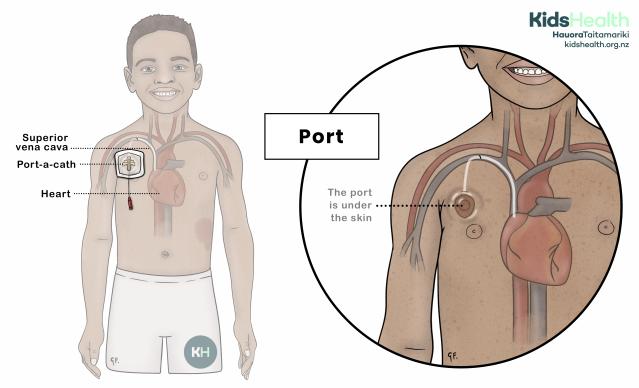
An illustration showing a port under the skin and where the catheter sits inside the body.
Source: KidsHealth
transcribeTranscript
The illustration shows a child with an implanted port (Port-a-cath) under the skin of the upper chest.
The port sits completely under the skin and is connected to a catheter that travels through a vein. The tip of the catheter sits near the heart.
A magnified back view on the right shows the port underneath the skin and the catheter entering a vein.
The following anatomy labels appear on the illustration and are connected to the relevant part with a dotted line:
- Superior vena cava
- Port-a-cath
- Heart
The title 'Port' appears in the centre of the illustration.
At the top right is the KidsHealth logo with the website: kidshealth.org.nz.
You can also read the overview page about central venous access devices (CVADs).
Why your child might need a port
A port is useful if your child needs long-term IV (intravenous) treatment. It can stay in for months to years if working well.
Putting in the port
Your child will have the procedure under a general anaesthetic in the operating theatre. Your child will be asleep and will feel nothing while the procedure is taking place.
The health professional will make 2 small cuts - one on the upper or side chest where the port sits, and one on the neck. Sometimes, the health professional may put the port in another area.
Once the health professional has put in the port, they will use an x-ray to check the device is in the right place.
After the procedure
The area where the port has been implanted may feel uncomfortable. This will get better after some time. Your child's healthcare team can give your child some pain relief if needed.
The healthcare team can use the port immediately if they need to.
They will check for any swelling, bleeding, redness, oozing and pain.
Accessing the port
The healthcare team use a special needle to access the port through the skin.
- the needle goes into the soft centre of the port
- the needle will be held in place with a see-through dressing
- it can stay in place for treatment, then be removed
The healthcare team may put numbing cream on your child's skin before accessing the port.
When the port is not in use, you can't see anything on the outside.
Activities while your child has a port
Your healthcare team will let you know when your child can go back to doing normal activities like school or day care.
When the port is not in use, your child can usually bathe and swim.
When a needle is in place, the area must stay dry.
Avoid contact sports.
Talk to your child's healthcare team and ask them any questions you may have.
Caring for your child's port
When the port is in use, the healthcare team will:
- change the port needle and dressing every 7 days
- replace the dressing if it becomes wet, dirty or loose
When the port it not in use the healthcare team will:
- flush the tube with sterile saline and a solution to prevent it from getting blocked
- remove the needle
- access the port once a month to check it's working well - they'll then flush the tube and remove the needle
Possible complications
When the port is in use, the port needle may sometimes come out. If this happens, your healthcare team will need to put it back in.
Sometimes blood clots in the port can cause a blockage. Your healthcare team can fix this using an anti-clotting medicine. They may need to remove the port if it remains blocked.
Monitor your child’s temperature and check the port site for signs of swelling, redness or pain. This can be a sign of infection.
Taking your child's temperature
Removing a port
A port can stay in for months to years. Your child's healthcare team will take it out at the end of treatment, or when your child no longer needs it. Your healthcare team will remove it in the operating theatre under a general anaesthetic.
Acknowledgements
The content on this page has been adapted from the leaflet 'Your child's port', Starship Child Health.
All the pages in the childhood cancer section of this website have been written by health professionals who work in the field of paediatric oncology. They have been reviewed by the members of the National Child Cancer Network (NZ). Medical information is authorised by the clinical leader of the National Child Cancer Network.
