
About communicating and connecting in babies, toddlers and pre-schoolers
Communication starts before birth
Communication starts before birth. Your baby may startle and kick when you hear a loud noise while pregnant. Or, they may calm when you listen to soft music or talk lovingly to them.
After pēpi (babies) are born, communication becomes more obvious. Early communication begins with brief eye contact, body movements, facial grimacing, and crying. Your newborn baby can recognise your voice and will stop moving and look at you briefly.
A video about early communication after birth.
A short clip taken from the video 'Look at you - aroha atu, aroha mai'.
Source: Te Whatu Ora - Counties Manukau
transcribeTranscript
Narrator
When a baby arrives into the world, they are ready to connect with you.
From birth, babies are able to give you cues to how they're feeling.
Quietly watching and looking at your pēpē will help you understand those cues.
Baby is looking at mom and mom is looking at her.
This is called mutual gaze.
Coraleigh is working hard and takes tiny rests by blinking and briefly looking away.
Children develop more interaction over time
With time, your child will develop more interaction - sounds, babble, first words, pointing, gestures, follow instructions, say a few words, have back-and-forth interactions and conversation, and tell you stories. They will learn the social use of language such as what to do and say when you meet someone new, and how to make friends.
Tamariki (children) develop the different stages in their communication as they get older. Some go through these stages quickly and some will take longer. Some take a different path.

Source: Carol Green

Source: Carol Green
Video clips of early interactions
A video showing babbling in a 6 week old baby.
A short clip taken from the video 'Look at you - aroha atu, aroha mai'.
Source: Te Whatu Ora - Counties Manukau
transcribeTranscript
Narrator
Fed and comfy, Rehutai is ready for more conversation.
[Mum and baby sounds in background].
Mum pokes her tongue out and notices Rehutai trying to copy.
[Mum and baby sounds in background].
She repeats the movement and gives him time to try it himself.
[Mum and baby sounds in background].
He is looking and concentrating very hard.
[Mum and baby sounds in background].
Then finally success.
Dad has full convo with his baby.
Source: @JordanProductionsTV
transcribeTranscript
[Dad] We need to work on that right?
[Baby] Babbling sounds
[Dad] Yes OK
[Baby] Babbling sounds
[Dad] Did you understand it though?
[Baby] Babbling sounds (sounding like no).
[Dad] No OK. All right. Chuckles.
[Baby] Babbling sounds
[Dad] Huh?
[Baby] Babbling sounds
[Dad] No not this one. This one's ...
[Baby] Babbling sounds
[Dad] Yeah that's the last one
[Baby] Babbling sounds
[Dad] That's what I was wondering. I don't know what they're gonna do next season. Cos they did some stuff this time.
[Baby] Babbling sounds
[Dad] Exactly what I was thinking
[Baby] Babbling sounds
[Dad] Oh yeah, yeah, yeah
[Baby] Babbling sounds
[Dad] Right, don't bring that in. You know what I'm saying? Don't do the same stuff. You know what I'm saying?
[Baby] Babbling sounds
[Dad] Yeah
[Baby] Babbling sounds
[Dad] Yeah. Like go somewhere else with that. But don't bring that in. You know what I'm saying? Yeah.
[Baby] Babbling sounds
[Dad] That's what I'm saying ... [makes sounds with gestures]. You know what I'm saying? And I was like what in the world? Don't do it here. You know what I'm saying? Yeah.
[Baby] Babbling sounds
[Dad] Yeah. Yeah.
[Baby] Babbling sounds
[Dad] Really? I thought the same thing.
[Baby] Babbling sounds
[Dad] Laughs. We think a lot alike huh.
[Baby] Babbling sounds
[Dad] Laughs. That's crazy.
[Baby] Babbling sounds
[Dad] Right.
How you can support your child
When you talk to your baby during everyday events like bathing or feeding, you're helping them learn the sounds, words, and rules of language and connection.
Talk and sing to your child when you're pregnant, after they are born, and keep doing it as they get older.
Encourage communication by sharing your child's interests with words and sounds. Then, give time for your child to respond. Their response might be:
- a newborn baby making mouth movements
- a 4 month old baby making sounds and bubbles with their mouths ('blowing raspberries')
- a 6 month old baby copying your mouth movements saying “da”
Talk about what your baby is seeing or doing. For example:
Can you hear the dog barking? He is saying hello.
Building blocks of communication
Remember, communication is not just about the words your child speaks. It is everything they do to communicate and connect with you and others.
Most tamariki develop communication skills following a typical pattern. This starts with attention, listening, social interaction and play skills. Once they have these base skills, they can learn more complex aspects of communication.
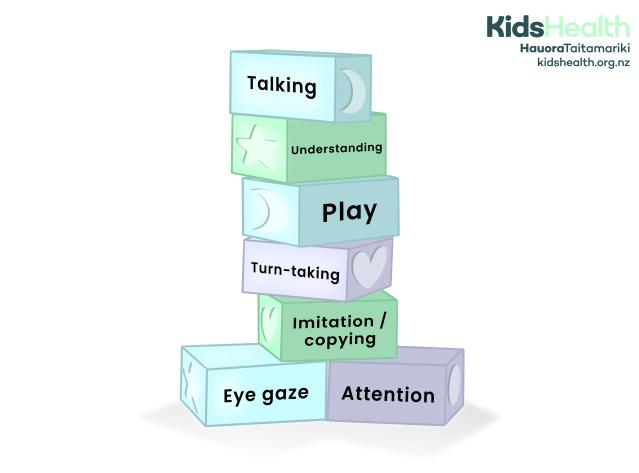
The building blocks for communication. Each block has a label (from the bottom of the pile to the top): 'Eye gaze', 'Attention', 'Imitation/copying', Turn-taking', 'Play', 'Understanding' and 'Talking'.
Source: KidsHealth
transcribeTranscript
This illustration shows the building blocks for communication. The building blocks are in a pile and each block has a label.
- The 2 blocks on the bottom of the pile are labelled 'Eye gaze' and 'Attention'.
- The next block up the pile is labelled 'Imitation/copying'.
- The next block up the pile is labelled 'Turn-taking'.
- The next block up the pile is labelled 'Play'.
- The next block up the pile is labelled 'Understanding'.
- The block at the top of the pile is labelled 'Talking'.
At the top right is the KidsHealth logo with the website: kidshealth.org.nz.
Use simple and effective strategies matched to your child's interests and learning style. This helps them develop communication and social skills. Games, singing, reading, and play all help build back-and-forth interactions.
Being out together around the house or your community lets you point out what you are seeing. Encourage your child to do the same.
Here are 3 simple effective strategies that help build communication.
Serve and Return
This is a common phrase used for building 2-way interactions and creating back and forth communication.
A child ‘serves’ by showing an interest in something. You ‘return’ by letting your child know you have heard and understood what they have shared with you.
- Share the focus. Share your child’s interest. The key is paying attention to what your child is looking at.
- Support and encourage. You can respond to a child’s ‘serve’ by saying nice and helpful words. Even a smile or a nod can encourage your child.
- Name it. When you return your child’s ‘serve’ and talk about what they see, feel and do, you help make important language connections in their brain.
- Take turns, back and forth. Taking turns helps children learn to listen, share, and how to get along with others. Waiting is important. When you return the ‘serve’, give your child a chance to answer.
- Practise endings and beginnings. Tamariki show when they’re done, or ready to move on to a new activity. It may be as simple as a blink in a newborn baby, a sound as your child glances away, or your child moving to a new activity. Sharing the focus is important in this step so they can learn how to shift from one interest to another.
Repeat - Model - Expand
- Repeat. Repeat key words and phrases as you feed in language. Tamariki learn words and concepts by hearing them many times in different and meaningful situations.
For example: "Up. Do you want me to pick you Up? Up, Yay, you are now Up."
Then later: "Let's lift Up your top so I can tickle your tummy. Up and tickle."
- Model. Model the correct language for your child and repeat your child’s incorrect attempts in the correct form.
Child: "John falled down."
Adult: "Yes, John fell down."
Child: "Two duck."
Adult: "Yes, two ducks."
- Expand. Expand by adding new information to what your child has already said.
Child: "David cry."
Adult: "David’s crying. He hurt his finger. Ouch!"
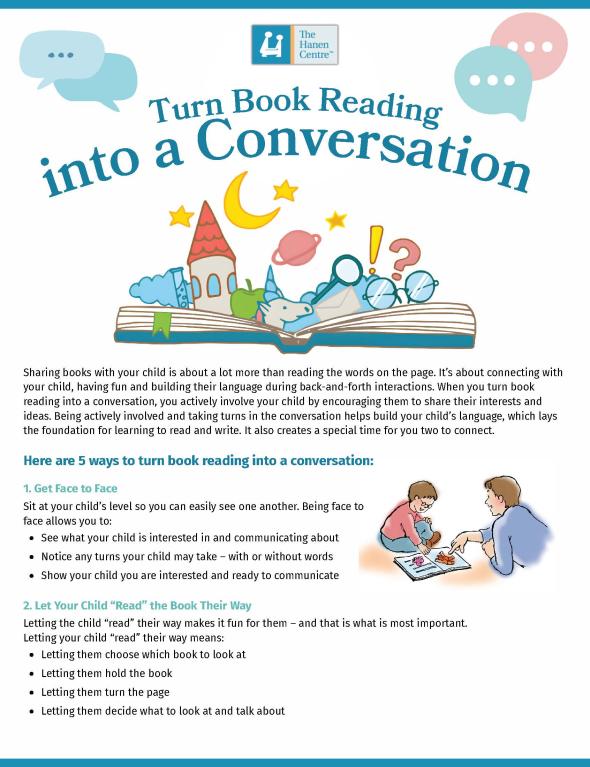
5 Ways To Turn Book Reading Into A Conversation
When you turn book reading into a conversation, you actively involve your child by encouraging them to share their interests and ideas. This helps build your child’s language, which lays the foundation for learning to read and write. It also creates a special time for you two to connect.
Here are 5 ways to turn book reading into a conversation:
- Get face to face.
- Let your child 'read' the book their way.
- Observe, wait and listen on each page.
- Then, follow your child's lead.
- Change the words in the book.
Find out more.
Source: The Hanen Centre
Watch a video showing the 5 steps of 'serve and return'.
Source: Moana Connect
transcribeTranscript
[Music]
Did you know that you can help build a child's brain?
Every day, communicating with your child helps a child’s growing brain.
You do this daily even before babies talk.
This is called serve and return, back and forth, like a game of ping pong or volleyball.
A child serves by showing an interest in something, and the adult answers in a supportive way.
Finding moments throughout the day to do it, is easy and fun, and you'll be building strong brains. You’re probably doing a lot of this already, without realising.
There are 5 steps to 'serve and return'.
The first one is to share your child’s interest.
When a child is interested, you can see it.
Watch this child look at something in a book. Right there. Pointing shows interest.
The key is paying attention to what the child is looking at.
By paying attention and seeing what your child is interested in, you can learn and teach your child, and feel closer to them.
Step 2 - support and encourage.
You can respond to a child's serve by saying nice and helpful words.
Even a kind smile can encourage a child.
You can also pick up the object the child points to and bring it closer.
Helping and playing with a child lets them know you understand them.
Step 3 - name it.
When you return a child’s serve and talk about what they see, feel, and do, you help make important language connections in their brain. This can be in your native language tongue.
This brain building happens even before a child can talk or understand your words.
You can name anything - a person, a thing, an action, a feeling.
When you name what a child is interested in, you help your child understand what is around them. They can learn to understand the world, and what to expect.
Naming also gives a child words to use later, and shows that words are important to you.
Step 4 - take turns back and forth.
Taking turns helps children learn to listen, share and how to get along with others.
Waiting is important. When you return a serve, give the child a chance to answer.
By waiting, you give the child time to think of ideas and build confidence in themselves and their skills.
Step 5 - practise endings and beginnings.
Children show when they're done or ready to move on to a new activity.
Sharing the focus is important in this step.
When you can find these moments for a child to take the lead, you support your child in learning about their world, and make more serve and returns.
Serve and return is important for a child's developing brain, and the best news is that you can do it anytime, anywhere, without any need for toys or technology.
Look for small chances throughout the day, like while you are cooking or shopping. Try to remember these 5 steps. Notice the serve, and share the child's focus of attention. Return the serve by supporting and encouraging. Name it, take turns going back and forth, and practise endings and beginnings.
Back and forth exchanges make everyday moments fun. If it is not already, it soon will become normal as you practise.
Remember, your baby is communicating with you, right from birth. By noticing and responding as often as you can, you are really helping their development.
Watch a video showing the 5 steps of 'serve and return'.
Source: Moana Connect (created by Moana Research, adapted with permission by the Center on the Developing Child at Harvard University and in collaboration with Brainwave Trust Aotearoa).
transcribeTranscript
Iloa nakai e koe, maeke ia koe ke lagomatai ke he talaagaaga he uhoniu he tama haau?
Ko e fakafetuiaga haau mo e tama he tau aho oti to fai lagomataiaga ke he talagaaga he haana uno niu. Taute tumau pihia e koe ke he tau aho oti a to maeke he tama ke tutala.
Ko e puhala nei kua fakahigoa ai “gahua mo e fetaliaki”, fakatai ia ke he pele ping pong poke volipolo. Fakakite he tama haana gahua ke he mena kua fiafia a ia ki ai, ti tali atu e tau tagata lalahi ke he tau puhala fakaohooho.
Kumi taha magaaho he aho ke taute e tau mena nei, mukamuka ti fiafia, mo e kua lagomatai a koe ke talaga e tau uho niu kua malolo. Liga kua fita ni he taute e koe e tau mena nei ka e nakai iloa poke mailoga. Maeke ia koe ke fakaaoga lima e faka-papahiaga ke fakagahua aki e “gahua mo e fetaliaki” mo e tama haau. Faka-papahiaga taha-fakailoa mo e tufatufa e tau mena kua fiafia e tama haau ki ai.
Ka fiafia e tama ti kitia mo e mailoga e koe.
Kitekite mo e onoono ke he tama, kaeke kua fai mena a ia ne kitia ki loto he pepa totou. Ha na tonu, ka tuhi e tama ki ai, ko e fakakiteaga haia he haana fiafia.
Ko e fakaakoaga uho - onoono fakamakutu atu ke he mena ne fae onoono e tama ki ai.
Onoono fakamakutu atu to kitia e koe e fakagahuahuaaga he “gahua”, ti maeke ia koe ke iloa mo e fakaako e tama haau. To logona e koe e mafanatia ke he haau a tama.
Faka-papahiaga ke uaaki, lagomatai mo e fakaohooho
Fakatautonu e tau gahua he tama haau ke he tau puhala vagahau kua mitaki ti fakaaoga e tau kupu kua fai fakaohoohoaga.
Mamali faka-mitaki ko e taha fakaohoohoaga ia ke he tama.
Maeke foki ia koe ke lagaki e mena ne tuhi e tama haau ki ai ti taatu ki a ia.
Ka lagomatai ti fefeua mo e tama ko e taha puhala ia ke iloa he tama kua maama e koe a ia.
Faka-papahiaga ke toluaki- fakailoa
Kaeke ke tali atu a koe ke he tau gahua he tama mo e tutala ke he tau mena ne kitia e ia, logona, mo e taute, lagomatai atu foki ke he tau kupu vagahau ke moua e matutakiaga mo e uho niu. Fakaaoga ti vagahau e vagahau he motu.
Ko e talaagaga he uho niu ko e mena kamata to maeke he tama ke vagahau, poke maama haau a tau kupu.
Maeke ia koe ke talahau e tau kupu ke he ha mena he tau mena, ko e tagata, tau mena taute mo e tau kupu ke lata mo e manatuaga mai he loto.
Kaeke ke talahau e koe e mana ne kua fiafia e tama haau ki ai, kua lagomatai e koe haau a tama ke maama e tau mena kua takatakai viko ki ai a lautolu. Maeke ia lautolu ke fakaako mo e maama e lalolagi, mo e tau mena kua lata ke taute.
Fakaaogaaga e tau kupu ke fakamailoga aki e tau mena ke maeke he tama ke liu fakaaoga foki ke he tau aho i mua, mo e ke iloa he tama kua mahuiga e tau kupu nei ki a koe.
Fakapapahiaga ke faaki-fetaliaki e taha ke he taha, ti liu futiaki foki
Tau fetaliaki ko e puhala mitaki ke lagomatai aki e tau fanau ke fanogonogo, fetufatufaaki mo e gahua auloa.
Ke fakatali ko e mena mahuiga. Kaeke ke tali poke taui atu e koe e gahua he tama, foaki falu a magaaho ke he tama ke tali atu a koe.
Kaeke ke fakatali a koe, kua foaki e koe ke he tama e tau magaaho ke manamanatu ke he tau puhala ke fakamalolo aki a lautolu mo e ha lautolu a tau mena taute.
Faka-papahiaga ke limaaki-taute e fakaotiaga mo e kamataaga
To fakakite atu he tau fanau kaeke kua mau a lautolu ke fakatolomaki atu ke he taha gahua foou.
Mahuiga ke tufatufa mo e fakakite e mena ke gahua mo e foli ki ai
Kaeke kua moua e koe e tau magaaho ke maeke he tama haau ke takitaki ….
Lagomatai e koe e tama haau ke fakaako ke he tau mena ke lata mo e lalolagi haana.
Taute fakaloga e tau “gahua mo e fetaliaki”
Lahi e mahuiga ke gahua fetaliaki ke lata mo e fakatolomakiaga he uho niu he tama, ko e mena ne mitaki lahi ai foki ha kua maeke ia koe ke taute he ha magaaho he tau magaaho, mo e ko fe ni e mena ke taute ki ai, maeke agaia ke taute kaeke kua nakai fai fakatino, tau koloa poke tau lakau hila.
Kumi e tau magaaho he aho, tuga e tau magaaho kaitunu poke oatu ke he tau fale koloa.Lali ke manatu e tau faka-papahiga nei ne lima. Mailoga e gahua, tufatufa mo e fakailoa e mena he tama ne manako ki ai. Tali poke fetaliaki ke he tau gahua he tama ke lagomatai mo e fakaohooho aki e tama. Fetaliaki ti liu futiaki ti fakagahua e fakaotiaga mo e kamataaga.
Gahua mo e fetaliaki, fakaaoga e tau magaaho he tau aho oti mo e fiafia. Kaeke kua nakai la taute, ti taute a, to aga mo e mahani ka taute tumau. Lali ke taute mo e tama haau, kamata a he aho nei.
Manatu, ko e tau fakafetuiaga a nei he tama haau mo koe, kamata mai he magaaho ne fanau ai. Ka mailoga mo e tutala tumau a koe ke he tama haau kua lagomatai lahi a koe ke he fakatolomakiaga he haana moui.
Watch a video showing the 5 steps of 'serve and return'.
Source: Moana Connect (created by Moana Research, adapted with permission by the Center on the Developing Child at Harvard University and in collaboration with Brainwave Trust Aotearoa).
Watch a video showing the 5 steps of 'serve and return'.
Source: Moana Connect (created by Moana Research, adapted with permission by the Center on the Developing Child at Harvard University and in collaboration with Brainwave Trust Aotearoa).
transcribeTranscript
‘Oku ke ‘ilo koa ‘oku ke malava ke tokoni’i e tupu fakalakalaka ‘a e ‘atamai ‘o e pepee`?
Ko ho’o fetu’utaki faka’aho mo ho’o pepee` ‘oku ne faka’ai’ai e tupu fakalakalaka hono ‘atamai. ‘Oku ke fakahoko faka’aho eni kimu’a pea toki lea ‘a e pepee`.
‘Oku ui eni ko e Teka mo e Tali, hange ko e va’inga pingi pongo pe volipolo`. ‘Oku ‘uluaki teka mai e pepee` ‘aki ‘ene mata fakatokanga pea tali atu leva ‘e he tokotaha tauhi e teka ko eni, ‘i he founga fietokoni mo fai poupoua.
Ko ho’o fakafaingamalie ho taimi he ‘aho` ke fai eni he founga faingofua mo fakakata`, ‘oku ke tokoni’i ai e tupu malohi honau ‘atamai. Mahalo ‘oku ke lolotonga fakahoko pe eni neongo ‘oku ‘ikai te ke fakatokanga’i. Te ke malava ke fakahoko ‘a e Teka mo e Tali he sitepu ‘e 5 ko eni.
Sitepu 1 – Mo fe’inasi’aki he me’a ‘oku tokanga ki ai ho’o pepee`.
‘Oku lava ke ke tala ‘a e me’a ‘oku mata fakatokanga ki ai ‘a e pepee`.
Fakatokanga’i ‘ene sio ki ha tohi`. Ko e taimi eni ke te tuhu ki he tohi ‘o faka’ilonga’i ‘ete tokanga ki he me’a ‘oku fakatokanga’i ‘e he pepee`.
Ko e kii mahu’inga taha heni` ke mo fe’inasi’aki he tokanga tatau ki he me’a ‘oku fakatokanga’i ‘e pepee`.
Ko e tokanga makehe ki he ngaahi teka mei he pepee` ‘a e founga ako mo e fakahinohino lelei. ‘Oku ke toe ongo’i vaofi ange ai mo ho’o pepee`.
Sitepu 2 – Poupou mo fakalotolahi
Te ke lava ‘o tali mai e teka ‘a pepee` ‘aki e ngaahi lea lelei mo fakalotolahi.
Na’a mo e malimali ‘ofa, ko e poupou lelei.
‘Oku lava foki ke te to’o hake e me’a ‘oku tuhu ki ai e pepee` pea ‘omi ke ofi mai.
Ko e tokoni mo e va’inga mo e pepee`, ‘oku ne fakamahino ‘oku ke mahino’i kinautolu.
Sitepu 3 – Fakahingoa
‘I he taimi ho’o tali e teka ‘a pepee`, mo talanoa ki he me’a ‘oku nau fai, sio, mo ala ki ai, ‘oku ke hanga ‘o fakafehokotaki e mahu’inga ‘o e lea` ‘i he ‘uto`. ‘Oku lava ke ke ngaue’aki heni ho’o lea fakafonua.
Ko e tupu fakalakalaka ko eni ‘o e ‘atamai` ‘oku kamata ia kimu’a pea toki lea pe mahino’i ‘e pepee` ho’o lea`.
Hanga ‘o fakahingoa ha taha, ha ngaue, ha fa’ahinga ongo, pe ha fa’ahinga me’a pe.
Ko e taimi ‘oku ke fakahingoa ai e me’a ‘oku fakatokanga ki ai ‘a pepee`, ko ho’o tokoni’i ia ho’o pepee` ke ne mahino’i hono ‘atakai`. Ko e poupou eni ke nau mahino’i honau mamani mo ‘ene fakafeangai ki ai`.
‘Oku tokoni foki e sitepu fakahingoa` ki ho’o faka’ilo lea ke ngaue’aki ‘e he pepee` ‘amui ange, kae’uma’a e mahu’inga ‘o e lea`.
Sitepu 4 – Fetongitongi he Teka mo e Tali
Ko e fetongitongi he teka mo e tali ‘oku ne tokoni’I e pepee` ke fanongo, vahevahe, mo ako ke alāanga mo e kakai kehe.
‘Oku mahu’inga e tatali. Ka hili leva ho’o tali mai ‘ene teka` pea tuku ha faingamalie ki he pepee` ke fai ‘ene tali`.
Ko ho’o tatali`, ‘oku ne ‘oange e faingamalie ki he pepee` ke ne fakakaukau mo ma’u e loto hangamalie ‘iate ia mo hono poto`.
Sitepu 5 – Toutou Faka’osi mo e Kamata
‘Oku lava ‘e he fanau` ke nau faka’ilonga mai kuo nau lava pea kuo nau fie hoko atu ki ha me’a ‘e taha. ‘
Oku mahu’inga e tokanga ki he fe’inasi’aki ko eni.
‘I he taimi ‘oku te faka’ataa ai e pepee` ke ne tataki kita, ‘oku ke fakalotoa ho’o pepee` ke ako ki hono mamani`.
Pea mo toe ‘aliaki ha ngaahi teka mo e tali.
‘Oku mahu’inga ‘a e fengaue’aki ‘a e Teka mo e Tali ki he tupu fakalakalaka e ‘atamai ‘o e pepee`, pea ko e ongoongo lelei taha`, he ‘oku malava ke ke fai eni ‘i ha taimi pe, i ha feitu’u pe, ‘ikai fiema’u ki ai ha naunau va’inga pe tekinolosia.
Puke e faingamalie kotoa pe lolotonga e ‘aho`, hange ko e lolotonga ‘ete kuki pe ‘I falekoloa. Feinga ke manatu’i e sitepu ‘e 5. Fakatokanga’i e teka ‘a pepee` mo ‘ene mata fakatokanga`. Tali mai e teka` ‘aki ho’o poupou mo e fakalotolahi. Fakahingoa pea fetongitongi he teka mo e tali`, kae’uma’a e toutou faka’osi mo e kamata.
Toutou teka mo tali, pea ‘ai ke fakakata mo malie. Kapau ‘oku te’eki ai, ‘e vave pe ke hoko eni ko e founga angamaheni kia koe. ‘Ahi’ahi e founga ni mo ho’o pepee` he ‘aho ni.
Manatu’i ‘oku lolotonga fakafetu’utaki atu ho’o pepee` kia koe talu pe mei he ‘aho na’e fa’ele’i ai`. ‘Oku ke tokoni’i ‘ene tupu fakalakalaka` ‘aki ho’o fakatokanga’i mo tali mai ‘ene toutou teka atu`.
Watch a video about the 5 steps of 'serve and return' in your preferred language.
Learning multiple languages
Most of the world speaks more than one language - this is normal and good for brain development. Pēpi and tamariki benefit from being exposed to all languages used within their families. They do well when they spend lots of time talking and interacting with their parents, whānau and others. Tamariki will gradually increase the language they understand and use across all the languages they are exposed to.
Exposure to multiple languages does NOT cause language problems. If you speak multiple languages at home and you are worried about your child's development, check: Is their difficulty with the second language only, or is it across all languages including your home language? Talk to your Well Child nurse or GP to explore more.
Resources to help you support your child's communication
Check the Raising Children, Australia website for lots of information about connecting and communicating by age group.
Newborns
Babies
Toddlers
Preschoolers
Find out about how to develop good communication with babies and children (to 12 years)
Speech, language and social communication
You can break communication down into 3 main groups of skills.
Speech - how we say words. It includes:
- the way we pronounce the sounds in words
- speaking clearly, in a way that makes speech meaningful and interesting
- speaking fluently, without hesitating too much or repeating sounds or words
Language - the words we use and understand to communicate with each other. It includes:
- expressive language – the ability to use words, signs or symbols and combine them together to express ideas
- receptive language – the ability to understand the meanings of the words and sentences others use
Social communication - the way we use and understand communication in social situations. It relates to how we interact with others in everyday situations for social reasons.
It includes:
- sharing something of interest
- asking about something (or asking for help)
- responding to something someone says
- back-and-forth interactions in a conversation
- using and understanding facial expressions and body language
- knowing how we communicate or behave in different social situations such as at home, at church, at a birthday party, in a playgound
- understanding others' feelings or perspectives
Milestones

Source: Carol Green

Source: Carol Green
Skills like learning to crawl, walk, wave, or talk are called developmental milestones. These are the ages most tamariki achieve a skill. Each child is different with some developing skills earlier and some later.
Keep in mind that if your baby was born early (before 37 weeks of pregnancy), they may reach developmental milestones later than other pēpi.
Examples of milestones
Pēpi usually start smiling back at you from 6 weeks of age. Most pēpi turn when you call their name at about 6 to 9 months of age.
Tamariki typically begin to say single words around 12 months. Some start as early as 10 months, while others may take until 15 months to say their first recognisable word. This is usually "dada" or "mama" (depending on their home language). This is all within the normal variation of child development. By 18 months, most tamariki can say at least 10 to 50 words.
Children reach milestones at different times
All tamariki reach developmental milestones at different times. At each stage they develop more ways of interacting and connecting, understanding what is said to them, and using eye contact, gestures, sounds, and then words to share their feelings and thoughts back with you.
Developmental Milestones: Newborns To 5 Years
Communication development
Typical communication development
Typical communication development is when your child has attention, social interaction, communication, and understanding skills that are within the average range of developmental milestones.
Find out about the typical development of communication skills in pre-school tamariki. Each page has tips to help your child's communication development
Communication Development: By 1 Year
Communication Development: By 18 Months
Communication Development: By 2 Years
Communication Development: By 3 Years
Communication Development: By 4 Years
Communication Development: By 5 Years
Children who might need extra or different help
Your child may be on a different path of development. They may need support with speech, language or social communication skills.
Speech disorders
Tamariki learn to say different sounds at different times. They start with sounds that are easy to make with their lips together such as m, b, d. They develop sounds that need more complex mouth movements such as th, l, r, later. Early, middle and later speech sounds help us think about the order that tamariki learn to say speech sounds. They develop from the time a child starts using words until the early years at school.
Children's speech generally gets easier to understand as they get older. Here's a guide:
- by 2 years of age, tamariki can be understood by familiar adults most of the time
- by 3 years of age, tamariki can be understood by unfamiliar adults most of the time
- by 4 years of age, tamariki can be understood by unfamiliar adults almost all of the time
- by 5 years of age, tamariki can be understood by unfamiliar adults all of the time
Some tamariki get stuck on different sounds and repeat them. This is called stuttering.
Show your child you are interested in what they say, not how they say it.
Language delay
Your child may be following the normal pattern of language development but is taking longer to develop communication skills. This most often happens with expressive language delay - how and what your child says, when other developmental skills are on track. Your child will understand what you say and follow instructions. They will use eye contact and gestures to get the message across. They communicate and interact with you but they don't yet have the words or language to say what they want or feel.
Your child may be taking longer to develop skills in several areas of development - understanding, talking, motor skills, problem-solving etc. Tamariki may seem to be younger than their actual age. This is sometimes called global developmental delay.
Your child may be taking longer to talk but have great eye contact and gestures. This may be due to hearing loss. It’s important for all tamariki with communication delay or differences to have a hearing check.
Differences in social communication development
Some tamariki follow a different path in their social communication development. This is often referred to as 'differences in communication'. Tamariki may seem to have little interest in communicating with you, or only interact when they want something. They may not have yet developed the base skills need to build communication - attention, eye gaze, and listening.
There can be a range of differences.
Some tamariki may talk in sentences with familiar people and situations but often about their own interests, with little back and forth interaction. They may not understand the social rules of when and how to communicate.
Some tamariki may use specific gestures, sounds or words to ask for things in very motivating situations, like requesting favourite foods or toys.
Some tamariki may interact with you when they want something. For example, they may pull your hand to the fridge if they want a drink, but without looking at you to connect via eye contact. They may not consistently respond when you call their name and appear to have selective hearing.
Some tamariki may appear very independent and happy in their own world with no obvious interest in other people or in interacting with other people. They may look briefly if a child cries or comes into their space, but are otherwise happy to play on their own. Others may be interested but are not sure how to connect with others.
Differences in social communication development often occurs with language delay. Caregivers most often recognise a delay in talking, or their child may start to say a few words and then stop using them. There may be other features when you look more closely at other aspects of communication:
- differences in their listening, and what your child does, and doesn't, pay attention to
- differences in when, how, and why your child communicates
- differences in when, how, and why your child interacts with other tamariki and people
- differences in play and behaviour
Your child may find it hard to shift their focus from something they are doing to something else. Or they might get upset when things are different to what they expect. It may be ‘their way or no way’.
They may experience things differently. They may be very sensitive to sound or different textures, but seek out other sensations. For example, tamariki who love and seek movement may enjoy running up and down your hallway for a long time, or enjoy spinning round and round. They may explore toys in a different way: spin wheels on a car; explore how the object works; line things up; or group objects by colour.
These may be signs of social, communication, play and behaviour differences you can see in tamariki who are on the autism spectrum.
Learn more about autism spectrum.
The timing of when a baby learns to communicate is often inherited from their parents. If you or your partner talked late, or had differences in your communication style, your baby might be the same. Your child may still be eligible to get support, so don’t wait. Check the milestones. You know your child well as you spend the most time with them. If you are worried about something, seek medical advice from your Well Child nurse or other health professional.
When to seek help
If you think your child is not reaching the typical milestones, or is developing differently, talk to your Well Child nurse or other health professional. Your child may benefit from a hearing test, learning support from the Ministry of Education, and possibly a check by a paediatrician or nurse practitioner. You know your child best.
You are with your child the most, so keep up the rich language and use the strategies above - 'Serve and Return' (back and forth) and 'Repeat, Model and Expand'.
Seek help if you are worried or your baby:
- isn’t using gestures, sounds, babble or words to communicate by 12 months, especially when they need help or want something
- doesn't consistently respond to their name
- doesn't often look at you when they want something, or when you talk to them
- has no single words by 16 months
- has no 2-word phrases by 24 months
- loses any language or social skills at any age
- or your child is not able to do the key skills for their age shown in the red flags identification guide below
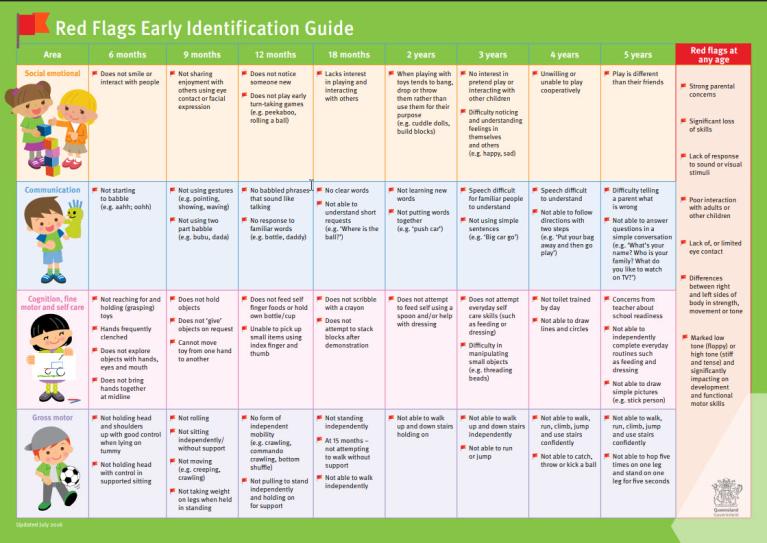
Source: Children's Health Queensland
Services that can support you and your child
Ministry of Education
If your child's communication development is affecting their behaviour, learning, friendships or your home life, the Ministry of Education may be able to help. You can self-refer your child to the Ministry of Education, Learning Support. Call the Ministry of Education on 0800 622 222 to talk about your concerns and see if they can help.
If your child goes to an early childhood centre, talk to your child's early childhood teacher or kaiako. They will help you understand how your child is communicating, following routines, and playing with other tamariki when away from their familiar home environment. They, too, can refer your child for learning support with your consent.

To ask for support for your child, contact your local Ministry of Education office. Call free on 0800 622 222 and follow the voice prompts or visit their website for more information.
Explore

Explore’s team of speech and language therapists have developed this course for parents, whānau, and caregivers. It will help you consider the link between communication and your child’s behaviour. It will give you suggestions and practical strategies to support your child’s communication in daily life.
Incredible Years Programmes
If your child's communication development is affecting their behaviour, learning, friendships or your home life, you may find the Incredible Years Parent Programme helpful. It provides you with specific skills to build on your relationship and connection with your child (aged 3 to 8). These skills encourage your child's play, language, learning and social and emotional development. The Ministry of Education and other contracted providers run this programme for parents and caregivers.
You can contact your local Citizens' Advice Bureau to find a provider near you. Or, try searching their online community directory.

You can search the community directory at the Citizens' Advice Bureau website for an Incredible Years provider near you.
Paediatrics
Your GP can refer your child to a paediatrician or nurse practitioner if your child has delayed development across several areas, or has developmental differences and possible autism spectrum. Child development teams may see some tamariki with complex developmental needs.
Your GP can help you navigate which service is best for you and your child.
More information
Find out more about 'Serve and Return'.
The following resource is designed for interacting with tamariki aged between 11 months and 30 months. It gives simple and clear strategies for communicating with your child - talking, showing, playing, singing, reading.