

Key points about epilepsy in children
- an epileptic seizure happens when your child's brain has abnormal electrical activity
- epileptic seizures can include unusual movements, behaviour or funny feelings
- although seizures can be frightening and awful to watch, most stop on their own
- when tamariki have more than one epileptic seizure, this may result in a diagnosis of epilepsy
What is epilepsy?
Epilepsy is the name of a group of disorders. Tamariki with epilepsy have epileptic seizures.
Epilepsy is quite common. It affects 1 in every 200 tamariki.
Anti-seizure medicines are usually very effective in controlling seizures.
What are epileptic seizures?
Our brains think and control our bodies using electrical messages. An epileptic seizure happens when there is abnormal electrical activity in your child's brain. This can cause unusual movements, behaviour or funny feelings. Normal brain function cannot continue until this abnormal electrical activity stops.
Different types of seizures
Some seizures can be quite subtle. For example, a seizure may involve only blank staring for a few seconds. Seizures can also sometimes be quite bizarre and tamariki can have quite inappropriate behaviour or feel very scared. Other seizures have obvious movement changes where one part or the whole body can go stiff and/or jerk quite violently.
Focal seizures
Sometimes the abnormal electrical activity starts only in certain areas of the brain, which is why only certain body parts may twitch or shake. These types of seizures are called focal seizures.
Generalised seizures
When the start of the abnormal electrical activity involves the whole brain these seizures are called generalised seizures.
Read more about the types of epileptic seizures.
Types Of Epileptic Seizures In Children
Will my child get any warning before a seizure?
Some older tamariki may experience an unusual feeling called an 'aura' which is the start of a focal epileptic seizure. This feeling may be a funny smell, a headache, a taste in their mouth or a stomach pain. If they have an 'aura' at the beginning of their seizures they may have time to tell you how they feel. Or, they may be able to lie on the floor so they are less likely to injure themselves.
Seizures can be frightening but remember they will stop
It may seem like the epileptic seizure goes on forever but most epileptic seizures last less than 5 minutes. Although they can be very frightening and awful to watch, epileptic seizures that last less than 5 minutes do not cause any damage to the brain.
Epileptic seizure triggers
Things that can increase the chance of an epileptic seizure include:
- tiredness
- illness
- fever
- stress
- excitement
Flashing lights or deep breathing that can trigger an epileptic seizure in some types of epilepsy. These are not triggers for all tamariki with epilepsy.
Can my child's seizure type change?
Even though your child experiences their own particular kind of seizure, seizure types can change from time to time. So it is important that you know what to do if a major seizure should ever happen.
Causes of epilepsy
There are many different causes of epilepsy.
Genetic causes
For most tamariki, the cause of their epilepsy is genetic.
Genes are the body's instruction manual. They help control how the brain develops and works. Sometimes, changes in genes can make a child more likely to have epilepsy. These changes are called genetic variants.
A single genetic variant: For some tamarki, a variant in a single gene causes epilepsy. This is called a monogenetic cause.
A combination of genetic variants: Most tamariki have a combination of variants in many genes. Individually, these genetic variants don’t cause seizures. But together, they make it more likely that a child will have epilepsy. This is called a polygenic cause.
A genetic cause does not always mean that epilepsy occurs in other members of your whānau.
Genetic changes that are inherited: Some tamariki inherit the genetic changes from their parents.
Genetic changes that happen for the first time in a child: Sometimes, the genetic changes are not present in either parent. They are not inherited. They appear for the first time in a child. This is called a de novo change.
Finding a genetic cause may help doctors better understand your child's epilepsy. For some tamariki, it can help:
- guide treatment
- provide information about what to expect in the future
- show whether other members of the whānau may also be at risk
Genetic testing
Most tamariki who have epilepsy caused by genetic changes, don’t need a gene test. This is because they have changes in many genes. Knowing these exact gene changes doesn’t inform what will happen in the future or what treatment to use.
Genetic testing is helpful for some tamariki with more severe epilepsy. These tamariki are more likely to have a single genetic change. Knowing the gene involved can help manage the epilepsy. It can also provide information on the long-term outcome.
Brain injury or brain abnormalities
Epilepsy can also happen if:
- the brain has not developed normally during pregnancy
- there has been an injury to the brain
Examples of injuries to the brain that may cause epilepsy include:
- a severe head injury
- a stroke
- a brain infection such as meningitis or encephalitis
- an infection during pregnancy that affects a baby's developing brain
- reduced oxygen to the brain around the time of birth
Other causes
Less commonly, epilepsy may be associated with:
- metabolic conditions
- immune disorders
- other medical conditions that affect how the brain works
When to get medical help for your child with epilepsy
Check advice about what to do when your child has a seizure.
Tests and investigations after an epileptic seizure
If your doctor thinks your child has had an epileptic seizure, they will contact the paediatric (children’s health) department at your local hospital. The hospital doctor who sees your child may arrange some tests.
EEG (electroencephalogram)
If your child has had an epileptic seizure they may need an EEG. An EEG is a recording of their brain's electrical activity. Your child can have an EEG as an outpatient. They don't need to stay in hospital.
MRI (magnetic resonance imaging)
Your child may also need an MRI scan to look at the structure of the brain. Whether your child needs an MRI will depend on the type of seizure they have and the results of the EEG.
Will my child need to take medicine for epilepsy?
Most tamariki need anti-seizure medicine if they’ve had 2 seizures. This is to help prevent further seizures. The specialists will talk about the options with you.
There are many different kinds of anti-seizure medicines for tamariki with seizures. Each one works differently to prevent seizures.
Will my child need rescue medicine for epileptic seizures?
If your child has had an epileptic seizure that lasted for more than 5 minutes, your doctor may prescribe medicine to stop a long seizure. This is called emergency epileptic seizure medicine or seizure rescue medicine and comes in 2 forms.
Midazolam
You can give midazolam either in between the teeth and cheek (buccal) or in the nose (intranasal)
Midazolam - Emergency Epileptic Seizure Medicine
Diazepam (Stesolid)
You can give diazepam to your child in their bottom (rectal).
Diazepam (Rectal) For Stopping Seizures
Call an ambulance after giving seizure rescue medicine
After you have given the medicine, call an ambulance unless otherwise instructed by your doctor.
While you are waiting for the ambulance, continue to lie your child on their side in the recovery position and stay with them.
The below illustration shows a child in the recovery position.
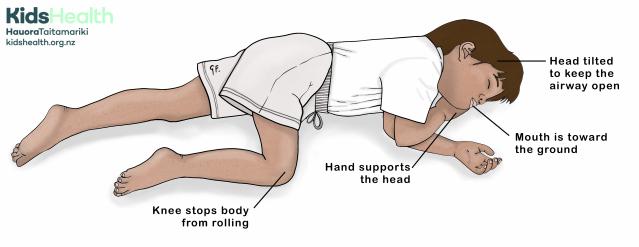
An illustration showing a child in the recovery position.
Source: KidsHealth
transcribeTranscript
The illustration shows a child with short brown hair, wearing a white T-shirt and shorts, lying on their side in the recovery position.
- The head is tilted to keep the airway open.
- The mouth is turned toward the ground.
- One hand is positioned under the head for support.
- The top knee is bent forward to stop the body from rolling.
At the top left is the KidsHealth logo with the website: kidshealth.org.nz
You may need to teach other people who care for your child how to use this medicine. This might include your child's teacher.
See the KidsHealth page on emergency epileptic seizure medicine to learn more.
Emergency Epileptic Seizure Medicine
What is status epilepticus?
Status epilepticus is the name for seizures that go on for a long time:
- 5 minutes or more for convulsive seizures
- 10 to 15 minutes or more for non-convulsive seizures
Very long seizures can be bad for the brain. It is unclear exactly how long a seizure needs to be to cause damage. It is likely to be 60 minutes or more for convulsive seizures and longer than that for non-convulsive seizures.
Call an ambulance if your child's epileptic seizure lasts for more than 5 minutes. Your child can receive further treatment in hospital.
If your doctor has prescribed rescue medicine use it as instructed by your doctor. This will usually be for any seizure that lasts for more than 5 minutes.
After you have given the medicine, call an ambulance. While you are waiting for the ambulance, continue to lie your child on their side in the recovery position and stay with them.
Most tamariki will not experience 'status'. It is not clear why some tamariki get status epilepticus. It depends on the type of epileptic seizure, how well medicine controls their seizures and the reason for their epilepsy.
Can my child die from epilepsy?
Sudden unexplained death in epilepsy (SUDEP) is a very rare but sad event. In any 1 year, it affects 1 in 4,500 tamariki with epilepsy. In other words, every year, 4,499 of 4,500 tamariki will not die from epilepsy. The best way to prevent SUDEP is to stop convulsive seizures and this is one of the reasons your doctor may recommend anti-seizure medicine for your child.
Safety for children with epilepsy
Your child's healthcare team will give you advice about increasing safety for your child with epilepsy. The advice will depend on the type and frequency of your child's seizures.
Safety For Children With Epilepsy
More information on epilepsy

Epilepsy New Zealand has educators who can answer any questions you may have and can act as a support person for you. You can contact your local educator at 0800 37 45 37
Acknowledgements
The content on this page has been developed and approved by the Paediatric Neurology Clinical Network, Paediatric Society New Zealand.
