

Key points about inguinal hernia in babies and children
- an inguinal hernia happens when tissue from inside the tummy pushes through an opening in the tummy muscles
- an inguinal hernia often shows up as a lump in the groin
- the lump may look bigger when your child cries, coughs or strains
- an inguinal hernia does not go away on its own - most tamariki (children) need an operation to repair it
- go to the nearest emergency department straight away if the lump stays out, becomes painful or changes colour
What is an inguinal hernia
An inguinal hernia forms when part of the bowel or other tissue pushes through an opening in the tummy muscles and into the groin. This can cause a lump or bulge under the skin.
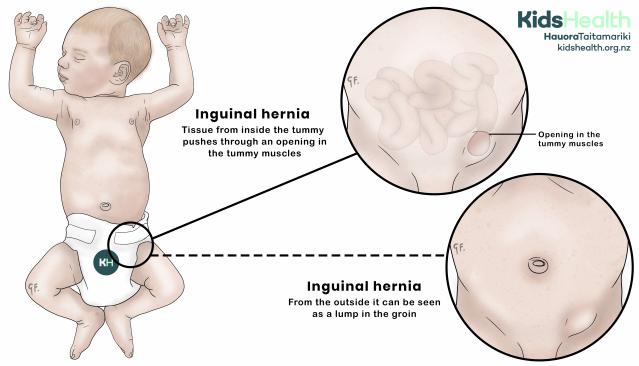
This illustration shows how tissue from inside the tummy pushes through an opening in the tummy muscles to form an inguinal hernia. From the outside, it can look like a lump in the groin.
Source: KidsHealth
transcribeTranscript
The illustration shows a baby lying on their back. A circle highlights the groin, with 2 enlarged diagrams showing an inguinal hernia from inside and outside the body.
- The top diagram shows tissue from inside the tummy pushing through an opening in the tummy muscles and into the groin. The opening is labelled Opening in the tummy muscles.
- Text beside the top diagram reads: Inguinal hernia. Tissue from inside the tummy pushes through an opening in the tummy muscles.
- The bottom diagram shows the outside of the baby’s tummy and groin. A lump is visible on one side of the groin.
- Text beside the bottom diagram reads: Inguinal hernia. From the outside it can be seen as a lump in the groin.
At the top right is the KidsHealth logo with the website: kidshealth.org.nz.
In boys, it may extend into the scrotum, the pouch of skin that holds the testicles. In girls, it may extend into the labia, the folds of skin around the vaginal opening.
Causes of an inguinal hernia
Before birth, pēpi (babies) have a small passage or tunnel between the tummy and the groin. This passage usually closes by itself. If it stays open, tissue from inside the tummy can move through it and form a hernia.
The opening is there from birth, but you may not notice the lump until later. Crying or straining can make a hernia easier to see. Inguinal hernias are more common in boys and in pēpi born early (prematurely).
Symptoms of an inguinal hernia
The main sign is a soft lump or swelling in the groin, scrotum or labia. It may:
- come and go
- look bigger when your child cries, coughs or strains
- get smaller or disappear when your child relaxes or lies down
The lump usually causes little or no pain, although some tamariki feel mild discomfort.
Sometimes an inguinal hernia can get stuck. This means the lump stays out and becomes firm, painful or tender. Your child may vomit, have a swollen tummy or seem unwell. This needs urgent medical care because the trapped tissue can be damaged if it loses its blood supply.
When to get urgent medical help
Go to the nearest emergency department straight away if your child has an inguinal hernia and:
- they seem unwell
- they have a painful lump in their groin
- they feel sick or vomit
- their tummy looks swollen
- the lump becomes red and tender
- the lump stays out and cannot be pushed back
Diagnosing an inguinal hernia
A health professional can usually diagnose an inguinal hernia by examining your child. Sometimes, your child may need an ultrasound if the diagnosis is unclear.
Managing an inguinal hernia
An inguinal hernia will not get better on its own. A health professional will refer your child to a children’s surgeon to discuss an operation. The surgeon and anaesthetist will explain the operation and anaesthetic and how quickly it needs to be done. You can ask them about anything that worries you.
Repairing the hernia cures the problem. During the operation, the surgeon usually makes a small cut in the groin. They repair the hernia and close the cut with dissolvable stitches. Your child will have a general anaesthetic, so they will be asleep and will not feel anything during the operation.
Your child’s healthcare team will tell you when your child can go home. Young pēpi and those born early may need to stay in hospital for monitoring after surgery. Your child’s healthcare team will explain how to care for them at home.
Long-term outlook
Most tamariki recover well after an inguinal hernia repair. Complications are uncommon. The chance of the hernia coming back after surgery is low.
Your child can usually return to their normal activities when they feel better. Follow the healthcare team's advice about sport and more strenuous activities.
Acknowledgements
Illustration by Dr Greta File. Property of KidsHealth.
