

Key points about intussusception
- intussusception is a rare condition
- it happens when one part of the bowel slides in on itself, causing a blockage
- it’s the most common cause of bowel blockage in young tamariki (children)
- signs of intussusception include tummy pain, vomiting and blood in their poo
- intussusception needs urgent treatment in hospital
What is intussusception?
Intussusception is a rare condition. It happens when one part of the bowel slides in on itself. This causes a blockage.
Intussusception is most common in tamariki under 2 years of age but can happen in older tamariki.
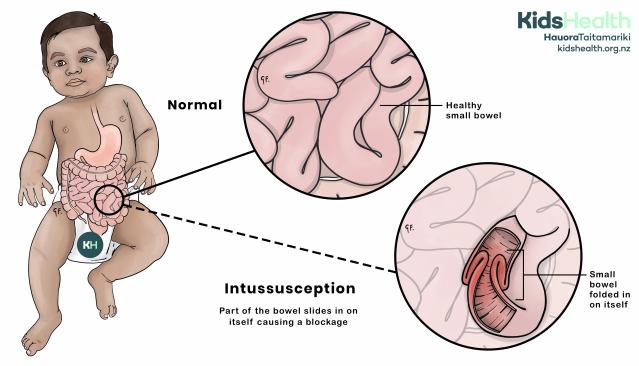
This illustration shows intussusception, where one part of the bowel slides in on itself, causing a blockage.
Source: KidsHealth
transcribeTranscript
The illustration shows a young child with an overlay of the digestive system on their abdomen. A circle highlights the small bowel, with two enlarged diagrams comparing normal and intussusception.
- The top circle is labelled Normal. It shows a healthy small bowel with no blockage. The label reads: Healthy small bowel.
- The bottom circle is labelled Intussusception. It shows part of the small bowel folded in on itself, coloured red to show swelling and blockage. The label reads: Small bowel folded in on itself.
- At the bottom right, text reads: Intussusception – Part of the bowel slides inside the next (like a telescope) causing a blockage.
At the top right is the KidsHealth logo with the website: kidshealth.org.nz
Causes of intussusception
Most of the time, the cause of intussusception is unknown. Sometimes it happens after an infection, like a tummy bug.
There is a small risk of intussusception after receiving a rotavirus vaccination. This is most likely to happen in the first week after vaccination.
The benefits of vaccination far outweigh the small risk of intussusception.
Signs and symptoms of intussusception
Pēpi (babies) and tamariki with intussusception may:
- have tummy pain
- have blood in the poo - the poo may have the appearance of red jelly
- vomit
- look pale
- be floppy and not interested in surroundings
When to get medical help for your child
If you're worried that your baby may have intussusception, seek urgent medical help. If you can't see a health professional straight away, call an ambulance. Call 111 within New Zealand (use the appropriate emergency number in other countries).
Tell the health professional if your baby has recently had a rotavirus vaccination.
Diagnosing intussusception
A health professional can usually make a diagnosis of intussusception after talking to you about your child's symptoms and by examining your child in hospital.
In some circumstances, your child may need other tests, such as:
- an x-ray of their tummy
- an ultrasound scan of their tummy
- blood tests
- a urine sample (to rule out a urinary tract infection)
See the section on x-rays and scans to learn more about different scans.
Managing intussusception
Tamariki with intussusception need to be in hospital. A radiologist (specialist doctor) can usually fix the intussusception. They do this by using air or fluid to push the folded part of the bowel back into its normal position. The radiologist may need to do this more than once.
A small number of tamariki will need surgery. After surgery, your child will need to stay in hospital for a few days to recover.
Possible complications of intussusception
Most pēpi recover completely with no further problems. But, intussusception can happen again for a small number of tamariki.
Acknowledgements
Intussusception illustration by Dr Greta File. Property of KidsHealth.
References
Te Whatu Ora | Health New Zealand. Rotavirus.
Medsafe. NZ. Information for consumers. Information on rotavirus vaccination (Rotarix)
HealthEd. Immunise against rotavirus - protect your child.
Immunisation Advisory Centre. Rotavirus.
