

Key points about irritable hip
- irritable hip (transient synovitis) is one of the most common causes of limping in tamariki
- if you think your child has irritable hip, take them to a health professional for assessment
- if your child is diagnosed with irritable hip, you can usually look after them at home
- it usually takes up to 2 weeks for tamariki to fully recover
- rest and pain relief can help with symptoms
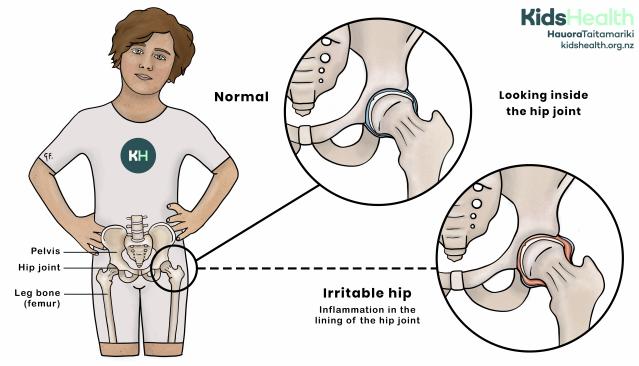
An illustration of a normal hip compared with irritable hip. It shows the hip joint in a normal state compared with an inflamed lining of the hip joint.
Source: KidsHealth
transcribeTranscript
The illustration is titled Irritable hip.
A child is shown with an overlay of the pelvis and hip joints. Labels point to the Pelvis, Hip joint, and Leg bone (femur).
- The top circle is labelled Normal. It shows a healthy hip joint where the leg bone (femur) fits smoothly into the pelvis. The joint lining is normal.
- The bottom circle is labelled Irritable hip. It shows inflammation in the lining of the hip joint, highlighted in red.
- On the right side, text reads: Looking inside the hip joint.
At the top right is the KidsHealth logo with the website: kidshealth.org.nz.
What is irritable hip?
Irritable hip, also called transient synovitis, is inflammation and swelling of the lining of the hip joint. This inflammation can cause pain and make it difficult for a child to walk or move their hip normally.
Causes of irritable hip
No one knows exactly what causes irritable hip. It can happen after a viral infection, but there is no infection in the hip joint itself.
Who gets irritable hip
Tamariki who get irritable hip are usually between 3 to 8 years old.
Signs and symptoms of irritable hip
Usually only one hip is affected.
Your child may:
- have a limp or difficulty crawling, standing or walking
- complain of pain in the hip, groin, thigh or knee
- have a normal temperature or a mild fever below 38 degrees Celsius
When to get medical help for irritable hip
If you think your child has irritable hip, take them to a health professional for review. Other conditions can cause similar symptoms and may need different treatment.
Call Healthline on 0800 611 116 for free health advice, or take your child to a health professional urgently if your child:
- develops a fever above 38 degrees Celsius
- cannot walk or put weight on their affected leg
- has redness or swelling anywhere on the affected leg
- has increasing pain that cannot be controlled with pain relief medicine
- is complaining of pain when sitting or lying still
- has pain or swelling in any other joints
- is becoming more unwell
- has pain that may have been caused by an injury
Once a health professional has diagnosed irritable hip, you can usually look after your child at home.
Take your child back to a health professional if:
- their pain or limp is not starting to improve within 3 days
- their symptoms are getting worse
- you are concerned about them for any other reason
Diagnosing irritable hip
Tamariki with irritable hip do not always need tests. A health professional will examine your child and may recommend tests. Tests can help to rule out an infection, injury or other cause of their symptoms.
Tests may include:
- blood tests
- an x-ray
- an ultrasound scan
Treating irritable hip
Irritable hip usually gets better on its own. Once a health professional has diagnosed irritable hip, you can usually look after your child at home. Things usually start to improve after a few days. Most tamariki are back to normal within 2 weeks.
You don't need antibiotics because irritable hip is not caused by a bacterial infection.
There are some things you can do at home to help.
Giving regular pain relief
Paracetamol
If your child has pain, you can give paracetamol to make them more comfortable. You must follow the dosage instructions on the bottle. It is dangerous to give more than the recommended dose.
Safe Use Of Paracetamol In Children
Other medicine
Your health professional may give your child ibuprofen (such as Nurofen or Fenpaed), or you can buy it at the pharmacy. Follow the dosage instructions carefully. It is dangerous to give more than the recommended dose.
Never give aspirin
Never give your child aspirin as this may increase the risk of Reye syndrome, which is a rare and serious illness.
Rest and fluids
Encourage your child to rest and to limit their activity. Most tamariki will do this themselves while they are sore.
Encourage your child to drink plenty of fluid.
Are there any long-term problems from irritable hip?
Irritable hip usually does not cause any long-term problems. A small number of tamariki may have irritable hip again in the future.
Acknowledgements
Illustration by Dr Greta File. Property of KidsHealth.
References
Kids Health Information | The Royal Children’s Hospital Melbourne: Transient synovitis (irritable hip)
