

Key points about joint infections in children
- a joint infection is also called septic arthritis
- bacteria usually cause joint infections
- symptoms can include joint pain, fever and difficulty moving or using the affected limb
- joint infections need urgent treatment in hospital
- treatment usually includes antibiotics and a procedure to drain or wash out the joint
- most children recover well when treatment starts early
What is a joint infection?
A joint is where 2 bones meet. Joint fluid helps the bones move smoothly. A joint infection happens when germs enter the joint fluid. Health professionals call this septic arthritis.
The infection can cause pus to build up inside the joint. This causes pain and swelling. Without treatment, the infection can damage the joint and nearby bones.
Joint infections often affect one joint, but in some cases, infection spreads to multiple joints. Infection can also spread to nearby bones. The hip, knee and ankle are common sites in children.
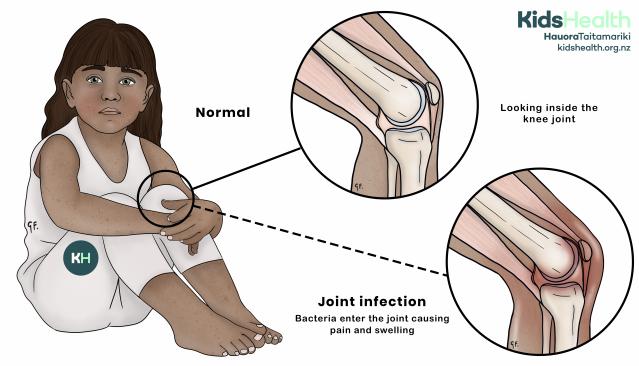
An illustration showing how a joint infection can cause pain and swelling in a child’s knee.
Source: KidsHealth
transcribeTranscript
The illustration shows a child sitting and holding their knee. Two circles show enlarged views looking inside the knee joint.
- The top circle is labelled ‘Normal’ and shows a normal knee joint.
- The bottom circle is labelled ‘Joint infection’. It shows redness and swelling around the knee joint. Text underneath says, ‘Bacteria enters the joint causing pain and swelling’.
At the top right is the KidsHealth logo with the website kidshealth.org.nz.
Causes of joint infections in children
Bacteria usually cause joint infections. The most common bacterial cause of joint infections is Staphylococcus aureus. This is sometimes called staph.
Many bacteria live on the skin, in the nose and throat, and in other parts of the body. Most of the time they do not cause harm. A joint infection can happen if bacteria get into the bloodstream and travel to a joint.
A joint infection can also happen when bacteria:
- spread from an infection in a nearby bone
- enter the joint through a deep cut, wound or broken bone
- enter the joint during an injection or operation
Sometimes, health professionals cannot find where the infection started.
Bone and joint infections can happen together
Sometimes, a child can have a joint infection and an infection in a nearby bone at the same time. An infection in a bone is called osteomyelitis. A bone infection can spread into a nearby joint.
Your child’s healthcare team will check for signs of a bone infection. They may arrange further scans or tests.
See the page on osteomyelitis to learn more about bone infections in children.
Bone Infection (Osteomyelitis) In Children
Symptoms of joint infections in children
Children with a joint infection often become unwell quickly.
Symptoms can include:
- pain in or around a joint
- pain when the joint moves
- difficulty moving or using the affected limb
- limping or refusing to walk
- not wanting to put weight on a leg
- swelling, redness or warmth around the joint
- tenderness around the joint
- fever
- tiredness, irritability or generally feeling unwell
- reduced appetite
Babies and young children may not be able to show where they have pain. They may seem irritable, have a fever or stop moving the affected arm or leg. A baby with an infected hip may become upset during nappy changes or hold their leg in an unusual position.
See the page on limping to learn more about when to seek medical help.
When to get medical help for your child
See a health professional urgently
Take your child to the nearest emergency department straight away if they:
- have severe joint pain
- cannot move or use a limb
- refuse to walk or put weight on a leg
Get urgent medical help if your child has these symptoms, even if they do not have a fever.
Call 111
A joint infection can sometimes lead to sepsis. Sepsis is the body’s extreme response to an infection. Sepsis can become life-threatening quickly.
Call 111 and ask for urgent medical help if your child:
- is very hard to wake or confused
- is floppy
- has trouble breathing or is breathing very fast
- has pale, blotchy or discoloured skin
- seems very unwell and is getting worse quickly
Sepsis In Children & Young People
Diagnosing joint infections in children
A health professional will ask about your child’s symptoms and health. They will examine the painful joint and check how well your child can move it.
Your child may need:
- blood tests to look for signs of infection
- blood cultures to check which bacteria may be causing the infection
- an x-ray
- an MRI scan
- an ultrasound scan
Sometimes, health professionals take a small sample of joint fluid from the joint. This can help them find out which type of bacteria is causing the infection and which antibiotics will work best.
Managing joint infections in children
Children with a joint infection need urgent treatment in hospital. The healthcare team will give treatment to help clear the infection, manage pain and support your child’s recovery.
Antibiotic treatment
Your child will usually have antibiotics through a cannula into a vein at first. These are called intravenous antibiotics, or IV antibiotics.
Once your child starts to improve, they may be able to change to antibiotics by mouth. Your child may need to keep taking antibiotics for several weeks. The length of treatment depends on the bacteria, the affected joint and how well your child responds.
It is important that your child takes every dose and finishes the full course of antibiotics, even if they feel better.
Antibiotic Advice For Children
Draining the infected joint
Your child will usually need a procedure to remove infected fluid and pus from the joint. The healthcare team may drain the joint using a needle or a tube. Some children may need an operation.
During an operation, a surgeon drains and washes out the joint. Your child will have a general anaesthetic and will be asleep for the procedure. Some children need more than one procedure to clear the infection.
Your child may need a splint or plaster cast to rest the joint while it heals.
Pain relief medicine
Your child may need pain relief medicine while the infection improves. The healthcare team will talk with you about what pain relief your child needs and how often to give it.
Hospital stay
While your child is in hospital, they may need:
- fluids through a drip if they are not drinking well
- support to move safely, such as crutches and other walking aids
- physiotherapy to help movement and strength as they recover
Follow-up care
Your child will need follow-up appointments after leaving hospital. The healthcare team may arrange further blood tests or scans. These checks help make sure the infection has cleared. They also check that the joint is moving normally and the bones are growing normally.
The healthcare team will let you know when your child can return to school, sport and other activities.
Long term outlook
Most children recover well when health professionals diagnose and treat the infection early.
A joint infection can sometimes damage the joint, nearby bone or the growth plate. This may affect how the joint moves or how the bone grows. Delays in treatment can increase the risk of these problems.
It is important to attend all follow-up appointments, even if your child seems well.
Acknowledgements
Illustration by Dr Greta File. Property of KidsHealth.
References
Hunter S, Crawford H, Baker JF. Ten-year Review of Acute Pediatric Hematogenous Osteomyelitis at a New Zealand Tertiary Referral Center. J Pediatr Orthop. 2023 May-Jun 01;43(5):e396-e401. doi: 10.1097/BPO.0000000000002385. Epub 2023 Mar 8. PMID: 36882888.
Hunter S, Brown E, Crawford H, Selak V, Grant C. Musculoskeletal Sepsis in the Pediatric Intensive Care Unit. Pediatr Infect Dis J. 2025 Mar 1;44(3):189-194. doi: 10.1097/INF.0000000000004604. Epub 2024 Nov 6. PMID: 39951138.
