

Key points about Kawasaki disease
- Kawasaki disease is a rare illness that affects young tamariki
- it causes high fevers for at least 5 days
- it makes tamariki very miserable
- Kawasaki disease can cause heart damage
- early treatment can prevent heart damage
What is Kawasaki disease?
Kawasaki disease is a rare but serious illness. It usually affects younger tamariki under the age of 5 years.
Kawasaki disease causes high fevers that last at least 5 days. If left untreated, about 1 in 5 tamariki with Kawasaki disease will suffer damage to their heart. It can also cause damage to other parts of the body.
The name of the disease comes from Tomisaku Kawasaki, the Japanese doctor who first described it in 1967.
Causes of Kawasaki disease
The cause of Kawasaki disease is unknown. It is more common in Japan than in most other countries.
One theory is that a common virus or infection causes the immune system to overreact.
Your child cannot 'catch' Kawasaki disease - it is not contagious.
How long Kawasaki disease lasts for
Without treatment, Kawasaki disease can last for 10 days or more.
If the disease affects the heart, then the damage can be permanent.
Signs and symptoms of Kawasaki disease
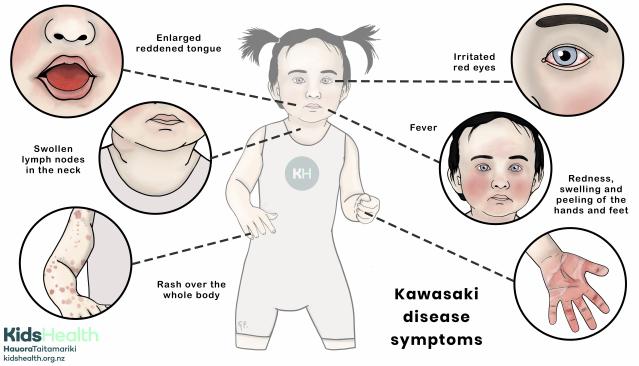
An illustration of Kawasaki disease symptoms. Including fever, rash, red irritated eyes, swollen lymph nodes in the neck, a red enlarged tongue, and redness, swelling or peeling of the hands and feet.
Source: KidsHealth
transcribeTranscript
The illustration is titled Kawasaki disease symptoms.
In the centre, a child is shown with dashed lines pointing to different symptoms:
- Top left circle shows an Enlarged reddened tongue.
- Middle left circle shows Swollen lymph nodes in the neck.
- Lower left circle shows a Rash over the whole body.
- Top right circle shows Irritated red eyes.
- Middle right circle shows the child’s face with the label Fever.
- Lower right circle shows a hand with Redness, swelling and peeling of the hands and feet.
At the bottom left is the KidsHealth logo with the website: kidshealth.org.nz.
The most striking feature of Kawasaki disease is a high fever that comes and goes for at least 5 days. Tamariki are usually very irritable and easily upset.
Other symptoms of Kawasaki disease include:
- a rash on the body, which is often worse in the groin area
- irritated red eyes
- an enlarged reddened tongue (sometimes called 'strawberry' tongue)
- reddened or dry, cracked lips
- redness or swelling of the hands and feet
- swollen lymph nodes in the neck
- peeling of the hands and feet (usually later in the illness)
- tummy pain
- vomiting
- runny poo (diarrhoea)
- joint pain and swelling
Diagnosing Kawasaki disease
If your child is unwell or has symptoms of Kawasaki disease, see a health professional.
There is no single test that can diagnose Kawasaki disease. Your health professional will consider other possible illnesses as well. The diagnosis can be difficult to make. A paediatrician (children’s health doctor) will usually confirm the diagnosis in hospital.
For your child to have a diagnosis of Kawasaki disease, they will usually have a fever for at least 5 days and at least 4 of the symptoms listed above.
Pēpi (babies) with Kawasaki disease may not have as many of the symptoms as older tamariki. The symptoms may not all be present at the same time.
Blood tests
Blood tests may help with the diagnosis.
Ultrasound scan of the heart (echocardiogram)
Once diagnosed with Kawasaki disease, your child will need an ultrasound scan of the heart (echocardiogram). This is to check whether the disease has affected their heart. This is a safe and painless scan. It is similar to an ultrasound scan used during pregnancy.
This ultrasound may happen in hospital or after your child has gone home from the hospital. Your child may need more echocardiograms to check how their heart is recovering.
Managing Kawasaki disease
If your child has Kawasaki disease, the healthcare team will discuss with you what treatment and follow-up your child needs. If you don't understand the plan for your child, it is OK to ask questions.
Immunoglobulin
Immunoglobulin is a blood product made of concentrated antibodies from donated blood. Your child will receive it through a vein (intravenously).
Immunoglobulin is very effective at reducing the risk of heart damage. It works best when given within 10 days of the start of the illness. Without treatment, the chance of heart damage is higher.
After your child has had immunoglobulin treatment, they shouldn't have the following vaccines for 11 months:
- measles, mumps, rubella (MMR) vaccination
- chickenpox (varicella) vaccination
That's because these vaccines may not work properly after immunoglobulin. Your child can have all the other vaccines, including the influenza vaccine, at the normal time. Immunoglobulin won't affect how these vaccines work.
Some tamariki may need a second dose of immunoglobulin if their symptoms have not improved after the first dose.
Aspirin
Your child's health professional will prescribe aspirin in case there has been heart damage. Your child will keep taking aspirin at least until they have an ultrasound scan of their heart.
If your child needs to keep taking aspirin after going home from hospital, there are some important things to remember.
Your child should not take ibuprofen or other anti-inflammatory medicine while they are taking aspirin.
If your child gets the flu or chickenpox while taking aspirin, contact a health professional straight away. They will advise you whether your child needs to stop taking aspirin.
What to look out for after your child has left hospital
If your child gets a fever again within 6 weeks of having Kawasaki disease, take them to see a health professional. Your child may need to go back to hospital.
Can children get Kawasaki disease more than once?
It is very unusual to have Kawasaki disease more than once.
Possible complications from Kawasaki disease
There is no way to prevent Kawasaki disease. Appropriate treatment given early enough in the illness will help prevent complications.
The major complication of Kawasaki disease is heart damage. The most common type of heart damage is caused by inflammation of the vessels that carry blood to the heart muscle. Immunoglobulin works by reducing the inflammation and preventing the damage.
In some tamariki, the heart changes get better over time. Others will need ongoing follow-up with a heart specialist.
There are other treatments available for tamariki with severe damage to their heart.
Acknowledgements
Illustrations by Dr Greta File. Property of KidsHealth.
