

Key points about pyloric stenosis
- the pylorus is the muscular passage between the stomach and small intestine
- all food leaving the stomach has to go through the pylorus
- when a baby has pyloric stenosis, the muscles in the pylorus have become too thick to allow milk to pass through it
- vomiting usually becomes more and more forceful and may become projectile
- if your baby has pyloric stenosis, they will need surgery
- if your baby is dehydrated from vomiting, they will need treatment with intravenous (IV) fluids before surgery
What is pyloric stenosis?
Pyloric stenosis is also called infantile hypertrophic pyloric stenosis. It happens when the muscle around the pylorus becomes too thick. This narrows the passage between the stomach and small intestine and stops milk from passing through. Symptoms usually develop in the first 6 weeks after birth.
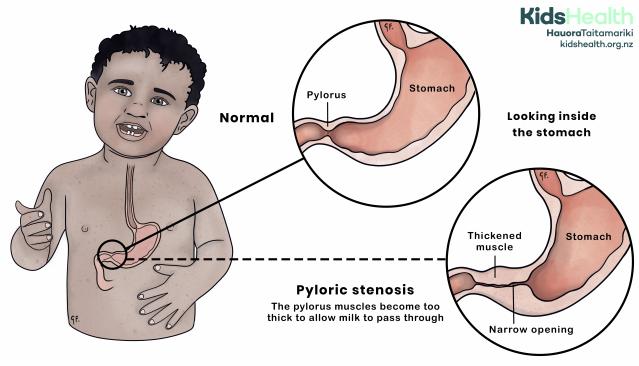
An illustration showing pyloric stenosis, compared with a normal stomach and pylorus.
Source: KidsHealth
transcribeTranscript
The illustration shows a young child standing facing forward, with the oesophagus and stomach visible inside the chest and upper tummy.
- A circular close-up labelled Normal shows the stomach and pylorus. The pylorus muscle is a normal thickness, allowing milk to pass easily from the stomach into the small intestine.
- Another circular close-up shows Pyloric stenosis. The pylorus muscle is thickened. This creates a narrow opening, making it hard for milk to pass out of the stomach.
- Text explains that pyloric stenosis happens when the pylorus muscles become too thick to allow milk to pass through.
At the top right of the illustration is the KidsHealth logo with the website: kidshealth.org.nz.
Causes of pyloric stenosis
Experts do not know exactly what causes the thickening and enlargement of the muscles in the pylorus.
Signs and symptoms of pyloric stenosis in babies
Vomiting
- vomiting of feeds, usually within 30 minutes of a feed
- vomiting typically starts happening 4 to 6 weeks after birth
- vomiting tends to become more frequent and forceful and may become projectile
- the vomit usually contains milk and may look curdled
- occasionally, the vomit may have small brown specks of old blood in it
- despite the vomiting, pēpi (babies) are usually keen to feed because they are hungry
Weight loss
- poor gain weight or weight loss
Dehydration
- dry mouth and tongue
- fewer wet nappies or not doing as much wee as usual
- unusual sleepiness and being difficult to wake (lethargic)
- sunken eyes
- the soft spot on the top of the head (anterior fontanelle) is more sunken than normal
Ripples
- sometimes, you can see ripples or waves move across the stomach (abdomen) after a feed
- these are muscle contractions (peristalsis) as the stomach tries hard to empty milk into the small intestine
Less poo
- less or smaller poos because less milk is passing into the small intestine
When to get medical help for your baby
If you think your baby has pyloric stenosis, see a health professional straightaway. Do not delay, as young pēpi who are not able to feed normally can become unwell quickly.
Diagnosing pyloric stenosis
The health professional will ask about your baby's symptoms. They may ask about:
- patterns of feeding and vomiting
- the colour of your baby's vomit
- any weight loss or failure to gain weight
The health professional may try to feel a mass or lump (the thickened pylorus) over your baby's stomach.
Your baby might need some investigations or tests.
An ultrasound scan of the abdomen
An ultrasound scan of your baby's tummy may show the thickened pyloric muscle.
A test feed
A health professional may give your baby a small feed. This can make it easier for them to feel the thickened pylorus in your baby’s tummy.
Blood tests
Most pēpi will need a blood test. Blood tests can show dehydration and changes in electrolytes and acid levels. The healthcare team will correct any abnormalities before surgery.
A barium meal
Only a small number of pēpi need a barium meal. A health professional will give your baby a small amount of a chalky liquid called barium. Your baby will then have an x-ray that follows the barium as it moves through their gut. This may help show any blockage or narrowing.
Managing pyloric stenosis
The treatment for pyloric stenosis is an operation called a pyloromyotomy. During the operation, the surgeon cuts through the thickened muscle of the pylorus. This widens the opening and allows milk to pass through. Surgeons can use different approaches. Your baby’s surgeon will discuss the planned approach with you before the operation.
Your baby will have the surgery under general anaesthetic and will be completely asleep.
Laparoscopic or 'keyhole' surgery
Laparoscopic or 'keyhole' surgery is where the surgeon makes 3 tiny cuts over the tummy. This is the most common technique.
Open surgery
During open surgery, the surgeon makes one small cut. The cut may be in the tummy button or directly over the pylorus.
What happens before the operation
Fasting
Your baby may not be able to eat or drink anything for a period of time before their surgery.
Nasogastric tube
Some pēpi may need a nasogastric tube. This is a tiny plastic tube inserted through their nose and down into their stomach. This allows the health professional to remove the stomach contents before your child has an anaesthetic.
IV drip
Your baby will need an intravenous (IV) drip before the operation. Repeated vomiting can cause dehydration and changes in the balance of electrolytes and acid in your baby’s blood. The healthcare team will correct any abnormalities before surgery. This usually takes several hours and can even take a couple of days.
Talk with the surgical team
Your baby's surgical team will explain what will happen during the operation. They will talk you through any other treatment that your baby may need. You will have the opportunity to ask questions.
What happens after the operation
Your baby may need medicine to help with pain after the operation. They will continue to receive fluids through the IV drip for the first few hours. This helps keep them hydrated until they start feeding again. Your baby can usually start having small feeds within a few hours. The healthcare team will tell you when and how to begin.
Your baby may still vomit or spill small amounts of milk after the operation. This should decrease over several days. Tell the healthcare team if the vomiting remains forceful or is not improving. Your baby can usually go home once they are feeding well and are otherwise well.
Caring for your baby at home after treatment for pyloric stenosis
Your baby may still be sore for a day or two once you go home. The healthcare team will suggest medicine to help with pain after you leave the hospital.
Follow the healthcare team’s instructions about bathing and caring for the wound. Get medical help if:
- the skin around the wound becomes red or swollen
- fluid or pus comes from the wound
- your baby develops a fever
- your baby stops feeding
Possible complications of treatment for pyloric stenosis
All surgery comes with some risks, including bleeding during or after the operation. There is a small chance of damage to the lining of the bowel. If this happens, the surgeon will usually find and repair it during the operation.
There is also a small risk of complications from the anaesthetic. You will have a chance to ask the surgeon and anaesthetist any questions before the operation.
Pyloric stenosis can happen again, but this is rare.
Long-term outlook
Most pēpi with pyloric stenosis recover fully after surgery and have no long-term problems.
Acknowledgements
Illustration by Dr Greta File. Property of KidsHealth.
