

Key points about spondylolysis in children and young people
- spondylolysis is a small stress fracture in part of a spinal bone
- it most often affects the lower back
- it is common in sporty tamariki and rangatahi
- some tamariki have mild symptoms, some have no symptoms
- most tamariki recover well with rest and physiotherapy
What is spondylolysis?
Spondylolysis is a stress fracture in a spinal bone (vertebra). The part that fractures is called the pars interarticularis. This is a small section of bone that can break more easily than other parts of the spinal bone.
This fracture usually develops slowly over time. It often happens from repeated stress on the lower back rather than from a single injury.
Spondylolysis does not always cause pain. Some tamariki never know they have it.
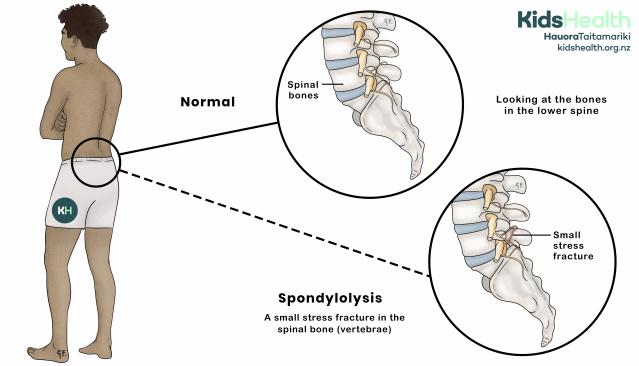
An illustration showing a normal lower spine compared with spondylolysis, where there is a small stress fracture in a spinal bone.
Source: KidsHealth
transcribeTranscript
This illustration shows a child’s lower back with a close-up of the lower spine.
- The top circle, labelled Normal, shows typical spinal bones with no damage.
- The bottom circle, labelled Spondylolysis, shows a small stress fracture in one of the spinal bones. The illustration highlights the area in the lower spine where the fracture occurs.
At the top right is the KidsHealth logo with the website: kidshealth.org.nz.
In some tamariki, spondylolysis can lead to spondylolisthesis. This is where one bone in the spine slips forward over the bone below it.
Spondylolisthesis In Children & Young People
A bit about the spine
The spine includes the:
- spine bones (vertebrae)
- intervertebral discs (soft discs between the bones)
- muscles and ligaments that support and move the spine
- the spinal cord and nerves
The vertebrae stack on top of each other to form a strong column. The discs act like shock absorbers. The muscles and ligaments act like strong ropes to hold the bones together and help the spine bend and move.
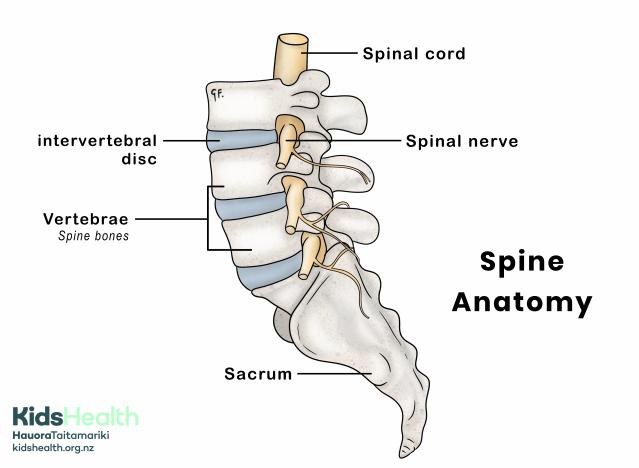
An illustration showing the parts of the lower spine.
Source: KidsHealth
transcribeTranscript
This illustration shows the structure of the lower spine.
- The vertebrae are the bones that make up the spine.
- The intervertebral disc sits between the vertebrae.
- The spinal cord runs down through the spine.
- The spinal nerve branches out from the spinal cord.
- The sacrum is the bone at the base of the spine.
At the bottom left is the KidsHealth logo with the website: kidshealth.org.nz.
Causes of spondylolysis
Spondylolysis usually develops from repeated strain on the lower back.
Common risk factors include:
- sports that involve repeated bending or arching of the back
- high training loads without enough rest
- rapid growth during the teenage years
- a history of spinal stress injuries in the whānau (family)
Symptoms of spondylolysis
Symptoms can vary.
Tamariki and rangatahi with spondylolysis may have:
- lower back pain that worsens with activity
- pain that improves with rest
- tight hamstrings
- stiffness in the lower back
Some tamariki have no symptoms at all.
Diagnosing spondylolysis
A health professional will:
- talk with you and your child about their symptoms and activity
- examine your child’s back and movement
Your health professional may arrange some tests. This may include:
- an x-ray of the spine
- an MRI or CT scan if symptoms continue or the diagnosis is unclear
Managing spondylolysis
Most tamariki recover without surgery.
Rest
Encourage your child to rest from painful activities and sports. They will need a gradual return to activity once pain settles.
Physiotherapy
Physiotherapy can help improve core strength and flexibility. The physiotherapist can give your child exercises and stretches to do.
Brace
Some tamariki may need a brace for a short time, especially if the pain started suddenly. If your child needs a brace, your health professional will talk with you about this.
Can spondylolysis be prevented?
You cannot prevent all cases of spondylolysis.
You can reduce risk by encouraging your child to:
- balance training with rest days
- avoid sudden increases in training intensity
- maintain good core strength and flexibility
- stop activity if they develop back pain
Looking after your child at home
You can support your child by:
- encouraging rest during painful periods
- helping them follow their physiotherapy programme
- supporting a gradual return to sport
- reassuring them that most tamariki recover well
Most tamariki return to normal activities once their pain settles.
When to get medical help for your child
When to see a health professional
See a health professional if you child has:
- ongoing or worsening back pain
- pain that stops them from normal activities or sport
- pain that does not improve with rest
When to see a health professional urgently
See a health professional urgently if your child:
- has increasing pain
- develops leg pain, weakness, or numbness
- has trouble walking
When to call 111
Call 111 and ask for urgent medical help if your child:
- suddenly cannot move their legs
- loses control of their bladder or bowels
- has severe back pain after a serious injury
Acknowledgements
Illustrations by Dr Greta File. Property of KidsHealth.
