

Key points about a lumbar puncture
- a lumbar puncture can help find out if your child has an infection of the lining or the fluid that surrounds the brain and spinal cord
- some tamariki (children) need a lumbar puncture for other reasons such as receiving medicines
- a doctor inserts a needle in the lower back to get a sample of cerebrospinal fluid (CSF)
- CSF is the fluid that moves around the brain and spinal cord
What is a lumbar puncture?
A lumbar puncture is also called a spinal tap or LP. A doctor inserts a needle in the lower back to get a sample of cerebrospinal fluid (CSF). CSF is the fluid that moves around the brain and spinal cord. The needle does not touch the spinal cord.
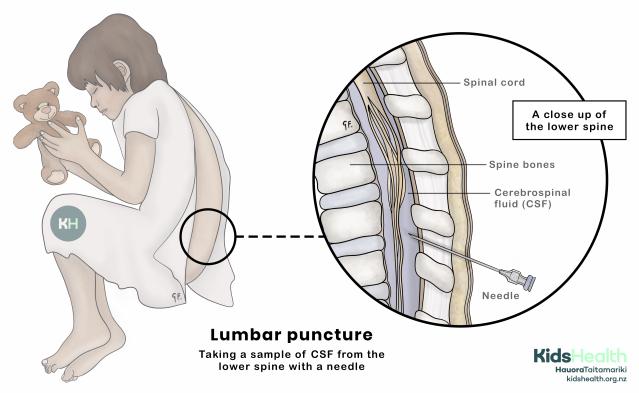
This illustration shows a child having a lumbar puncture, with a close-up of the lower spine showing where the needle goes to collect fluid.
Source: KidsHealth
transcribeTranscript
On the left is an illustration of a child sitting curled up and holding a teddy bear - showing the common position to lie in during a lumbar puncture. A circular area on the lower back is magnified to show a close-up of the spine.
The magnified section shows the following structures, each labelled:
- Spinal cord – a cord-like structure running down the middle of the spine.
- Spine bones – the bony parts stacked along the spine.
- Cerebrospinal fluid (CSF) – shown in a light purple colour around the spinal cord.
- Needle – inserted between the spine bones into the fluid-filled space.
Text at the bottom reads: Lumbar puncture - Taking a sample of CSF from the lower spine with a needle.
At the bottom right is the KidsHealth logo with the website: kidshealth.org.nz.
Reasons for having a lumbar puncture
Doctors usually do a lumbar puncture to find out if your child has an infection of the lining or the fluid that surrounds the brain. This type of infection is called meningitis.
Check some information on meningococcal disease.
Occasionally, your child may need a lumbar puncture for another reason such as:
- receiving medicine
- helping diagnose a condition
- managing a specific condition
If your child needs a lumbar puncture for another reason, your health professional will discuss this with you.
What happens during a lumbar puncture
The test may be a little bit awkward as your child needs to be still the whole time and may feel some discomfort.
The following steps usually happen during a lumbar puncture.
A health professional may put a local anaesthetic patch on your child’s skin. This numbs the area where they will put the needle. It takes about 30 to 60 minutes for the patch to work.
If your child is very scared or anxious, the healthcare team may give them some medicine that will help them to relax.
Young pēpi may have sucrose by mouth.
It is very important that during this test your child keeps still. The healthcare team will hold your child gently but firmly to make sure they stay still.
Your child will lie curled up on their side with their knees tucked up under their chin.

This illustration shows a common lying position for a lumbar puncture.
Source: KidsHealth
transcribeTranscript
An illustration of a child lying on their side in a curled-up position, holding a teddy bear. The child's knees are tucked towards their chest and their chin is bent down towards their chest. The back is curved to show a common position used for a lumbar puncture. The child is wearing a hospital gown.
Text on the left reads: 'Lying position for a lumbar puncture'.
At the bottom right is the KidsHealth logo with the website: kidshealth.org.nz.
The healthcare team will clean the skin on the lower part of your child's back. They will place a drape over the area to keep it clean.
The health professional may also use local anaesthetic that they inject into the skin over your child's lower back. The local anaesthetic may sting and it takes a couple of minutes to start working.
The doctor will carefully insert the lumbar needle into the lower back.
The healthcare team will collect drops of spinal fluid and then remove the needle.
Your child will have a small plaster over the area.
Possible risks from having a lumbar puncture
Sometimes a lumbar puncture is not successful. Sometimes the health professionals can’t get any fluid or they get blood instead of CSF.
The healthcare team will make sure that it is safe for your child to have the test. There are very few side effects from a lumbar puncture.
After the test, some tamariki may have a headache for up to a couple of days. A small number of tamariki may complain of feeling sore where the needle went in.
You may notice a little bit of swelling where the needle went in, but this should go away in a few days.
Complications such as nerve damage and infection are extremely rare.
What happens after a lumbar puncture
If your child is having a lumbar puncture to look for infection, the results will usually be available quite quickly.
How to help your child during a lumbar puncture
If your child asks about what is happening, be honest, answer their questions and explain the test in simple terms.
You can help your child by:
- staying with them if possible
- being comforting and reassuring
- encouraging them to ask the health professionals questions
- using distractions like music, their favourite toy or watching something together
If you can’t stay with your child during the test, a staff member will stay and comfort them.
Helping Your Child Manage Their Treatment
Caring for your child after a lumbar puncture
If your child complains of a headache or a sore back, it may be helpful to give your child some mild pain relief such as paracetamol. When giving paracetamol, you must follow the dosage instructions on the bottle. It is dangerous to give more than the recommended dose.
If your child has a headache, encourage them to lie down and rest. If the headache becomes severe or does not go away, take your child to see a health professional.
Acknowledgements
Illustrations by Dr Greta File. Property of KidsHealth.
