

Key points about torticollis in babies
- torticollis happens when one of the neck muscles is tight or shorter than the other
- it can cause your baby’s head to tilt to one side and turn to the opposite side
- torticollis is common in pēpi (babies) and usually develops in the first few weeks after birth
- most pēpi get better with early treatment and gentle exercises at home
What is torticollis?
Torticollis means twisted neck. This happens when one of the muscles in the neck, the sternocleidomastoid muscle, is tighter or shorter than the other side. The tight muscle tilts the head to one side and turns the chin to the opposite side. This makes it harder for your baby to turn their head both ways.
Some pēpi have torticollis when they are born. Others develop it in the first few weeks of life.
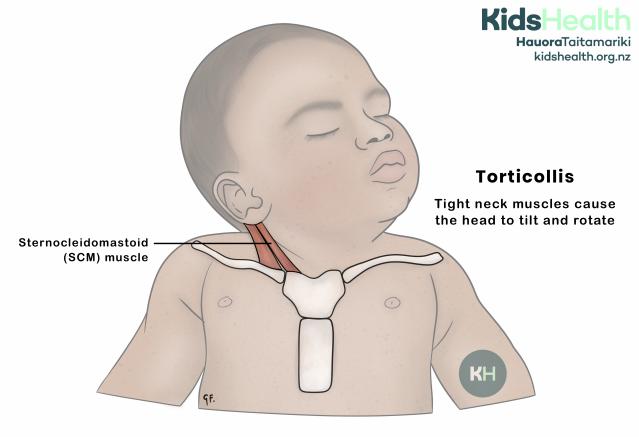
An illustration showing torticollis in a baby, with the tight neck muscle causing the head to tilt and turn.
Source: KidsHealth
transcribeTranscript
An illustration of a baby from the chest up. The baby’s head is tilted to one side and turned to the opposite side.
A muscle on the side of the neck is highlighted. A label points to it and reads: Sternocleidomastoid (SCM) muscle
To the right of the baby is the heading: Torticollis
Underneath it is the text: Tight neck muscles cause the head to tilt and rotate
At the top right is the KidsHealth logo with the website: kidshealth.org.nz
Causes of torticollis in babies
Sometimes torticollis happens because your baby was in a certain position before birth. It can also happen during or after delivery.
The muscle may have stretched or developed a small amount of scar tissue, which makes it tight.
Sometimes, torticollis can happen without any clear reason. It is not anyone’s fault, and nothing you did during pregnancy or birth caused it.
Symptoms of torticollis in babies
Pēpi with torticollis may:
- tilt their head to one side
- prefer to look in one direction
- find it hard to turn their head the other way
- have a small, firm lump in the side of the neck
- look like their trunk may be curved due to the head being tilted
- have a slight flat spot on one side of their head (called plagiocephaly)
Pēpi with torticollis might also prefer to feed from one breast or side more than the other.
Positional Head Flattening In Babies
Diagnosing torticollis in babies
Your health professional can usually diagnose torticollis by examining your baby. They will:
- look at how your baby holds and moves their head
- gently feel your baby’s neck muscles
- check for any lumps or tight areas
- look for other problems that might affect how your baby moves their head
Most pēpi won’t need an x-ray or scans.
It’s important to see a health professional to get the right diagnosis.
Managing torticollis in babies
Most pēpi with torticollis get better with gentle exercises and play.
Physiotherapy
Your health professional or physiotherapist will show you how to do gentle exercises with your baby at home. These are safe and can help if you do them regularly.
Positioning and play
You can help your baby look and turn toward the side they don’t usually use.
Consider changing where your baby’s cot or pēpi-pod is placed. Pēpi often turn towards interesting things in the room, including you.
Place interesting things on the side your baby does not usually look towards. For example, if your baby usually looks to the left, place their cot or pēpi-pod so the interesting things in the room are on their right.
Tummy time
Giving your baby time on their tummy when awake and supervised helps strengthen their neck and shoulder muscles.
Surgery
Most pēpi with torticollis improve within a few months. Rarely, a child may need surgery if their torticollis doesn’t improve with physiotherapy. Surgery usually won’t happen until a baby is a little older.
Looking after your baby at home with torticollis
There are things you can do at home to help your baby.
You can try:
- placing toys or interesting things on the side your baby doesn’t usually look toward
- changing the direction your baby lies in their cot, so they have to turn their head both ways to look at you
- feeding your baby from both sides
- carrying your baby so they have to look to the side they don’t usually use
- giving your baby plenty of tummy time when they are awake and you can watch them
Don’t force your baby’s head into a position. Use slow and gentle movements. Your baby should not be in discomfort. Pēpi should not have their necks manipulated.
Always place your baby on their back to sleep. Change their head position each time they sleep to stop a flat spot from forming.
Acknowledgements
Illustration by Dr Greta File. Property of KidsHealth.
