

Key points about juvenile idiopathic arthritis (JIA)
- juvenile idiopathic arthritis (JIA) is a long-term condition that causes inflammation in the joints
- JIA can affect tamariki of any age, including very young tamariki
- symptoms can include joint pain, swelling, stiffness and difficulty moving
- symptoms can come and go and can last for months or years
- JIA is an autoimmune condition, but experts do not know exactly what causes it
- treatment may include medicines, exercise, physiotherapy and regular health checks
- with treatment and support, many tamariki with JIA can live active and healthy lives
What is juvenile idiopathic arthritis (JIA)?
Juvenile idiopathic arthritis (JIA) is a group of conditions that cause inflammation in the joints of tamariki and rangatahi. The inflammation lasts for at least 6 weeks, although health professionals can sometimes diagnose JIA earlier.
A joint is where 2 bones meet. Healthy joints move smoothly and comfortably. In JIA, the immune system causes inflammation inside the joint. This inflammation can cause pain, swelling and stiffness. It can also make movement more difficult.
Juvenile means the condition starts before the age of 16 years.
Idiopathic means the exact cause is unknown.
Arthritis means inflammation of the joints.
JIA is a long-term condition. How many joints it affects and how severe it is can vary from child to child. It can also change over time. This means each child may need different treatment and monitoring.
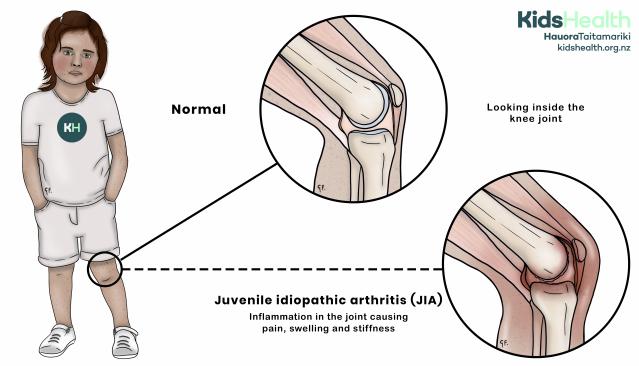
Illustration showing how inflammation from juvenile idiopathic arthritis (JIA) can affect a knee joint.
Source: KidsHealth
transcribeTranscript
The illustration shows a child standing with their left knee highlighted. Two circles are connected to the child’s knee to show a close-up of the inside of the knee joint.
- The top circle is labelled ‘Normal’ and shows the inside of a normal knee joint.
- The lower circle is labelled ‘Juvenile idiopathic arthritis (JIA)’ and shows inflammation around the knee joint. Beneath the label, the text reads: ‘Inflammation in the joint causing pain, swelling and stiffness.’
- The text on the right reads: ‘Looking inside the knee joint’.
At the top right is the KidsHealth logo with the website: kidshealth.org.nz.
Types of juvenile idiopathic arthritis
There are several types of JIA.
Oligoarticular JIA
This is the most common type of JIA. It often begins between 2 and 4 years of age.
It affects 4 or fewer joints during the first 6 months of illness.
It often affects larger joints such as the knees or ankles.
This type has the highest risk of developing eye inflammation called uveitis.
Polyarticular JIA
It can begin at any age.
This type affects 5 or more joints within the first 6 months.
It can affect both large and small joints.
Systemic JIA
This type affects the whole body. Tamariki may have fevers, a rash and feel generally unwell.
Joints may or may not be affected.
Enthesitis-related arthritis (ERA)
This type causes inflammation in the joints. It can also cause inflammation where tendons or ligaments attach to bone (entheses).
It often affects the lower limbs and can sometimes affect the spine.
Psoriatic arthritis
This type occurs in tamariki who have psoriasis or a family history of psoriasis. Psoriasis is a skin condition. It can affect the joints, skin and nails.
Undifferentiated arthritis
Some tamariki have symptoms that do not clearly fit into one type of JIA. Others have symptoms that overlap between different types.
Causes of juvenile idiopathic arthritis
Experts do not know exactly what causes JIA.
JIA is an autoimmune condition. This means the immune system mistakenly attacks healthy tissues in the body. In JIA, the immune system targets the lining of the joints and causes inflammation.
Nothing that you or your child did caused JIA.
Researchers think that both genes and environmental factors may play a role. However, no single cause has been identified.
Symptoms of juvenile idiopathic arthritis
Symptoms can vary from child to child.
Common symptoms include:
- joint pain
- swollen joints
- joint stiffness, especially in the morning or after resting
- difficulty moving a joint normally
- limping, particularly in the morning
- tiredness or fatigue
- reduced participation in physical activities
Some tamariki have symptoms in only 1 joint. Others have symptoms in several joints.
Tamariki with systemic JIA usually also:
- have at least daily fevers
- have a rash that comes and goes with the fever
- have swollen lymph glands
- feel generally unwell
Eye inflammation
Some tamariki with JIA develop inflammation in the eye called uveitis.
Uveitis often causes no symptoms at first. Without treatment, it can affect vision.
Regular eye checks are an important part of care for many tamariki with JIA.
Diagnosing juvenile idiopathic arthritis
There is no single test that can diagnose JIA.
A health professional will ask about your child's symptoms and examine their joints. They will look for signs of swelling, stiffness, pain and reduced movement.
Your child may need tests such as:
- blood tests
- scans such as ultrasound, X-rays or MRI scans
- eye examinations
These tests can help rule out other conditions. They can also give more information about your child's arthritis.
A health professional may diagnose JIA if your child has had joint inflammation for at least 6 weeks. They will also make sure there is no other cause for the symptoms.
Many tamariki with JIA see a paediatric rheumatology team. These specialists care for tamariki with conditions that affect the joints, muscles and immune system.
Managing juvenile idiopathic arthritis
Treatment aims to reduce inflammation and control symptoms. It also helps prevent joint damage and keeps your child active.
Treatment depends on the type of JIA and how severe it is.
Medicines for juvenile idiopathic arthritis
Different medicines can help control inflammation and reduce symptoms. Your child's healthcare team will explain how the medicines work. They will also talk about possible side effects.
Anti-inflammatory medicines
Some tamariki take non-steroidal anti-inflammatory medicines (NSAIDs). Examples of NSAIDs are ibuprofen or naproxen. These medicines can help reduce pain and stiffness when taken regularly.
Disease-modifying medicines
Some tamariki need medicines that target the underlying inflammation. Methotrexate is one example. These medicines can help prevent joint damage and improve long-term outcomes.
Biologic medicines
Biologic medicines target specific parts of the immune system. A specialist may recommend these medicines if other treatments are not working well.
Corticosteroids
Health professionals sometimes use corticosteroids to quickly reduce inflammation. They may give corticosteroids by mouth or as an injection into the joint.
Other ways to manage juvenile idiopathic arthritis
Regular exercise
Exercise helps keep joints flexible and muscles strong. It also supports general health and wellbeing. Tamariki with JIA should stay as active as possible, when joints are not inflamed. A health professional can help your child choose activities that suit them.
Physiotherapy
A physiotherapist can teach exercises that help restore and maintain strength, movement and joint function.
Occupational therapy
An occupational therapist can help if arthritis makes everyday activities more difficult. They can suggest ways to make these activities easier.
Eye checks
Regular eye checks are important. Some tamariki with JIA can develop uveitis without any symptoms.
Healthy lifestyle habits
Healthy lifestyle habits can help your child feel their best. These include getting enough sleep, eating well and balancing activity with rest.
Emotional support
Living with a long-term condition can be challenging. Some tamariki may feel frustrated, worried or different from their peers.
Reach out for support from your whānau and friends. School staff, healthcare professionals and support groups can also support your child and whānau.
Possible complications of juvenile idiopathic arthritis
Early diagnosis and treatment can reduce the risk of complications. Many tamariki with JIA do very well with modern treatments.
Possible complications of JIA include:
- joint damage from ongoing inflammation
- slower growth in some tamariki
- eye inflammation (uveitis), which can affect vision if left untreated
- difficulty taking part in everyday activities because of pain, stiffness or fatigue
- impacts on emotional wellbeing
When should I get medical help for my child with juvenile idiopathic arthritis
Take your child with JIA to see a health professional if:
- their symptoms are getting worse
- they develop new joint swelling or stiffness
- they have side effects from their medicines
- they have problems with their vision or a painful red eye
- you are worried for any reason
Long-term outlook
Many tamariki find that treatment helps their symptoms. They can continue to take part in school, sport and other activities.
Most tamariki with JIA have times when their symptoms get worse, called flares. They may also have times when their symptoms improve or disappear, called remission. Treatment aims to control JIA and help tamariki stay symptom-free for as long as possible. Around half of tamariki with JIA will continue to need care into adulthood.
Regular follow-up with a healthcare team is important. Early treatment and regular check-ups can help prevent complications. They can also help your child stay as healthy and active as possible.
Having JIA does not stop tamariki and rangatahi from achieving their goals. With the right treatment and support, most tamariki with JIA can live full and active lives.
More information
This booklet (PDF, 3.4 MB) explains juvenile idiopathic arthritis, including symptoms, diagnosis, treatment and daily life with JIA. It also includes practical information and support for children, young people and their families.

Arthritis NZ provides information and support for people affected by arthritis across New Zealand. Their website includes resources about arthritis, treatment and living well with long-term conditions, as well as information for families and caregivers.
Acknowledgements
Illustrations by Dr Greta File. Property of KidsHealth.
