

Key points about asthma medicines
- inhalers (puffers) are the most common medicine for tamariki with asthma
- there are 2 main types of inhalers - relievers and preventers
- asthma medicines help open the airways and reduce swelling inside them
- some tamariki may also need other medicines to help control their asthma
Different asthma inhaler medicines
An asthma inhaler delivers medicine to your child’s lungs.
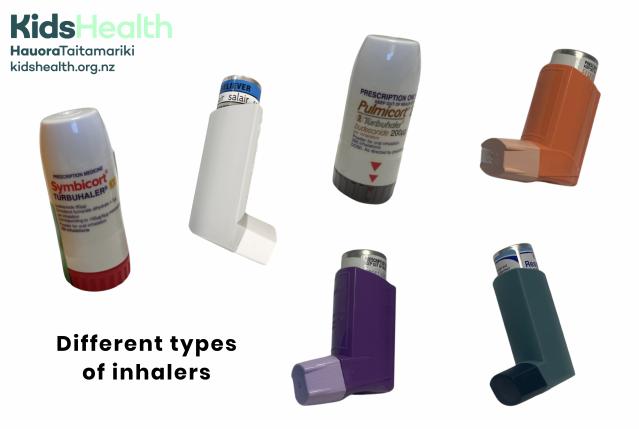
A photo of different types of inhalers used to give asthma medicine.
Source: KidsHealth
transcribeTranscript
The photo shows several different types of inhalers used to give asthma medicine.
The inhalers include:
- a Symbicort Turbuhaler
- a grey Salair inhaler
- a Pulmicort Turbuhaler
- an orange Flixotide inhaler
- a purple Seretide inhaler
- a blue Respigen inhaler
Text at the bottom left reads: Different types of inhalers.
At the top left is the KidsHealth logo with the website: kidshealth.org.nz
There are different inhaler medicines to manage asthma. Your child’s asthma medicines will depend on how their asthma is affecting them.
Relievers
Reliever medicines relax the muscles in the airways in the lungs. This helps your child to breathe more easily.
Reliever medicines work quickly, and their effect can last for up to 4 hours. Use a reliever if your child has coughing, wheezing or tightness in the chest.
Reliever medicines can help your child to feel better quickly. If your child needs to use their reliever more than 2 to 3 times a week, talk to your health professional. Your child may need to trial a preventer inhaler.
If your child gets asthma symptoms with exercise, your health professional may suggest trying a reliever before exercise.
Relievers work best when used with a spacer.
A photo of a spacer
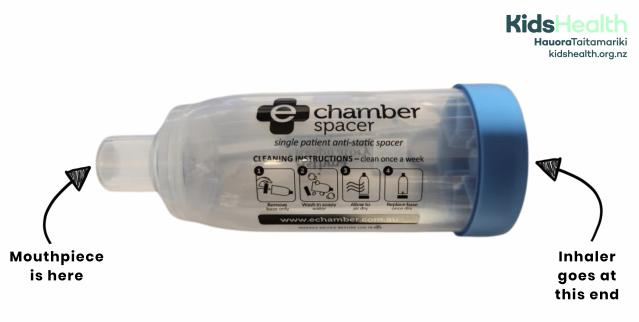
Photo of a spacer showing it has a mouthpiece at one end and an opening for the inhaler at the other.
Source: KidsHealth
transcribeTranscript
The photo shows a spacer lying horizontally.
- An arrow points to the narrow end of the spacer on the left. Text underneath says: Mouthpiece is here.
- An arrow points to the wider blue end of the spacer on the right. Text underneath says: Inhaler goes at this end.
At the top right is the KidsHealth logo with the website kidshealth.org.nz.
An example of a reliever inhaler attached to a spacer
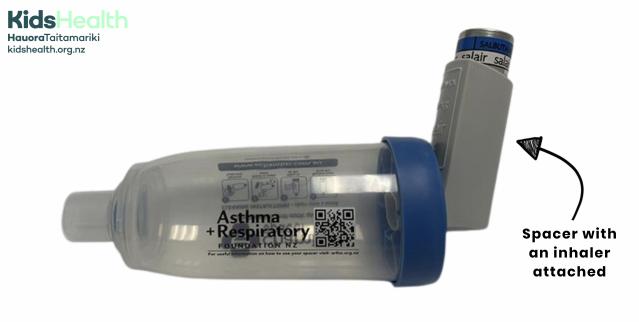
A photo of a reliever inhaler attached to a spacer.
Source: KidsHealth
transcribeTranscript
The photo shows a spacer with an inhaler attached at one end. The mouthpiece of the spacer is at the opposite end.
- An arrow points to the inhaler. Text underneath says: Spacer with an inhaler attached.
At the top left is the KidsHealth logo with the website kidshealth.org.nz.
Preventers
Preventers reduce the chance of your child having an asthma attack. Talk to your health professional about whether your child should have a preventer. Preventer medicines help reduce swelling and narrowing in the airways in the lungs.
Preventers work slowly to help improve your child's asthma symptoms. Your child won't notice any instant change in how they feel.
It’s best for your child to use a spacer with their preventer. This helps get the medicine to the right place in the lungs.
A preventer inhaler
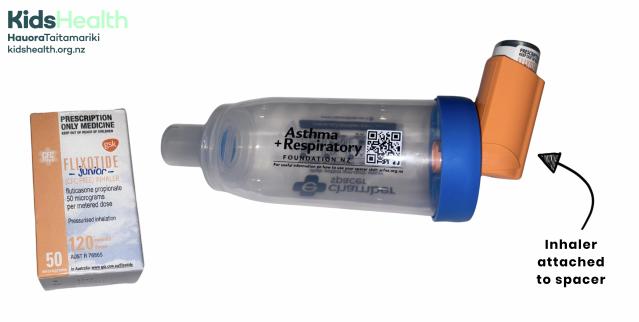
A photo of a preventer inhaler - Flixotide (fluticasone), attached to a spacer.
Source: KidsHealth
transcribeTranscript
The photo shows a box of Flixotide Junior beside a spacer with an orange Flixotide inhaler attached.
The box states that Flixotide Junior contains fluticasone propionate 50 micrograms per metered dose and contains 120 metered doses.
An arrow points to the orange inhaler with the label: Inhaler attached to spacer.
At the top left is the KidsHealth logo with the website: kidshealth.org.nz
Dry powder inhaler
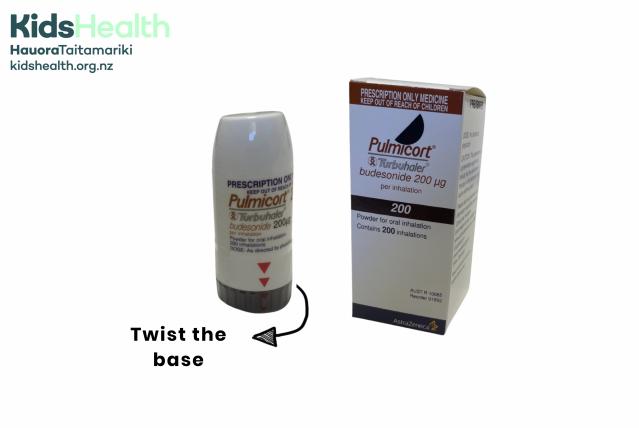
A photo of a dry powder inhaler - Pulmicort (budesonide). This is also called a Turbuhaler.
Source: KidsHealth
transcribeTranscript
The photo shows a Pulmicort Turbuhaler beside its box.
The box is labelled:
- Pulmicort Turbuhaler
- budesonide 200 micrograms per inhalation
- Powder for oral inhalation
- Contains 200 inhalations
An arrow points to the base of the Turbuhaler with the label: Twist the base.
At the top left is the KidsHealth logo with the website: kidshealth.org.nz
Combination inhalers
Combination inhalers contain both preventer and reliever medicines. They help to relieve asthma symptoms and prevent asthma attacks.
They need to be used every day, even if your child feels well. Some combination inhalers can be used during an asthma attack. Some tamariki need a different reliever during asthma attacks.
Examples of combination inhalers
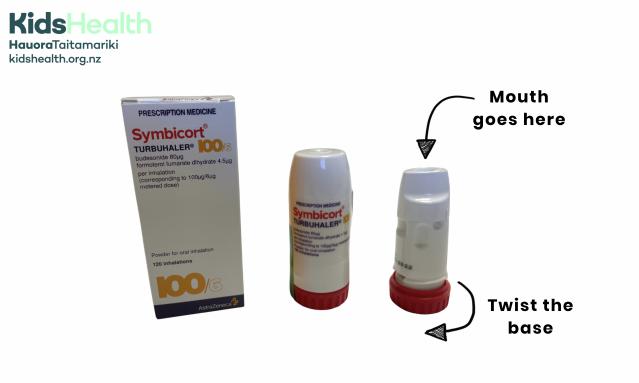
A photo of a combination inhaler - Symbicort (budesonide with formoterol). This is also called a Turbuhaler.
Source: KidsHealth
transcribeTranscript
The photo shows a box of Symbicort Turbuhaler 100/6 and 2 views of the inhaler. One shows the inhaler with its cap on. The other shows the inhaler with the cap removed.
An arrow points to the mouthpiece with the label: Mouth goes here.
Another arrow points to the red base of the inhaler with the label: Twist the base.
At the top left is the KidsHealth logo with the website: kidshealth.org.nz
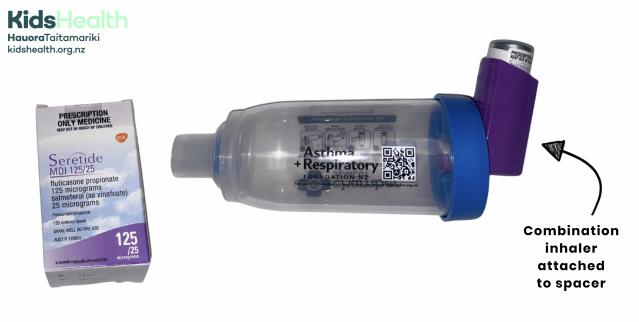
A photo of a combination inhaler - Seretide (fluticasone with salmeterol), attached to a spacer.
Source: KidsHealth
transcribeTranscript
The photo shows a box of Seretide MDI 125/25 beside a spacer with a purple Seretide inhaler attached.
The box states that Seretide contains fluticasone propionate 125 micrograms and salmeterol 25 micrograms.
An arrow points to the inhaler attached to the spacer with the label: Combination inhaler attached to spacer.
At the top left is the KidsHealth logo with the website: kidshealth.org.nz
Other asthma medicines
Oral steroids
Your child may need oral steroids (Redipred), if they have an asthma attack. Oral steroids reduce the swelling inside your child's airways.
Oral steroids come as tablets or a liquid.
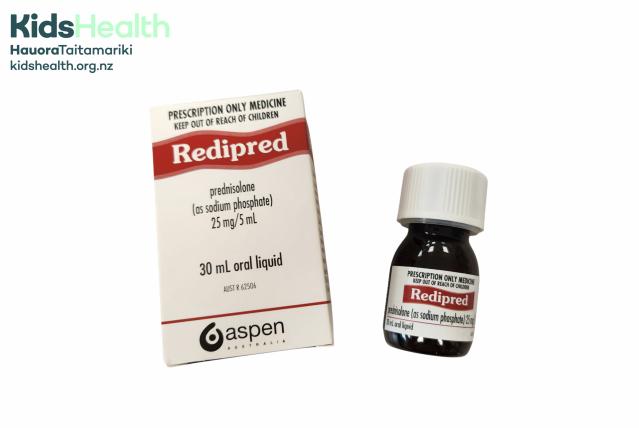
A photo of an oral steroid - Redipred (prednisolone).
Source: KidsHealth
transcribeTranscript
The photo shows a box and bottle of Redipred, a prescription-only medicine.
The box is labelled:
Redipred
prednisolone (as sodium phosphate)
25 mg/5 mL
30 mL oral liquid
The bottle beside the box has a matching Redipred label.
At the top left is the KidsHealth logo with the website: kidshealth.org.nz
Your child will need to continue with their usual inhalers.
Read more about Redipred (prednisolone).
Prednisolone For An Asthma Attack
Montelukast
Montelukast can be helpful for some tamariki with asthma and wheeze.
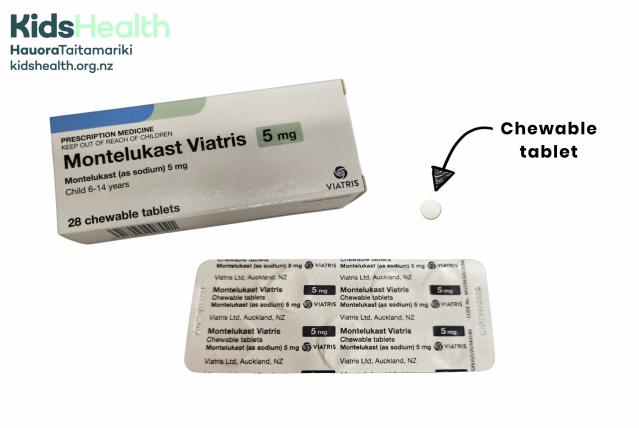
A photo of a montelukast box, packet and tablet.
Source: KidsHealth
transcribeTranscript
The photo shows a box of Montelukast, a blister pack of montelukast and a single chewable tablets.
- The box states that the medicine is for children aged 6 to 14 years and contains 28 chewable tablets.
- Beside the box is a single round tablet. An arrow points to the tablet with the label: Chewable tablet
The KidsHealth logo and website, kidshealth.org.nz, appear at the top left.
Asthma action plan
Ask your child's health professional for an asthma action plan. The best way to manage your child’s asthma symptoms is to follow their asthma action plan.
Having an asthma action plan gives guidance on what medicines to use and when. This is for interval symptoms and asthma attacks. It’s a good idea to review the asthma action plan every year.
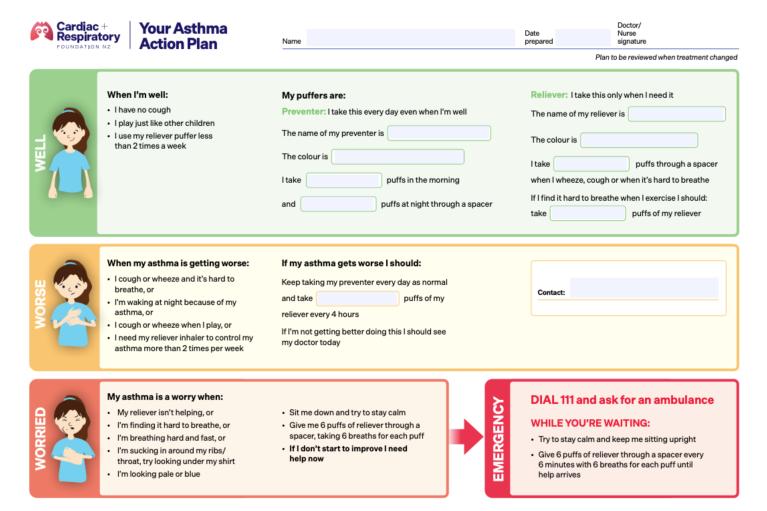
Take a look at the Cardiac + Respiratory Foundation NZ website for an example of what a blank asthma plan looks like. It's available in English, te reo Māori, Samoan and Tongan.
More information and support
Asthma Interval Symptoms In Children
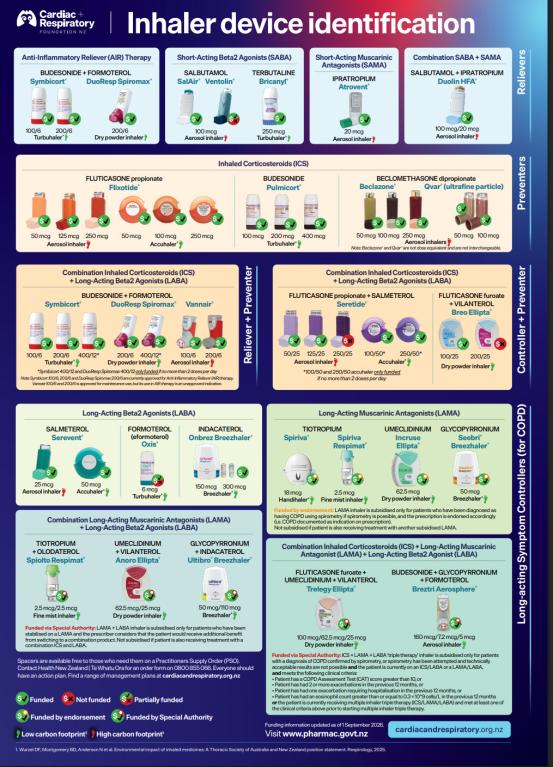
Check these resources at the Asthma + Respiratory Foundation website:
In this video, Lachlan is showing how to use an inhaler with a spacer.
Source: Asthma Waikato
transcribeTranscript
[Music]
[Health professional]
Hi everyone, this is Lachlan and he is my asthma star today and he's going to show us how to use the MDI inhaler with the spacer correctly.
Right Lachlan, first of all we're going to take off the lid of the inhaler.
We're going to shake the inhaler - mix the medicine and aerosol together. We're going to place the inhaler into the spacer and place the spacer mouthpiece into the mouth forming a good seal.
Now one puff with 6 breaths.
Using the spacer delivers 50% more medicine.
Well done Lachlan.
To have another dose, we need to shake the inhaler again, place the inhaler into the spacer and repeat the sequence.
Remember everyone, it's one puff with 6 breaths.
The spacer's washed once a week with warm soapy water and allowed to drip-dry.
Place the lid back onto the inhaler.
Children aged 0 to 4 years are recommended to use a mask with the spacer.
Between the ages of 2 and 4, start weaning off the mask.
Using the spacer without the mask delivers ⅔ more medicine to the lungs than using the mask. However, during an acute flare-up, a good seal with the mouthpiece may not be achievable. So using a mask might be required.
Well done Lachlan and thank you for showing us how to use the MDI inhaler with the spacer correctly.
A video about how to use a Turbuhaler - a common dry powder inhaler.
Source: Healthify He Puna Waiora
transcribeTranscript
Kia ora, my name is Tasha and I'm a pharmacist at Auckland City Hospital.
Today I'm going to show you how to use your Turbuhaler.
First you'll need to remove the cap.
Do this by twisting the cap until it comes off.
Next, you'll need to activate your dose.
To do this, twist the base, first anti-clockwise and then back til you hear a click
To inhale your dose, you will need to breathe out away from your device.
Then, make a tight seal around the mouthpiece with your lips, and breath in rapidly.
Once you get down to around 10 doses, this window will become partially coloured red.
When this happens, you'll need to go and get a repeat from your pharmacist, or a new prescription from your doctor.
After you've inhaled your dose, replace the cap and twist it until it is on properly.
Do not wash this device in water as it will damage the inhaler.
If it needs a clean, clean it with a clean dry cloth, especially around the mouthpiece.
If you have any questions about any of the inhaler devices, please go and ask your pharmacist.
They'll be more than happy to help and answer any questions.

Asthma New Zealand provides information. They also offer free appointments to people with asthma in some regions, or nationally through telehealth. You can self-refer or a health professional can refer you.

Cardiac + Respiratory Foundation NZ brings together the Asthma and Respiratory Foundation NZ, Kia Manawanui Trust – The Heart of Aotearoa, Lung Foundation NZ, and the Bronchiectasis Foundation NZ. Check out their website for information and resources on asthma and other respiratory conditions.
