

Key points about spacers
- your child needs to use a spacer with a metered dose inhaler (MDI)
- spacers helps deliver asthma inhaler medicine to the right place in the lungs
- always have a spacer with your child wherever they go
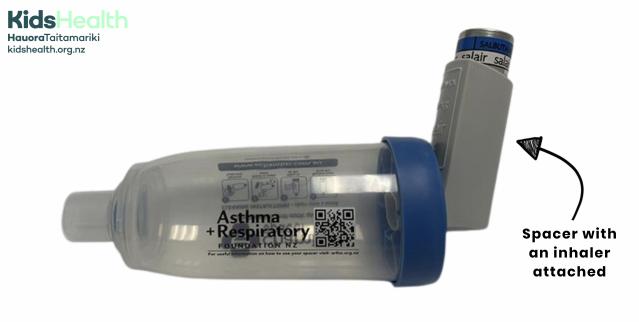
A photo of a reliever inhaler attached to a spacer.
Source: KidsHealth
transcribeTranscript
The photo shows a spacer with an inhaler attached at one end. The mouthpiece of the spacer is at the opposite end.
- An arrow points to the inhaler. Text underneath says: Spacer with an inhaler attached.
At the top left is the KidsHealth logo with the website kidshealth.org.nz.
What is a spacer?
A spacer is a cylinder that helps deliver asthma inhaler medicine to the right place in the lungs.
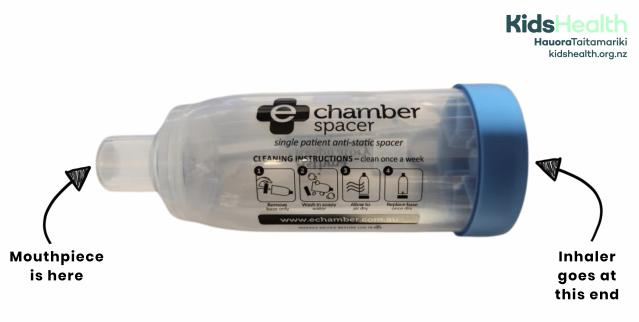
Photo of a spacer showing it has a mouthpiece at one end and an opening for the inhaler at the other.
Source: KidsHealth
transcribeTranscript
The photo shows a spacer lying horizontally.
- An arrow points to the narrow end of the spacer on the left. Text underneath says: Mouthpiece is here.
- An arrow points to the wider blue end of the spacer on the right. Text underneath says: Inhaler goes at this end.
At the top right is the KidsHealth logo with the website kidshealth.org.nz.
A spacer helps prevent the medicine staying in the mouth and throat. This can cause side effects such as:
- sore throat
- hoarse voice
- fungal throat and mouth infections
It’s important for your child to rinse their mouth out after using preventer medicine.
How to use an inhaler with a spacer
See the 5 steps for using an MDI with a spacer.
Hold the inhaler upright and give it a good shake.

Fit the inhaler into the opening at the end of the spacer.

Seal the lips firmly around the mouth piece. Younger tamariki need to use a mask. Press the inhaler once only.

Take 6 slow breaths in and out through the mouth. Don't remove the spacer from the mouth between breaths.

Remove the spacer from the mouth. Repeat steps 1 to 4 for further doses.

Tamariki under 4 need to use a mask attached to their spacer.
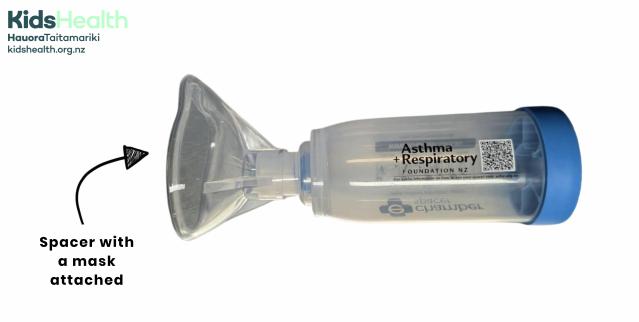
A photo of a spacer with a face mask attached.
Source: KidsHealth
transcribeTranscript
The photo shows a spacer with a clear face mask attached to the mouthpiece.
An arrow points to the face mask with the label: Spacer with a mask attached.
At the top left is the KidsHealth logo with the website: kidshealth.org.nz
In this video, Lachlan is showing how to use an inhaler with a spacer.
Source: Asthma Waikato
transcribeTranscript
[Music]
[Health professional]
Hi everyone, this is Lachlan and he is my asthma star today and he's going to show us how to use the MDI inhaler with the spacer correctly.
Right Lachlan, first of all we're going to take off the lid of the inhaler.
We're going to shake the inhaler - mix the medicine and aerosol together. We're going to place the inhaler into the spacer and place the spacer mouthpiece into the mouth forming a good seal.
Now one puff with 6 breaths.
Using the spacer delivers 50% more medicine.
Well done Lachlan.
To have another dose, we need to shake the inhaler again, place the inhaler into the spacer and repeat the sequence.
Remember everyone, it's one puff with 6 breaths.
The spacer's washed once a week with warm soapy water and allowed to drip-dry.
Place the lid back onto the inhaler.
Children aged 0 to 4 years are recommended to use a mask with the spacer.
Between the ages of 2 and 4, start weaning off the mask.
Using the spacer without the mask delivers ⅔ more medicine to the lungs than using the mask. However, during an acute flare-up, a good seal with the mouthpiece may not be achievable. So using a mask might be required.
Well done Lachlan and thank you for showing us how to use the MDI inhaler with the spacer correctly.
Caring for spacers
Wash the spacer once a week with a mild dishwashing detergent. Then leave it to air dry. This will stop the medicine from sticking to the spacer and blocking the valve at the mouthpiece.
Your child needs a new spacer every year. You can get this when you see a health professional to update your child's asthma action plan.
Asthma action plan
Ask your child's health professional for an asthma action plan. The best way to manage your child’s asthma symptoms is to follow their asthma action plan.
Having an asthma action plan gives guidance on what medicines to use and when. This is for interval symptoms and asthma attacks. It’s a good idea to review the asthma action plan every year.
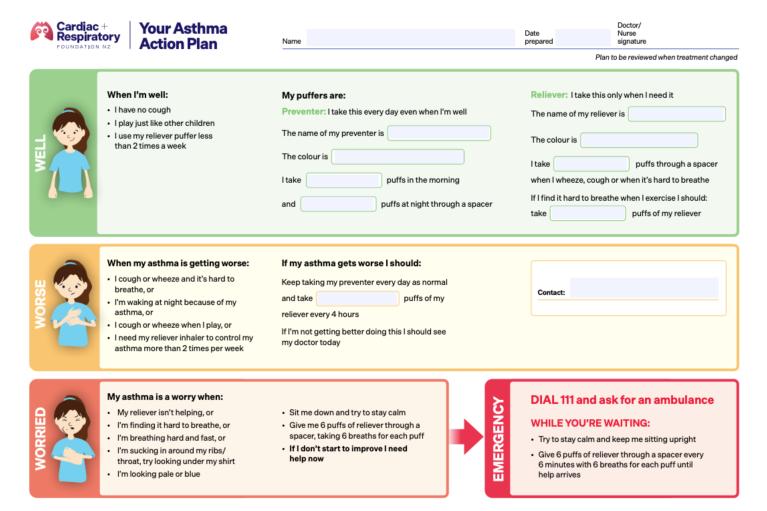
Take a look at the Cardiac + Respiratory Foundation NZ website for an example of what a blank asthma plan looks like. It's available in English, te reo Māori, Samoan and Tongan.
More information and support
Asthma Interval Symptoms In Children

Read a booklet about managing your child's asthma in English, te reo Māori or Samoan.

Asthma New Zealand provides information. They also offer free appointments to people with asthma in some regions, or nationally through telehealth. You can self-refer or a health professional can refer you.

Cardiac + Respiratory Foundation NZ brings together the Asthma and Respiratory Foundation NZ, Kia Manawanui Trust – The Heart of Aotearoa, Lung Foundation NZ, and the Bronchiectasis Foundation NZ. Check out their website for information and resources on asthma and other respiratory conditions.
Acknowledgements
The photos of the child using the spacer are from Asthma + Respiratory Foundation NZ.
