

Key points about inflammatory bowel disease
- the 2 main types of inflammatory bowel disease are Crohn’s disease and ulcerative colitis
- inflammatory bowel disease causes ongoing inflammation in the digestive system
- symptoms can include tummy pain, ongoing watery poo, blood in the poo, tiredness, weight loss and poor growth
- inflammatory bowel disease is a long-term condition, but treatment can control inflammation
What is inflammatory bowel disease?
Inflammatory bowel disease (IBD) causes inflammation in the digestive system (gastrointestinal tract).
IBD is a long-lasting (chronic) condition. With effective treatment, tamariki with IBD can remain symptom-free for long periods.
There are 2 main types of IBD.
Crohn's disease
Crohn's disease can affect any part of the digestive system from the mouth to the bottom (anus). It commonly affects the large bowel (colon) and the end of the small bowel. Inflamed areas can occur between areas of healthy bowel.
Ulcerative colitis
Ulcerative colitis affects the colon and rectum. Inflammation usually starts in the rectum and can extend through part or all of the colon.
Inflammatory bowel disease unclassified (IBDU)
Sometimes there is inflammation affecting the digestive system, but it is not clear whether it is caused by Crohn’s disease or ulcerative colitis at the time of diagnosis. This is called inflammatory bowel disease unclassified, or IBDU. Over time it may become clearer that your child has Crohn’s or ulcerative colitis.
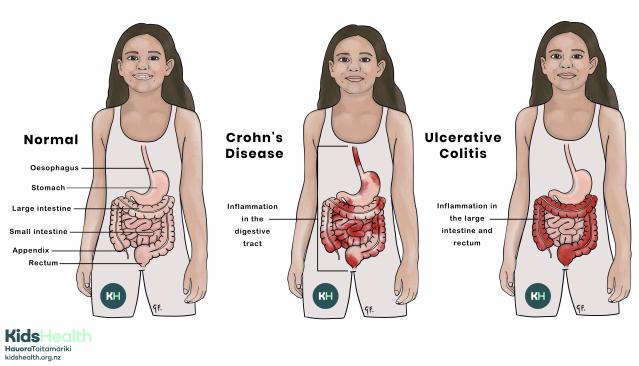
This illustration shows a normal digestive system compared with Crohn’s Disease and Ulcerative Colitis.
Source: KidsHealth
transcribeTranscript
The illustration shows three side-by-side images of the same girl with an overlay of the gastrointestinal tract.
On the left, the diagram is labelled Normal. It shows the digestive system with the oesophagus, stomach, small intestine, large intestine, appendix, and rectum. All organs look healthy.
In the middle, the diagram is labelled Crohn’s Disease. It shows the same digestive system, but areas of the digestive tract are coloured red to show inflammation. A label reads: Inflammation in the digestive tract.
On the right, the diagram is labelled Ulcerative Colitis. It shows the same digestive system, but the large intestine and rectum are coloured red to show inflammation. A label reads: Inflammation in the large intestine and rectum.
At the bottom left is the KidsHealth logo with the website: kidshealth.org.nz.
How common is inflammatory bowel disease?
IBD is becoming increasingly common around the world. More young tamariki are now developing IBD.
Causes of inflammatory bowel disease
The exact cause of inflammatory bowel disease is not known. It is likely to be due to a combination of factors.
Genetic factors (family history)
IBD can run in families. A child is more likely to develop IBD if a close family member has Crohn’s disease or ulcerative colitis. But most tamariki with IBD do not have a close relative with the condition.
Many different genes may affect a person’s chance of developing IBD. Genes alone do not cause it.
Immune system
The immune system plays a key role in the development of IBD. The immune system normally protects the body from infections. In tamariki with IBD, the immune system may react in an unusual way and contribute to inflammation in the digestive system. This can damage the lining of the bowel.
Smoking
People who smoke are more likely to develop Crohn's disease and may have more severe disease. Protect your child from cigarette smoke and vaping aerosols.
Diet
No one specific food causes inflammatory bowel disease. Researchers are looking at how food and the environment may be linked to IBD. A healthy diet with a variety of foods, especially fruit and vegetables, may help reduce the risk of developing IBD.
Some foods may make symptoms worse for some tamariki, particularly during a flare-up.
Signs and symptoms of inflammatory bowel disease
IBD causes parts of the digestive system to become inflamed and ulcerated. The symptoms will depend on which parts are involved and how much of the digestive system is affected.
Symptoms of IBD in children
If your child has IBD (Crohn's or ulcerative colitis), they may have:
- tummy pain
- loose, watery poo (diarrhoea), which may be bloody or contain mucus
- ana from the bottom (rectal bleeding)
- needing to poo urgently, frequently, or with little warning
- waking during the night to poo
- tiredness
- weight loss
- fever
- poor growth
- loss of appetite
- anaemia or low iron
- nausea
- vomiting
- joint or bone pain
If your child has Crohn's disease, they may also have:
- mouth ulcers
- perianal abscesses (pus collections under the skin near the bottom)
What to do if your child has symptoms of IBD
If you are worried that your child may have IBD, take them to a health professional.
How inflammatory bowel disease is diagnosed
Appointment with a health professional
When you take your child to a health professional, they will ask about your child’s symptoms. They will also examine your child.
Tests
Your child may need some tests that may include:
Blood tests
To look for signs of inflammation, anaemia and nutrient deficiencies.
Poo samples
To look for infection, parasites and inflammation.
Appointment with a specialist
Your health professional may arrange an appointment with a specialist. This may be a doctor who specialises in children's health (paediatrician).
Endoscopy
If the results of the tests show that your child could have IBD, they may need an endoscopy. An endoscopy is a test that involves passing a flexible camera into the bowel through either the mouth (a gastroscopy) or bottom (a colonoscopy). The endoscopy helps the specialist look for inflammation in the digestive system.
Your child will usually have a general anaesthetic for the endoscopies. This means they will be asleep during the procedure.
Your child will usually have both a gastroscopy and a colonoscopy.
Gastroscopy
During a gastroscopy, the specialist passes a thin, flexible tube with a camera through your child’s mouth. The tube goes down into the food pipe (oesophagus), stomach and the first part of the small bowel.
Colonoscopy
During a colonoscopy, the specialist passes a thin, flexible tube with a camera through your child’s bottom. This allows the specialist to look at the colon and the far end of the small bowel.
During these two procedures, the specialist will take tiny samples of tissue called biopsies. These are tested in a laboratory to look for signs of IBD.
Scans and other tests
Your child may need a scan to look at parts of the small bowel that cannot be seen during an endoscopy.
This may include:
- an MRI scan of the bowel, called magnetic resonance enterography
- an ultrasound scan of the bowel
- a small camera that your child swallows, called capsule endoscopy
- an x-ray dye test of the bowel, called a barium study
Capsule Endoscopy For Children
The healthcare team will also check for other possible causes of your child's symptoms.
Treatment of inflammatory bowel disease
Treatment for IBD depends on which parts and how much of the digestive system is affected. It also depends on whether your child has Crohn's disease, ulcerative colitis or IBDU.
Treatment for IBDU usually follows a similar approach to treatment for ulcerative colitis. The healthcare team will continue to review your child, as their type of IBD may become clearer over time.
The aims of treatment are to:
- control inflammation
- relieve symptoms
- help the bowel heal
- support healthy growth and nutrition
- ensure that your child lives a full and active life
- reduce the risk of flare-ups and complications
What is the best diet if my child has inflammatory bowel disease?
Most tamariki with IBD can eat a normal, balanced diet when their symptoms are under control. Your child may need changes to their diet during a flare-up or while having certain treatments.
Your child's healthcare team can guide you if you need to make any diet changes. Some tamariki will meet with a dietitian as part of their treatment.
Ongoing check-ups for your child with inflammatory bowel disease
Tamariki with IBD need regular check-ups with their specialist healthcare team.
These appointments help the team:
- check your child’s symptoms
- monitor their growth, development and nutrition
- check whether treatment is controlling inflammation
- look for possible side effects of treatment
- support your child’s emotional wellbeing and participation in school and other activities
Check-ups can include blood tests, poo tests, scans and sometimes another endoscopy. It's important to attend appointments and have the tests the healthcare team recommends.
When to get medical help for your child with inflammatory bowel disease
Contact your child's healthcare team if:
- their symptoms are getting worse or are not improving
- they are losing weight
- their medicines are making them feel unwell
- they develop any new symptoms
- you are worried about their health
How inflammatory bowel disease may affect your child
IBD can be mild and easily controlled in some tamariki and rangatahi (young people). Others may have IBD that is more difficult to manage.
Your child may need to go to the toilet often, urgently and with little warning. Worrying about not reaching a toilet in time can cause anxiety, especially at school. Talk to your child’s school about how they can support your child.
Can my child with inflammatory bowel disease live a full and active life?
Yes. At times, symptoms or treatment may affect your child’s daily life. It may also take time to find the treatment that works best for them. Effective treatment and support can help most tamariki with IBD stay well. This means they can enjoy school, sport, friendships and other activities.
Possible health risks for children with inflammatory bowel disease
Long-term bowel health
People who have had ongoing inflammation in the colon for many years have a higher risk of bowel cancer. This can happen with ulcerative colitis or Crohn’s disease that affects the colon.
The risk is very low during childhood. As your child gets older, their specialist will let you know when regular colonoscopies should begin and how often they are needed. These colonoscopies can help find early changes before they develop into bowel cancer.
Liver and bile duct problems
A small number of people with IBD develop inflammation in the liver or bile ducts. Your child will have regular blood tests to check their liver. They may need more tests if the results are not normal.
More information and support

You can contact Crohn's and Colitis New Zealand for more information and support. They have information for parents, teens and children including a newsletter and support groups.
Camp Purple Live
Crohn’s and Colitis New Zealand runs Camp Purple Live. This annual camp is for tamariki and rangatahi living with inflammatory bowel disease. The camp gives tamariki an opportunity to meet others with similar experiences. It helps them build confidence as they take part in camp activities.
Crohn’s and Colitis New Zealand may also offer events for younger tamariki and seminars for parents and caregivers. Check their website for current dates, age requirements and registration information.
A video all about Camp Purple, run by Crohn's and Colitis New Zealand. Camp Purple is where tamariki and rangatahi can interact with others with similar challenges.
Source: Crohn's and Colitis NZ
Acknowledgements
Illustration by Dr Greta File. Property of KidsHealth.
References
Paediatric Gastroenterology Clinical Network. Management of Inflammatory Bowel Disease in Children and Adolescents in New Zealand. A Clinical Guideline. 2014.
