

Key points about ulcerative colitis treatment
- treatment options depend on the severity of your child’s ulcerative colitis
- management may include medicines, surgery or changes to your child’s diet
- talk to your health professional about your child’s medicines and make sure you know why your child is taking them
- effective treatment can control inflammation and reduce the risk of flare-ups and complications
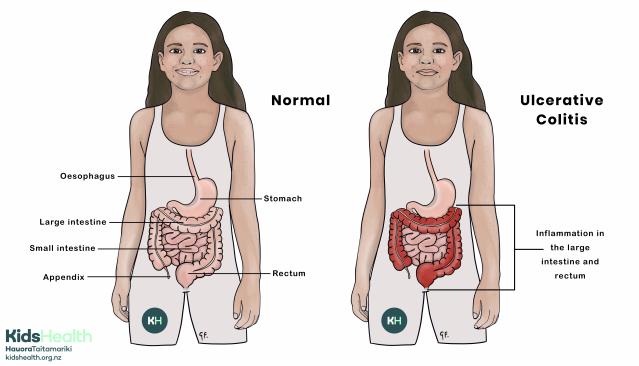
This illustration shows a normal digestive system compared with ulcerative colitis, where there is inflammation in the large intestine and rectum.
Source: KidsHealth
transcribeTranscript
The illustration shows two side-by-side images of the same girl with an overlay of the gastrointestinal tract.
On the left, the diagram is labelled Normal. It shows the digestive system with the oesophagus, stomach, small intestine, large intestine, appendix, and rectum. All organs look healthy.
On the right, the diagram is labelled Ulcerative Colitis. It shows the same digestive system, but the large intestine and rectum are coloured red to show inflammation. A label reads: Inflammation in the large intestine and rectum.
At the bottom left is the KidsHealth logo with the website: kidshealth.org.nz
Ulcerative colitis is one of the main types of inflammatory bowel disease (IBD).
Treatment options for children with ulcerative colitis
Treatment aims
The aims of treatment for ulcerative colitis are to:
- control inflammation
- relieve symptoms
- help the bowel heal
- support healthy growth and nutrition
- ensure that your child lives a full and active life
- reduce the risk of flare-ups and complications
Some tamariki may need to see a dietitian as part of their treatment.
Treatment options
Treatment depends on how severe your child’s ulcerative colitis is and how much of their colon is affected. Your child’s healthcare team will talk with you and your child about the best treatment.
Effective treatment can control inflammation and reduce symptoms. It may take some time to find the treatment that works best for your child.
How medicines help children with ulcerative colitis
The aims of treatment with medicines
In ulcerative colitis, the immune system reacts in an unusual way and contributes to inflammation in the large bowel (colon). Some medicines calm or block parts of this immune response. This can reduce inflammation and help the bowel heal.
Your child may need medicines to:
- reduce inflammation
- relieve symptoms such as pain, diarrhoea and bleeding
- help the bowel heal
- keep ulcerative colitis under control
- ensure that they can enjoy a full and active life
- replace vitamins or minerals they are lacking
Being informed about your child's medicines
Talk to your health professional about your child’s medicines. Make sure you know:
- the names of the medicines
- how much medicine to give
- when and how to give each medicine
- why your child is taking each medicine
- possible side effects
Alternative or complementary treatments
Friends or family may suggest alternative medicines or treatments. Talk to your child’s healthcare team before trying these. Some treatments may be harmful or affect how your child’s medicines work.
Medicines for ulcerative colitis
Aminosalicylates (or 5ASA medicines)
These medicines are a treatment for tamariki with mild to moderate symptoms and for mild flare-ups. Mesalazine is an example of an aminosalicylate medicine. Your child may take these as tablets, capsules, granules or by enema or suppository in their bottom (rectum or back passage). Other aminosalicylate medicines include olsalazine and sulfasalazine.
Steroids
Steroids are for treatment of flares of your child’s ulcerative colitis. These are not expected to be for long-term use. Examples include budesonide, prednisone and methylprednisolone. Your child may take these as tablets or capsules, liquid or into a vein (intravenously). Hydrocortisone can be given as an enema into the bottom (rectum or back passage).
Immunosuppressants
Your health professional may prescribe one of these medicines if your child's symptoms cannot be effectively treated with an aminosalicylate medicine alone. An example of an immunosuppressant medicine is azathioprine.
Biologics
Biologic medicines work on controlling your immune system. They target specific proteins or pathways that cause inflammation and damage.
There are a number of biologic medicines. Each targets the inflammation in inflammatory bowel disease (IBD) in different ways.
TNF inhibitors
TNF stands for tumour necrosis factor. It is one of the causes of inflammation in ulcerative colitis.
TNF inhibitors are for tamariki who either:
- have severe ulcerative colitis, or
- have symptoms that don't improve when they take other medicines
Examples of TNF inhibitors are:
- infliximab (given as an infusion via an IV line)
- adalimumab (given as an injection under the skin)
Ustekinumab
Ustekinumab is a medicine that works by blocking another natural inflammatory substance in your body. This medicine helps to decrease inflammation in the gut, which eases symptoms. This may slow or stop damage from ulcerative colitis.
If tamariki with severe ulcerative colitis do not respond to treatment with TNF inhibitors, they may need to receive treatment with Ustekinumab.
This medicine is given as an infusion initially and then as an injection under the skin.
Vedolizumab
Vedolizumab is another medicine for tamariki with severe ulcerative colitis. This medicine acts to stop white blood cells reaching the wall of the bowel. This helps reduce inflammation in the bowel.
Tamariki have this medicine as an infusion into a vein.
Upadacitinib
This medicine is a tablet that is taken by mouth every day.. It is another medicine for tamariki with severe ulcerative colitis.
Vitamins and minerals
Ulcerative colitis can affect how well the body absorbs some vitamins and minerals. Some tamariki may need vitamin and mineral supplements.
These may include:
- iron
- vitamin D
- vitamin B12
- folate
- magnesium
- calcium
Nutrition and diet for children with ulcerative colitis
Ulcerative colitis is not caused by any specific food. Most tamariki with ulcerative colitis can eat a varied, balanced diet when they are well.
Eating during flare-ups
During a flare-up, some foods may make symptoms such as diarrhoea, tummy pain or bloating worse. This is different for every child.
It may help to:
- offer smaller meals more often
- keep a short diary of what your child eats and any symptoms they have
- avoid foods that clearly make your child’s symptoms worse
Some tamariki find that spicy, oily or fatty foods make their symptoms worse. Fizzy drinks and drinks containing caffeine may also make symptoms worse.
Raw fruit and vegetables can be harder to tolerate during a flare-up. Cooking, peeling or blending them may make them easier to eat.
Some tamariki may find that milk or other dairy products make their symptoms worse. Do not remove dairy foods for a long time without talking to your child’s healthcare team or dietitian.
Your child’s healthcare team or dietitian can help you make sure your child is still getting enough energy and nutrients.
Eating when well
When your child is well, they usually do not need to avoid particular foods. Encourage them to eat a full and varied diet.
Can a low FODMAP diet help my child with ulcerative colitis?
A low FODMAP diet (a diet that avoids certain sugars) is not an effective treatment for the inflammation in ulcerative colitis.
However, a low FODMAP diet can be useful in managing other tummy symptoms that can occur in tamariki with ulcerative colitis. These symptoms are like those seen in irritable bowel syndrome (IBS), which can be present with ulcerative colitis. It is important to talk with your child's healthcare team before making any significant changes to your child's diet.
Surgery for ulcerative colitis
Some tamariki with ulcerative colitis may need surgery. Your child’s healthcare team will talk with you about this if surgery may be needed.
For tamariki with very severe ulcerative colitis, surgery to remove the colon can remove the part of the bowel affected by the disease. Surgery is usually considered after medicines have been tried.
More information and support
Any long-lasting illness may affect a child’s mental health, general wellbeing and quality of life. If their ulcerative colitis is difficult to treat, it may affect their school and participation in daily activities.
If you are concerned that your child is finding it difficult to cope with having ulcerative colitis, it is important to discuss this with your child’s healthcare team. Additional support can be provided. You can also reach out to Crohn's and Colitis New Zealand for more information and support.

You can contact Crohn's and Colitis New Zealand for more information and support. They have information for parents, teens and children including a newsletter and support groups.
Acknowledgements
Illustration by Dr Greta File. Property of KidsHealth.
References
Paediatric Gastroenterology Clinical Network. Management of Inflammatory Bowel Disease in Children and Adolescents in New Zealand. A Clinical Guideline. 2014.
