

Key points about Crohn's disease treatment in children
- treatment options depend on how severe your child's Crohn's disease is
- treatment for tamariki (children) with Crohn's disease may include medicines, special diets or surgery
- talk to your health professional about your child's medicines and make sure you know about the medicines and why your child is taking them
- effective treatment can control inflammation and reduce the risk of flare-ups and complications
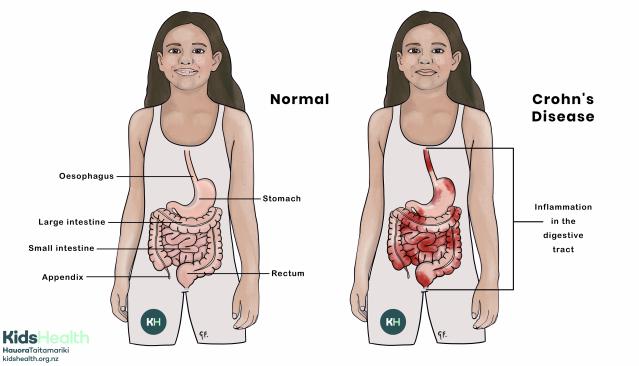
This illustration shows a normal digestive system compared with Crohn’s Disease, where there is inflammation in the digestive tract.
Source: KidsHealth
transcribeTranscript
The illustration shows two side-by-side images of the same girl with an overlay of the gastrointestinal tract.
On the left, the diagram is labelled Normal. It shows the digestive system with the oesophagus, stomach, small intestine, large intestine, appendix, and rectum. All organs look healthy.
On the right, the diagram is labelled Crohn’s Disease. It shows the same digestive system, but areas of the digestive tract are coloured red to show inflammation. A label reads: Inflammation in the digestive tract.
At the bottom left is the KidsHealth logo with the website: kidshealth.org.nz
Crohn's disease is one type of inflammatory bowel disease (IBD).
Treatment options for children with Crohn's disease
Treatment aims
The aims of treatment for Crohn's disease are to:
- control inflammation
- relieve symptoms
- heal the surface of the bowel
- make sure your child is growing well
- make sure your child has the vitamins and minerals they need
Most tamariki will meet with a dietitian as part of their treatment.
Treatment options
Treatment options depend on how severe your child's Crohn's disease is. Your child's paediatrician or other specialist will talk with you and your child about the best treatment.
With the right treatment, it's possible to manage your child's symptoms and prevent flare-ups. It can take some time to find the best treatment for your child.
Exclusive enteral nutrition for children with Crohn's disease
Exclusive enteral nutrition (EEN) is a treatment for Crohn's disease. It involves drinking a formula for a specific period, instead of drinking and eating usual food.
EEN uses a specifically balanced formula that meets all of your child's daily nutritional needs. EEN can reduce inflammation and help the lining of the bowel heal. This should also help your child regain weight they have lost because of their condition.
Often tamariki have EEN as the first treatment after they are diagnosed with Crohn's disease. They may also have EEN if they have a relapse.
EEN works as well as medicines and has minimal side effects. Some tamariki having EEN may have mild nausea, bloating or runny poo.
How long will my child need exclusive enteral nutrition?
Usually, tamariki have EEN for around 8 weeks. Some tamariki will continue to drink a small volume of formula for longer. Your child's dietitian will tell you how much of the formula you will need to give.
How will my child take exclusive enteral nutrition?
EEN comes in a number of flavours. Most tamariki will drink the EEN. For tamariki who are unable to drink the EEN, it may be given through a flexible tube which goes through the nose and into the stomach (a nasogastric tube).
When your child is taking EEN, they need to drink extra water but they should not have any other food or drink.
EEN provides all your child’s nutrition so they don't need any other food. It is important that your child keeps drinking water as the only other fluid.
Storing EEN
Follow the storage instructions on the formula and advice from your child’s dietitian.
Some formulas need refrigeration once opened or prepared. Chilling the formula may make it easier to drink.
You can freeze EEN so the servings are still cold when your child has it at school.
When can my child have regular food and drink again?
At the end of EEN, your child will reintroduce usual food while reducing the amount of formula over a number of days. Their dietitian will give you a food reintroduction plan that works for your child.
How medicines help children with Crohn's disease
The aims of treatment with medicines
Treatment for tamariki with Crohn's disease may include medicines to:
- stop or control the inflammation
- stop the disease from getting worse, or keep your child free from symptoms
- prevent the immune system from attacking the body and causing the inflammation - your child may have some of these medicines by injection or infusion in hospital
- manage symptoms such as pain, nausea or indigestion
- provide the body with missing vitamins and minerals
Being informed about your child's medicines
Talk to your health professional about your child’s medicines. Make sure you know:
- the names of the medicines
- how much medicine to give
- when and how to give each medicine
- why your child is taking each medicine
- possible side effects
Alternative or complementary treatments
Your friends and family may suggest trying alternative medicines or treatments. Please discuss these with your health professional first, as some therapies can be harmful or may interact with your child's current medicines.
Medicines for Crohn's disease
Tamariki with Crohn's disease may need to take more than one medicine regularly. When any medicine is considered, your child’s specialist will go through the risks and the benefits, and mention possible important side effects.
Steroids
These are for treatment of flares of Crohn’s disease. These are not for long-term use. Examples include:
- budesonide
- prednisone
- methylprednisolone
Your child may have steroids as tablets, capsules, liquid or directly into a vein (intravenously). They can also be given as enemas.
Immunosuppressants
Some tamariki with Crohn's disease will receive medicine to suppress the immune system. This can help reduce the inflammation in the bowel. An example is azathioprine.
Aminosalicylates
These are medicines that may be used for tamariki with mild to moderate symptoms. Examples include mesalazine, which your child may take as tablets, capsules or granules. These medicines can also be given as suppositories or enemas.
Biologics
Biologic medicines work on controlling your immune system. They target specific proteins or pathways that cause inflammation and damage.
There are a number of biologic medicines. Each targets the inflammation in Crohn’s disease in different ways.
TNF inhibitors
TNF stands for tumour necrosis factor. It is one of the causes of inflammation in Crohn's disease.
TNF inhibitors are for tamariki who have:
- severe Crohn's disease, or
- symptoms that don't improve when they take other medicines, or
- a complication of Crohn’s disease that involves a fistula (an abnormal connection between the intestine and the skin or between two parts of the intestine)
Examples of TNF inhibitors are:
- infliximab (given as an infusion via an IV line)
- adalimumab (given as an injection under the skin)
Ustekinumab
Ustekinumab is a medicine that works by blocking another inflammatory substance in your body. This medicine helps to decrease inflammation in the gut, which eases symptoms. This may slow or stop damage from Crohn's disease.
If tamariki with severe Crohn's disease do not respond to treatment with TNF inhibitors, they may need to have ustekinumab.
This medicine is given as an infusion initially and then as an injection under the skin.
Vedolizumab
Vedolizumab is another medicine for tamariki with severe Crohn's disease. This medicine acts to stop white blood cells reaching the wall of the bowel. This helps reduce inflammation in the bowel.
Tamariki have this medicine as an infusion into a vein.
Upadacitinib
This medicine is a tablet that your child takes by mouth every day. It is another medicine for tamariki with severe Crohn's disease.
Vitamins and minerals
Crohn's disease can cause problems with absorption of vitamins and minerals. Many tamariki will need vitamin and mineral supplements. These are likely to include:
- iron
- vitamin D
- vitamin B12
- folate
- magnesium
- calcium
Can a low FODMAP diet help my child with Crohn's disease?
A low FODMAP diet (a diet that avoids certain sugars) is not an effective treatment for the inflammation in Crohn's disease.
However, a low FODMAP diet can be useful in managing other tummy symptoms that can occur in tamariki with Crohn’s disease. These symptoms are like those seen in irritable bowel syndrome (IBS), which can be present with Crohn’s disease. It is important to talk with your child's healthcare team before making any significant changes to your child's diet.
Surgery for Crohn's disease
Some tamariki with Crohn's disease may need surgery if medicines don't work well enough. Your child's health professional will talk to you about this if necessary.
More information and support
Any long-lasting illness may affect a child’s mental health, general wellbeing and quality of life. If their Crohn’s disease is difficult to treat, it may affect their school and participation in daily activities.
If you are concerned that your child is finding it difficult to cope with having Crohn’s disease, it is important to discuss this with your child’s healthcare team. Additional support can be provided. You can also reach out to Crohn's and Colitis New Zealand for more information and support.

You can contact Crohn's and Colitis New Zealand for more information and support. They have information for parents, teens and children including a newsletter and support groups.
Acknowledgements
Illustration by Dr Greta File. Property of KidsHealth.
References
Paediatric Gastroenterology Clinical Network. Management of Inflammatory Bowel Disease in Children and Adolescents in New Zealand. A Clinical Guideline. 2014.
