

Key points about omphalocele in babies
- omphalocele is a birth defect of the abdominal (tummy) wall
- it happens when your baby’s abdominal wall does not fully close around the base of their umbilical cord
- some pēpi (babies) with omphalocele also have other health conditions
- the healthcare team will plan for your baby to be born at a hospital with a neonatal intensive care unit and paediatric surgical services
- treatment depends on the size of the omphalocele and which organs are inside it
- your baby will need surgery to fix the omphalocele
What is omphalocele?
Omphalocele is a rare condition where there is a birth defect of the abdominal (tummy) wall. It happens when your baby’s abdominal wall does not fully close around the base of their umbilical cord. This allows organs that usually grow inside the abdomen to grow outside it. A protective membrane, or sac, covers the organs.
Omphalocele usually involves the bowel. It may also involve the liver and other organs. The size of the omphalocele depends on how many organs are growing outside your baby’s abdomen.
Omphalocele is also known as exomphalos.
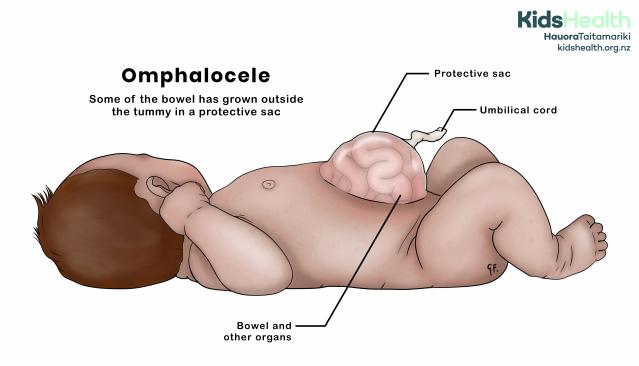
This illustration shows an omphalocele, where some of the bowel and other organs have grown outside the tummy inside a protective sac.
Source: KidsHealth
transcribeTranscript
The illustration shows a newborn baby lying on their back. Some of the bowel and other organs are outside the baby’s tummy inside a protective sac. The umbilical cord connects to the sac.
Labels point to:
- the protective sac
- the umbilical cord
- the bowel and other organs inside the sac
Text at the top left reads: Omphalocele. Some of the bowel has grown outside the tummy in a protective sac.
At the top right is the KidsHealth logo with the website: kidshealth.org.nz.
Causes of omphalocele
The cause of omphalocele is not always known.
If a scan during pregnancy shows your baby may have omphalocele, you will be closely monitored. You will have regular ultrasound scans during your pregnancy. These will include a detailed look at your baby’s heart. Scans help your healthcare team monitor your baby’s wellbeing.
Some pēpi with omphalocele also have other health conditions. These may affect their chromosomes, heart or other organs.
Your health professional may also offer genetic testing.
Planning your baby’s birth
Several health professionals will care for you and your baby. These may include:
- a neonatologist - a doctor specialising in the care of newborn pēpi
- a paediatric surgeon - a doctor who specialises in surgery for pēpi and tamariki (children)
- an obstetrician - a doctor who specialises in care during pregnancy and birth
- neonatal nurses - nurses who specialise in caring for newborn pēpi
Your healthcare team will talk with you about your baby’s condition. They’ll cover possible complications and treatment options.
Your baby will need to be born at a hospital with:
- a neonatal intensive care unit (NICU)
- paediatric surgical services
If your baby is born in a region without a neonatal intensive care unit and paediatric surgical services, you will be transferred after birth.
Your healthcare team will help plan where your baby will be born.
You may have an opportunity to visit the NICU and meet some of the team before your baby is born.
Vaginal birth is usually possible
It’s usually possible to give birth vaginally. Your obstetrician may recommend a caesarean. This is more likely if the omphalocele is very large or there are other reasons for it. They will discuss this with you.
Managing omphalocele
Specialist care after birth
When your baby is born, the neonatal team will assess their wellbeing. Your baby may need support with their breathing.
The team will cover the omphalocele with transparent plastic. This helps protect the membrane and prevents your baby from losing heat.
The healthcare team will pass a tube through your baby’s nose or mouth and into their stomach. This keeps their stomach empty.
Your baby will then move to the NICU. They will stay in an incubator and the healthcare team will monitor them closely.
The team will place intravenous lines (IV Lines) to allow your baby to receive fluids directly into their bloodstream. Your baby may still be able to have small amounts of colostrum after birth.
Your baby may also have an echocardiogram, sometimes called an ECHO. This is an ultrasound scan that checks the structure and function of their heart.
Your baby’s healthcare team will explain any treatment your baby needs. They will answer your questions.
Surgery
Your baby will need surgery to:
- place the contents of the omphalocele inside their abdomen
- repair their abdominal wall
The type and timing of treatment will depend on the size of the omphalocele and which organs are inside it.
Your baby’s surgeon will explain which treatment they recommend and what it will involve.
Your baby will have a general anaesthetic for any surgery, so they will be fully asleep. The surgeon will discuss any concerns you have and ask you to sign a consent form. You will meet the anaesthetist before the surgery. They will talk with you about the anaesthetic and how they will give it.
Repair in one surgery
If the omphalocele is small, the surgeon may be able to place the organs inside your baby’s abdomen and repair the abdominal wall in one surgery.
Treatment in stages
If the omphalocele is large, it may not be possible to repair it in one surgery.
The first stage may involve placing a temporary transparent covering, called a silo, over the omphalocele. The healthcare team will gradually make the silo smaller over several days. This gently moves the organs into your baby’s abdomen. The surgeon will then close the opening in the abdominal wall.
Delayed surgery
If the omphalocele is very large, surgery may need to be delayed until your baby has grown. Special dressings will protect the omphalocele while skin gradually grows over it. This can take several weeks or months. The surgeon will repair the abdominal wall when there is enough room inside your baby’s abdomen.
Care after surgery
After the surgery, your baby will return to the NICU. You will be able to see your baby once they are settled.
The healthcare team will monitor your baby closely. Your baby may need a ventilator, or breathing machine, until they are ready to breathe on their own.
Your baby will receive pain relief through an intravenous infusion into their vein. They may also have a small tube called a catheter placed into their bladder to drain urine for a while.
Feeding your baby
Your baby will receive nutrition through an intravenous line while their bowel recovers. This is called total parenteral nutrition (TPN).
When your baby is ready, they will start having small amounts of breastmilk or formula. At first, milk may go through a tube passed through their nose or mouth and into their stomach. As the amount of milk increases, the healthcare team will reduce the TPN. Once your baby’s bowel is working well, they can start breastfeeding or bottle feeding.
You will receive help and support with feeding your baby.
The length of your baby’s hospital stay will vary
It’s difficult to predict how long your baby will need to stay in hospital. This will depend on:
- the size of the omphalocele
- the treatment or surgery your baby needs
- how well your baby recovers
- whether your baby has other health conditions
Getting support
It’s understandable to feel anxious or worried. The hospital environment and the number of people involved in your baby’s care can feel overwhelming.
Your baby’s healthcare team and NICU social worker will provide guidance and support. Ask them any questions you have, including how you can care for and bond with your baby.
Follow up
After your baby goes home from hospital they will have appointments with a paediatrician. Where possible, these will take place close to where you live.
The paediatric surgical team will also check your baby’s wound and the area where the surgery took place. These appointments may be available at your local hospital.
You can ask questions or discuss concerns at any of these appointments.
Possible complications after surgery
After abdominal surgery, scar tissue called adhesions can sometimes develop. Adhesions, a kink in the bowel or another problem can cause a bowel obstruction. This means the bowel becomes partly or completely blocked.
The healthcare team will monitor for possible complications during your baby's follow-up appointments.
When to get medical help
After your baby leaves the NICU, see a health professional urgently if:
- your baby seems unwell
- your baby vomits green fluid (bile)
- your baby has a distended (swollen) tummy
- you are worried for any reason
More information, support and resources
Acknowledgements
Adapted from the leaflet: 'Exomphalos / Omphalocele. Neonatal Services. Matatiki, Child & Youth Health, Waitaha Canterbury'.
