

Key points about congenital diaphragmatic hernia
- a congenital diaphragmatic hernia (CDH) is caused by a hole in the diaphragm
- the intestines or stomach, and sometimes the liver and spleen, can move from the tummy area into the chest area
- if your baby has a CDH, they will need immediate treatment after birth
What is a CDH?
The diaphragm is a flat sheet of muscle that sits under the lungs, separating the chest from the tummy. The diaphragm helps us to breathe.
A CDH is caused by a hole in the diaphragm. The intestines or stomach, and sometimes the liver and spleen, can move from the tummy area into the chest area. This puts pressure on and squashes the developing lungs. CDH can also affect the developing heart. CDHs can happen on either side of the chest but most happen on the left side of the chest.
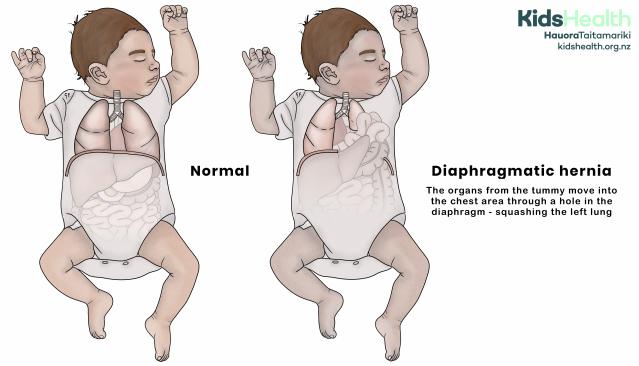
An illustration comparing normal anatomy with a diaphragmatic hernia.
Source: KidsHealth
transcribeTranscript
The illustration shows two images of a baby lying on their back.
- On the left, the image is labelled Normal.
The lungs sit in the chest above the diaphragm, and the organs from the tummy sit below the diaphragm. - On the right, the image is labelled Diaphragmatic hernia.
Organs from the tummy have moved into the chest area through a hole in the diaphragm. These organs squash the left lung. - Text explains that a diaphragmatic hernia happens when organs from the tummy move into the chest through a hole in the diaphragm, squashing the left lung.
At the top right of the illustration is the KidsHealth logo with the website: kidshealth.org.nz.
Most pēpi with a CDH are very unwell when they are born. They can have severe breathing troubles and need treatment straight away.
During pregnancy, pēpi get oxygen from their mother’s bloodstream. After birth, your baby's lungs need to provide oxygen to the body so the organs can work properly. If the lungs are small or don't have much space to expand, they may not work properly.
Sometimes, the heart is also pushed over to the ‘wrong’ side of the chest. This can affect the growth of the lung on the opposite side.
CDH is a rare, serious condition.
Causes of CDH
CDH is not caused by anything you have or haven't done.
CDH can happen on its own. But it's more common in pēpi who may have a heart defect, or in pēpi who have a gene or chromosome condition.
You can talk with your specialist team about your own baby's situation.
CDH diagnosis
Health professionals can often diagnose CDH at your 20 week scan during pregnancy. An ultrasound scan can show the organs from the tummy area in the chest.
Sometimes, CDH is not diagnosed until later in pregnancy or after birth.
Once the ultrasound scan shows CDH, a fetal maternal medicine specialist will review the ultrasound pictures. A team of health professionals will care for you and your baby before, during and after birth.
Paediatric surgeons are doctors who specialise in children’s surgery. Neonatologists are doctors who provide medical care for newborn pēpi. A paediatric surgeon and a neonatologist will talk with you about your baby's condition, and possible complications and treatment.
Where to give birth to your baby with CDH
You'll need to have your baby at a hospital where there is a neonatal intensive care unit (NICU) with a paediatric surgical team. These units have experience in caring for pēpi with CDH. You may have an opportunity to visit the NICU and meet some of the team before your baby is born. Talk to your healthcare team about arranging this.
Managing CDH
Immediate care after birth
Your baby will need immediate treatment after birth. So you may not hear your baby cry and you may not be able to hold your baby immediately after birth.
Treatment includes a breathing tube and machine to help your baby breathe. The breathing machine is called a ventilator.
Your healthcare team will also place a tube through your baby's nose or mouth into their stomach to release trapped air.
Care in the NICU
Your healthcare team will transfer your baby to the NICU. They will place special lines into the blood vessels of the umbilical cord or veins. This allows the healthcare team to watch your baby's blood pressure and take blood samples for testing. It also allows them to give your baby fluids and medicines.
Your baby will have heart scans to check how well their heart is pumping. These heart scans are called echocardiograms. The results will help the healthcare team decide which medicines to give to support your baby's heart.
Surgery
Your baby will need surgery to repair the hole in the diaphragm. The timing of surgery will depend on how well your baby's lungs and heart are working. The healthcare team will watch your baby very closely to decide the best time for surgery.
Before surgery
Most pēpi need several days of care to help them become as well as possible before surgery. Some pēpi have problems with blood flow through the lungs. They may need extra medicine, such as nitric oxide, to help with this.
The surgeon and anaesthetist will talk with you about the surgery. In Auckland, a paediatric intensive care (PICU) specialist will also meet with you. (In Auckland, your baby will transfer to PICU before surgery).
This team will explain what will happen and answer your questions. You will need to sign a consent form before your baby has the anaesthetic and surgery. Make sure you ask the doctor questions and discuss any concerns you may have before you sign the consent form.
You can be with your baby until they are asleep from the anaesthetic.
After surgery
The surgeon will let you know how the operation went as soon as it is finished.
After the surgery, the healthcare team will watch your baby closely. They will support your baby's breathing until the lungs recover. How long this takes depends on how much the condition affected your baby's lungs and heart.
Your baby will have intravenous (IV) pain relief medicine. This is medicine that goes straight into a vein. Medicine may include:
morphine for pain relief
midazolam for any distress
The healthcare team may put a small tube into your baby's bladder to drain urine.
Feeding
The healthcare team will feed your baby through a vein. This is called total parental nutrition (TPN). Your baby will have TPN before and after the surgery. TPN will continue until your baby is ready to have small amounts of breastmilk or formula through a tube. As milk feeds increase, the TPN will slowly decrease until your baby is only having milk feeds. You will receive support to help establish feeds by mouth when your baby is ready for this.
Guidance and support for you
If your baby has been diagnosed with a CDH, it's normal to worry. There will be a large healthcare team caring for your baby and this can feel overwhelming. So can all the interventions and medicines. But you will receive lots of guidance and support. Don't hesitate to ask your healthcare team any questions. For example, you can ask them what you can do to care for, and bond with, your baby.
Talk with your healthcare team about support that may be available to you. This may include:
access to counselling, cultural and spiritual supports for you and your whānau
financial help with travel and accommodation when going to specialist appointments and when your baby is in NICU, if you are away from where you live
Complications and survival
For some pēpi with CDH, treatment can be quite straightforward. But for other pēpi, treatment can be complex. There are several possible complications, including:
delayed oral feeding due to rapid breathing
gastro reflux - when stomach contents are released back up towards the mouth causing pain and irritation
the need for oxygen for your baby at home until their lungs grow
Some pēpi may not survive. Survival depends on many things, including how the condition has affected the heart and lungs. Your healthcare team will give you information that is specific to your baby.
Checks after leaving hospital
Before you leave hospital, your healthcare team will talk to you about what follow-up checks your baby needs.
More information, support and resources
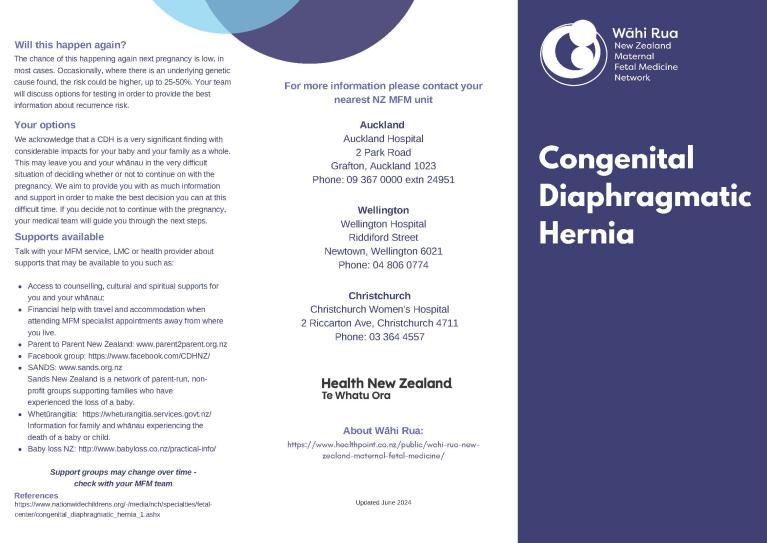
Source: Wāhi Rua | NZ Maternal Fetal Medicine Network
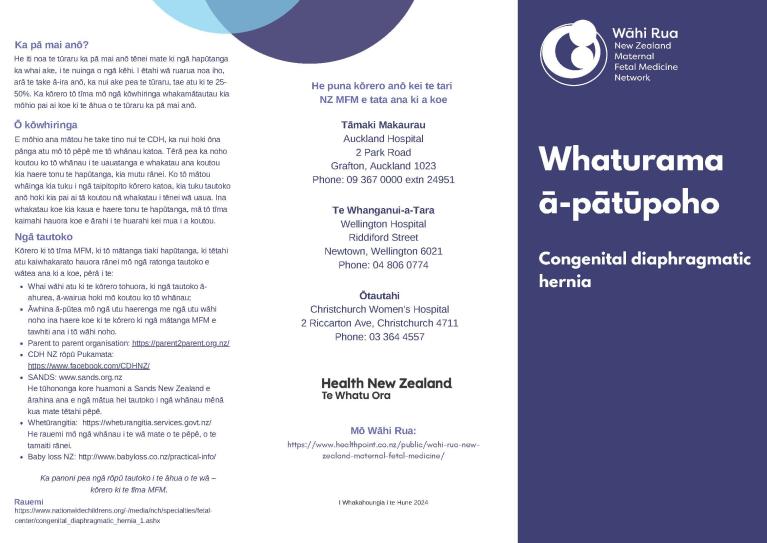
Te reo Māori version
Source: Wāhi Rua | NZ Maternal Fetal Medicine Network
This facebook group was created to support, advise and help families, relatives and friends in New Zealand affected by CDH.

See the Parent to Parent website to find out about the support for families of babies, children and adults with any type of disability, neurodiversity or health impairment.
SANDS is a network of parent-run, non-profit groups supporting parents and families who have experienced the loss of a baby.

Whetūrangitia is an online service supporting bereaved parents and whānau by bringing together information and resources in one place.
Acknowledgements
Adapted from the leaflet: 'Congenital diaphragmatic hernia (CDH). Neonatal Services. Matatiki, Child & Youth Health, Waitaha Canterbury'.
