

Key points about UTD grades and follow-up
- urinary tract dilatation (UTD) is often found during a routine pregnancy ultrasound scan
- before birth, UTD grades are called A1, A2 and A3
- after birth, UTD grades are called P1, P2 and P3
- a higher grade usually means your baby needs closer checking
- the grade depends on several scan findings, not just one measurement
- your baby’s grade may change between scans
- a higher grade does not mean your baby will definitely need surgery
To learn more about urinary tract dilatation, see the page on urinary tract dilatation in babies.
Urinary Tract Dilatation (UTD) In Babies
What is urinary tract dilatation?
Urinary tract dilatation means part of the urinary tract looks wider than expected on an ultrasound scan. UTD is a scan finding. It does not tell the healthcare team what is causing the widening.
The part of the kidney that collects urine is called the renal pelvis. In UTD, the renal pelvis or another part of the urinary tract looks wider than usual.
See the page on urinary tract dilatation in babies to learn more about UTD.
Urinary Tract Dilatation (UTD) In Babies
Understanding the letters and numbers
Health professionals use a grading system to describe UTD and help plan your baby’s care. Each grade has a letter and a number, such as A1 or P2. You may see these grades in your baby’s ultrasound reports or letters from their healthcare team.
The letter tells you whether the grade was given before or after birth:
- A means antenatal, or before birth
- P means postnatal, or after birth
The number describes the level of risk, from 1 to 3. A higher number usually means your baby needs closer follow-up and may need more tests or treatment.
The grade helps the healthcare team decide what to do next. It does not tell them the cause of the UTD by itself.
How health professionals decide the grade
The renal pelvis is the part of the kidney that collects urine. Health professionals measure its width during an ultrasound.
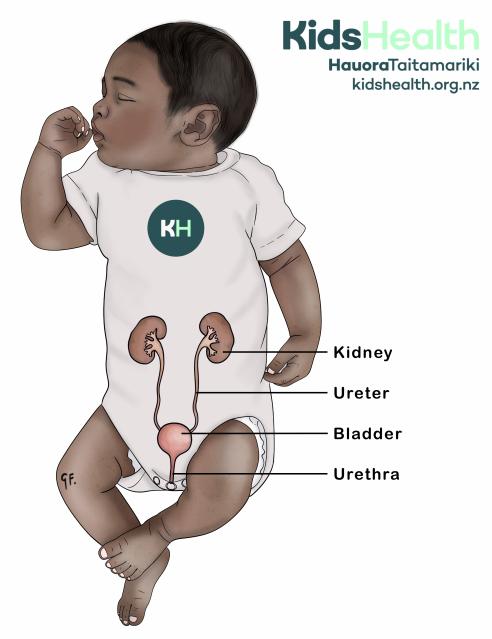
This illustration shows the urinary system in a baby.
Source: KidsHealth
transcribeTranscript
The illustration shows a baby wearing a white bodysuit, with an overlay of the urinary system on their body.
The urinary system includes:
- 2 kidneys
- 2 ureters, which run from the kidneys to the bladder
- the bladder
- the urethra, which carries urine out of the bladder
The kidney, ureter, bladder and urethra are labelled.
At the top right is the KidsHealth logo with the website: kidshealth.org.nz.
They also look at:
- whether the small spaces that collect urine inside the kidney, called calyces, are widened
- the thickness and appearance of the kidneys
- whether the tubes that drain the urine are widened
- the appearance of the bladder
During pregnancy, they also check the amount of fluid around your baby. The grade depends on these findings together, not just the width of the renal pelvis.
Sometimes a team of health professionals reviews the scans together to decide the best plan for your baby. This does not necessarily mean there is a serious problem.
Antenatal grades and care during pregnancy
Lower-risk UTD: A1
A1 is lower-risk UTD. The dilatation is usually mild.
If your healthcare team finds mild UTD during the middle of pregnancy, they will usually arrange another ultrasound at around 32 weeks.
Mild UTD often improves before birth or remains mild. If it has completely resolved on a later pregnancy scan, your baby may not need an ultrasound after birth. Your healthcare team will confirm the plan.
Intermediate-risk UTD: A2
A2 is intermediate-risk UTD.
Your healthcare team will arrange further scans during pregnancy. They may also refer you to a maternal fetal medicine service. This service specialises in caring for pēpi (babies) before birth.
The scan findings help the team plan your baby’s care after birth.
Higher-risk UTD: A3
A3 is higher-risk UTD.
The scan may show more significant dilatation or other findings that need closer assessment. These may include a possible blockage or differences in the appearance of the urinary tract.
Your healthcare team will arrange further scans and specialist advice. They will also plan any care your baby may need after birth.
Your baby may need specialist care at a hospital with the right services.
Ultrasound scans after birth
The timing of your baby’s scans depends on the pregnancy scan findings and how your baby is after birth. Your baby’s healthcare team will explain their individual plan.
A1: lower-risk UTD
If your baby still needs follow-up, they will usually have their first ultrasound within the first few months of life.
A2: intermediate-risk UTD
Your baby will usually have an ultrasound at around 7 days old, then another within a few months.
A3: higher-risk UTD
Your baby will usually have an ultrasound at around 7 days old, then another within a few months. Some pēpi also need an earlier scan.
Scans during the first 24 to 48 hours
Only a small number of pēpi need an ultrasound this soon after birth. If your baby needs an early scan, your healthcare team will arrange this and explain what to expect.
Repeat scans after an early ultrasound
An ultrasound during the first few days after birth can make the dilatation look less significant than it is.
If your baby has an ultrasound before they are 7 days old, they will usually need another scan after they are 7 days old.
Postnatal grades and follow-up
After birth, the healthcare team uses the ultrasound findings to give any remaining UTD a postnatal grade: P1, P2 or P3. A higher grade usually means closer follow-up.
The postnatal grade helps them decide whether your baby needs:
- more ultrasound scans
- other kidney or bladder tests
- a referral to a child health specialist (paediatrician)
- treatment
Lower-risk UTD: P1
Your baby will usually need another ultrasound to check the dilatation. Their family doctor may manage follow-up.
Intermediate-risk UTD: P2
Your baby needs specialist advice and further ultrasound scans. The specialist will decide whether your baby needs other tests or antibiotics to help prevent urinary tract infections.
Higher-risk UTD: P3
Your baby needs urgent specialist advice. The specialist will plan further scans and decide whether your baby needs other tests or treatment.
A P3 grade does not mean your baby will definitely need surgery.
Your baby’s healthcare team will explain the scan results and the next steps.
Urinary Tract Dilatation (UTD) In Babies
Changes in your baby’s grade
Your baby’s grade before birth may be different from their grade after birth. The grade can also change between later scans.
The dilatation may improve, remain the same or become more noticeable. Scans after birth can also provide more information about the urinary tract.
A different grade does not necessarily mean something has gone wrong. Your baby’s healthcare team will explain what the change means and whether it changes the follow-up plan.
Keeping track of your baby’s follow-up
You may find it helpful to write down:
- your baby’s current UTD grade
- whether it affects one kidney or both
- the date of the next scan
- who will arrange the scan
- who to contact if you have questions
Take your baby to all follow-up appointments, even if they seem completely well. UTD itself does not usually make pēpi look or act unwell, so scans are important for checking what is happening.
If you have not heard about an expected appointment, contact your health professional.
Acknowledgements
Illustrations by Dr Greta File. Property of KidsHealth.
