

Key points about asthma
- asthma happens when the airways of the lungs become narrow
- symptoms include cough, wheezing and difficulty breathing
- things that can trigger asthma symptoms include viral infections and allergies
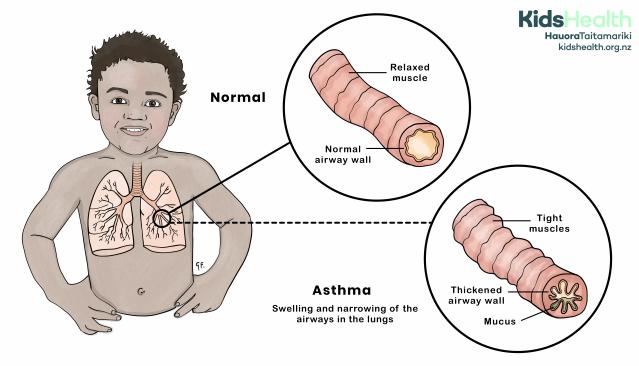
This illustration shows asthma, where the airways in the lungs become swollen, narrowed, and filled with mucus.
Source: KidsHealth
transcribeTranscript
The illustration shows a young child with an overlay of the lungs and main airway on their chest. A circle highlights the airways, with two enlarged diagrams comparing a normal airway and asthma.
- The top circle is labelled Normal. It shows an airway with a relaxed muscle and a clear, open passage. Labels read: Relaxed muscle and Normal airway wall.
- The bottom circle is labelled Asthma. It shows an airway with tight muscles, a thickened airway wall, and mucus narrowing the passage.
- At the bottom right, text reads: Asthma – Swelling and narrowing of the airways in the lungs.
At the top right is the KidsHealth logo with the website: kidshealth.org.nz
What is asthma?
Asthma is a common breathing condition. It affects the small and medium-sized airways in the lungs.
In asthma, your child's airways can become inflamed causing:
- thickening and swelling of the airway walls
- an increase in mucus or phlegm
- tightening of the muscles in the airway walls
These changes cause narrowing of your child's airways. This leads to cough, wheezing and difficulty breathing.
Wheezing is a musical, whistly sound that tamariki make, usually when breathing out. It can also happen when they breathe in. The sound comes from the chest, not from the nose or throat.
Source: KidsHealth
Signs and symptoms of asthma
See your health professional and ask about asthma if your child:
- coughs and wheezes, and coughs with a cold
- coughs and wheezes after exercise
- coughs and wheezes at night
- cannot keep up with other tamariki
Why some children have asthma symptoms
Many tamariki in Aotearoa New Zealand will have asthma symptoms at some time during childhood.
It’s not clear why some tamariki have asthma and others do not.
Your child is more likely to have asthma if:
- someone else in the whānau (family) has asthma
- they have eczema, hay fever or allergies
- they’ve had lots of chest infections
Triggers of an asthma attack
Infections
Viruses like colds are a common trigger of asthma attacks.
Your child may be able to get a free flu vaccination each year. Talk with your health professional about keeping your child’s vaccinations up to date.
Allergies
If your child has allergies to things like pollens, grass, dust or pet fur, this can worsen their asthma. A symptom diary can help clarify what your child might be allergic to. Talk to your health professional about ways to reduce allergy symptoms in your child.
Find out more about allergies.
Home environment
Cold and mouldy environments can trigger asthma. Find out ways you can keep your home healthy.
Cigarette smoke
Cigarette smoke can trigger asthma attacks and can make your child's asthma symptoms worse. Make sure your child grows up in a smoke-free and vape-free environment.
If you want to give up smoking or vaping, contact Quitline or talk with your health professional or whānau (family).

If you want to give up smoking or vaping call Quitline free on 0800 778 778. Quitline can provide free support and advice to help you or someone in your whānau quit smoking. Visit their website for more information.
Activity
Physical activity is a big part of helping tamariki stay healthy and fit. Physical activity is also an important part of asthma management. But sometimes too much activity can trigger an asthma attack.
Changes in the weather
Changes in the weather may make asthma symptoms worse. Talk to your health professional about ways to manage your child’s asthma symptoms when seasons change.
Stress
Stress is an important trigger of asthma attacks. Your child may benefit from practising breathing techniques before asthma attacks start.
How to improve asthma symptoms
Asthma action plan
Ask your child's health professional for an asthma action plan. The best way to manage your child’s asthma symptoms is to follow their asthma action plan.
Having an asthma action plan gives guidance on what medicines to use and when. It’s a good idea to review the asthma action plan every year.
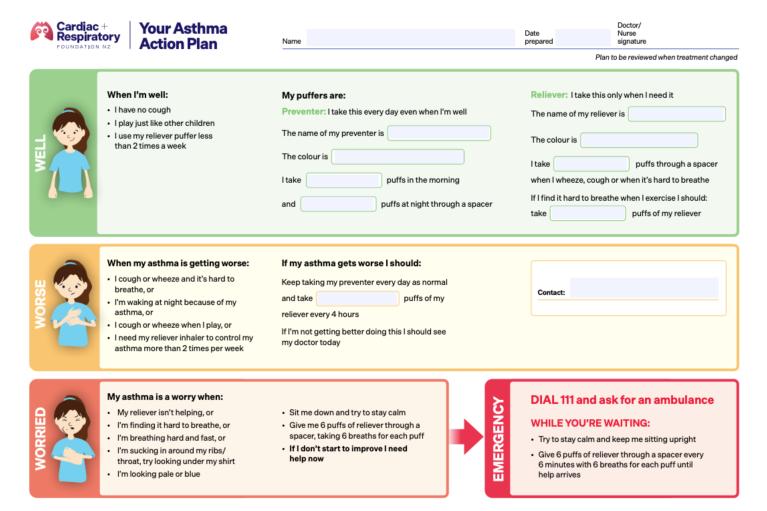
Take a look at the Cardiac + Respiratory Foundation NZ website for an example of what a blank asthma plan looks like. It's available in English, te reo Māori, Samoan and Tongan.
Asthma medicines
There are many medicines to help manage asthma. It can be confusing.
Find out about different types of asthma medicines and when to use them.
Will my child grow out of asthma?
For many tamariki, asthma symptoms can decrease before they become adults. Some tamariki will need to keep taking asthma medicine throughout their childhood. Talk to your health professional about getting the right asthma treatment for your child.
More information and support
You can watch a video to see how your health professional can help.
A young student goes to his health professional about his asthma. His health professional explains that even though there's no cure for asthma, you can manage the condition well. The health professional gives advice and tips for managing asthma.
Source: A collaboration between Asthma NZ and Raise Up
transcribeTranscript
[Health professional]
Hey David. Have a seat.
What's been happening?
[David]
Ah, asthma's really getting me down.
Can it be cured?
[Health professional]
Unfortunately, there's no cure. But we can manage it.
[David]
How?
[Health professional]
So do you use your preventer morning and night?
[David]
Not always .. but I often forget.
[Health professional]
OK. Well if you put your preventer with your toothbrush, when you brush your teeth morning and night, you can take your preventer.
It's sort of like a reminder.
[David]
Will asthma get in the way of my sports?
[Health professional]
Not if you do what I'm telling you to do.
If you manage it well, you can be just as competitive with your classmates. There's many professional athletes that have asthma, but they know how to manage it.
[David]
Cool.
[Health professional]
Yeah, we can do that together.
[David]
Cool.
Read a booklet about managing your child's asthma in English, Te Reo Māori or Samoan.
The Asthma + Respiratory Foundation NZ website has an online learning tool. There is a version for parents, whānau and caregivers. There is also a version for teachers and other educational specialists. Learn more about asthma - what it is, the symptoms, common triggers, and what to do in an emergency.
Cardiac + Respiratory Foundation NZ brings together the Asthma and Respiratory Foundation NZ, Kia Manawanui Trust – The Heart of Aotearoa, Lung Foundation NZ, and the Bronchiectasis Foundation NZ. Check out their website for information and resources on asthma and other respiratory conditions.

Asthma New Zealand provides information. They also offer free appointments to people with asthma in some regions, or nationally through telehealth. You can self-refer or a health professional can refer you.
Acknowledgements
Illustration by Dr Greta File. Property of KidsHealth.
